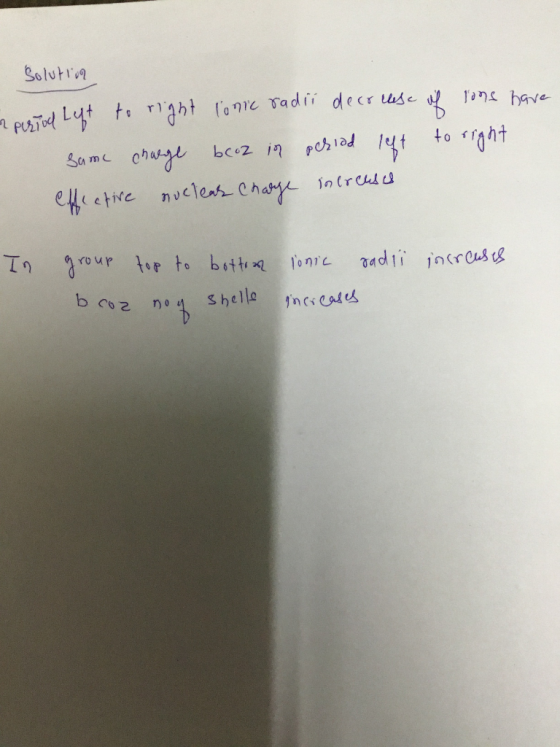
What is the trend going across a period and down a group for ionic radii. Justify...
What is the trend going across a period and down a group for ionic radii. Justify your answer
Homework Answers
Add Answer to:
What is the trend going across a period and down a group for ionic radii. Justify...
34. Explain the general trend for atomic radius going across a period; to the right. 35....
 34. Explain the general trend for atomic radius going across a period; to the right. 35. Explain the general trend in atomic radius going down a group.
Going down a group/column, there is a trend that is the same as the one for...
Going down a group/column, there is a trend that is the same as the one for atomic radius: Ionic radius _______________________ down a group due to ________________________________.
“Ionic radius” is one of the more difficult trends as there is no distinct trend going...
“Ionic radius” is one of the more difficult trends as there is no distinct trend going across a period, only down a group. However, there are other smaller trends that are just as important. Compare the ions of Na, Mg, and Al. Fill in the following statement: “For _____________ ions in the same period, as the charge increases, the ionic radius _______________.” Explain this observation. Compare the ions of N, O, and F. Fill in the following statement: “For ______________...
What is the trend for …. When you go across the period? Down a family? For...
What is the trend for …. When you go across the period? Down a family? For each trend, explain in your own words what it means and/or why it is. a) atomic size? b) ionization energy? c) electron affinity? Which should be larger according to the general trend? Explain. Li, Na? K or K+? Cl or Cl-? P or S?
1. Describe and explain the trend of the ionization energy of elements: (i) across a period;...
1. Describe and explain the trend of the ionization energy of elements: (i) across a period; (ii) down a group, in the periodic table. 2. Reactivity of alkali metals (Group 1A) increases from top to bottom down the group, but the reactivity of halogen (Group 7A) decreases from top to bottom down the group. Explain why the difference.
For the main group elements,in general, upon going from left to right across a period of...
For the main group elements,in general, upon going from left to right across a period of the periodic table, the ionization energy__,theatomicsize,__ and the metallic character__
Part A Why do atomic radii decrease from left to right across a period of the...
 Part A Why do atomic radii decrease from left to right across a period of the periodic tablo? O Atomic radii decrease from left to right across a period because the total number of electrons on the electron shell decreases. O Atomic radii decrease from left to right across a period because the effective nuclear charge increases. O Atomic radii decrease from left to right across a period because the effective nuclear charge decreases O Atomic radii decrease from left...
A Linear trend is calculated as : Y^=28.5+0.75t, The trend projection for period 15 is Group...
A Linear trend is calculated as : Y^=28.5+0.75t, The trend projection for period 15 is Group of answer choices 11.25 44.25 39.75 28.5
Question 2 (1 point) Which of these describes atomic radii as one travels across a period...
 Question 2 (1 point) Which of these describes atomic radii as one travels across a period (from left to right)? There is no change in the atomic radius across a period. The atomic radius does not vary in any predictable way across a period. The atomic radius increases as one moves across a period. The atomic radius decreases as one moves across a period.
Which of the following statements about the alkali metals (group 1A) are true? I. Their ionic...
Which of the following statements about the alkali metals (group 1A) are true? I. Their ionic radii follow the trend Li+ > Na+ > K+ > Rb+ II. Their first ionization energies follow the trend Li+ > Na+ > K+ > Rb+ III. Their reactivity follows the trend Li > Na > K > Rb IV. They have two valence electrons in their neutral atomic form.
 34. Explain the general trend for atomic radius going across a period; to the right. 35. Explain the general trend in atomic radius going down a group.
 Part A Why do atomic radii decrease from left to right across a period of the periodic tablo? O Atomic radii decrease from left to right across a period because the total number of electrons on the electron shell decreases. O Atomic radii decrease from left to right across a period because the effective nuclear charge increases. O Atomic radii decrease from left to right across a period because the effective nuclear charge decreases O Atomic radii decrease from left...
 Question 2 (1 point) Which of these describes atomic radii as one travels across a period (from left to right)? There is no change in the atomic radius across a period. The atomic radius does not vary in any predictable way across a period. The atomic radius increases as one moves across a period. The atomic radius decreases as one moves across a period.
Most questions answered within 3 hours.
-
Where is the error in this code sequence?
String s1 = "Hello";
String s2 = "ello";...
asked 10 months ago -
Financial data for Joel de Paris, Inc., for last year
follow:
Joel de Paris, Inc.
Balance...
asked 10 months ago -
Consider this reaction:
Al2(SO4)3 (aq)+ BaCl3
(aq) Al2Cl6 (aq)- +
3BaSO4(s) . What is the...
asked 10 months ago -
Suppose that Savneet is considering increasing her
recent random sample from 20 car rentals to 40...
asked 10 months ago -
Trucks arrive at an unloading terminal at an average rate of 120
per hour.
Trucks arrive...
asked 10 months ago -
Why are methanol and ethanol completely soluble in water while
octanol is not very little soluble....
asked 10 months ago -
A facilities manager at a university reads in a research report
that the mean amount of...
asked 10 months ago -
When the CuSO4 is rehydrated by adding water to the anhydrous
compound, is this an endothermic...
asked 10 months ago -
A ray of sunlight is passing from diamond into crown glass; the
angle of incidence is...
asked 10 months ago -
A block of mass 0.249 kg is placed on top of a light, vertical
spring of...
asked 10 months ago -
how do the kidneys compensate in the presences of acidosis
a) trigger hyperventilate
b) reserve acid...
asked 10 months ago -
Question 501 pts
The rental rate of capital to the firm increases. Which of the
following...
asked 10 months ago