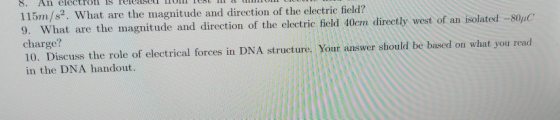
Cannot figure out questions 9 and 10
Homework Answers

Add Answer to:
Cannot figure out questions 9 and 10 8. An electrol Is release o rest 115m/s2. What...
a) What is the magnitude of the electric field 31.8 cm directly above an isolated 2.71×10⁻⁵...
a) What is the magnitude of the electric field 31.8 cm directly above an isolated 2.71×10⁻⁵ C charge? b) What is the direction of the electric field? What is the direction of the electric field? upward downward
What is the magnitude of the electric field 27.6 cm directly above an isolated 3.50×10⁻⁵ C...
What is the magnitude of the electric field 27.6 cm directly above an isolated 3.50×10⁻⁵ C charge? What is the direction of the electric field?
What is the magnitude of the electric field 21.3 cm directly above an isolated 2.93×10⁻⁵ C...
What is the magnitude of the electric field 21.3 cm directly above an isolated 2.93×10⁻⁵ C charge? What is the direction of the electric field?
What is the magnitude of the electric field 25.5 cm directly above an isolated 3.50×10⁻⁵ C charge? What is the direction of the electric field?
 A) What is the magnitude of the electric field 25.5 cm directly above an isolated 3.50×10⁻⁵ C charge? B) What is the direction of the electric field?
Please help with following questions Three charges are arranged as shown in the figure below. Find...
 Please help with following questions
Three charges are arranged as shown in the figure below. Find the magnitude and direction of the electrostatic force on the charge q = 4.80 nC at the origin. (Let r12-0.230 m.) 100m Need Help? Two small metallic spheres, each of mass m = 0.50 g, are suspended as pendulums by light strings from a common point as shown in the figure below. The spheres are given the same electric charge, and it is found...
Please help with following questions
Three charges are arranged as shown in the figure below. Find the magnitude and direction of the electrostatic force on the charge q = 4.80 nC at the origin. (Let r12-0.230 m.) 100m Need Help? Two small metallic spheres, each of mass m = 0.50 g, are suspended as pendulums by light strings from a common point as shown in the figure below. The spheres are given the same electric charge, and it is found...
Al AL no, 16 form Texas A&M University-Corpus Christi Summer II 2015 Term 5. A charged...
 Al AL no, 16 form Texas A&M University-Corpus Christi Summer II 2015 Term 5. A charged dust particle of mass 3.0 g suspended in air directly 2.lem below a fixed point charge of is Q- 0.58 nC. What is the charge of the dust particle? (H) 0.92 (A) 2.5 (C) 11.2 uC (D) 11.2 uC released 6. A metal sphere of 2 g mass has a positive charge of 10vc and is held in the origin, The sphere is from...
Problem 23.29 (Multistep) An accelerated electron An electron is initially at rest. At time t1=0 it...
 Problem 23.29 (Multistep)
An accelerated electron
An electron is initially at rest. At time t1=0 it is accelerated
upward with an acceleration of a= 1 × 10¹⁹
m/s2 for a very short time (this large acceleration is
possible because the electron has a very small mass). We make
observations at location A, x= 16 meters from the electron
(see the figure).
Part 1
(a) At time t2= 1 ns (1 × 10⁻⁹ s), what is the magnitude
and direction of...
Problem 23.29 (Multistep)
An accelerated electron
An electron is initially at rest. At time t1=0 it is accelerated
upward with an acceleration of a= 1 × 10¹⁹
m/s2 for a very short time (this large acceleration is
possible because the electron has a very small mass). We make
observations at location A, x= 16 meters from the electron
(see the figure).
Part 1
(a) At time t2= 1 ns (1 × 10⁻⁹ s), what is the magnitude
and direction of...
When released from rest in a uniform electric field of magnitude 1.00 x 10^4 N/C, a...
 When released from rest in a uniform electric field of magnitude 1.00 x 10^4 N/C, a charged particle travels 2.00 cm in 2.00 x 10⁴-7s in the direction of the field. You can ignore any nonelectric forces acting on the particle. Set up your solution to answer the following questions: (0 Is the particle positively or negatively charged? (ii) What is the charge-to-mass ratio of this particle, i.e. the ratio of the charge to the mass? (i) Other experiments show...
When released from rest in a uniform electric field of magnitude 1.00 x 10^4 N/C, a...
 When released from rest in a uniform electric field of magnitude 1.00 x 10^4 N/C, a charged particle travels 2.00 cm in 2.00 x 10A-7s in the direction of the field. You can ignore any nonelectric forces acting on the particle. Set up your solution to answer the following questions: (i) Is the particle positively or negatively charged? (ii) What is the charge-to-mass ratio of this particle, i.e. the ratio of the charge to the mass? (ii) Other experiments show...
Question 8 (3 Points) This assignment is set up for sequential assessment. Complete each question and...
 Question 8 (3 Points) This assignment is set up for sequential assessment. Complete each question and submit the answer before moving on to the next question. Correct answers for each question will be made available once the maximum number of attempts have been made for each submission. Parallel Plate Capacitor Separation de A plater + -Q A plate area Vater As shown in the above figure, each plate of a parallel plate capacitor has an area of A = 0.032...
 Please help with following questions
Three charges are arranged as shown in the figure below. Find the magnitude and direction of the electrostatic force on the charge q = 4.80 nC at the origin. (Let r12-0.230 m.) 100m Need Help? Two small metallic spheres, each of mass m = 0.50 g, are suspended as pendulums by light strings from a common point as shown in the figure below. The spheres are given the same electric charge, and it is found...
Please help with following questions
Three charges are arranged as shown in the figure below. Find the magnitude and direction of the electrostatic force on the charge q = 4.80 nC at the origin. (Let r12-0.230 m.) 100m Need Help? Two small metallic spheres, each of mass m = 0.50 g, are suspended as pendulums by light strings from a common point as shown in the figure below. The spheres are given the same electric charge, and it is found...
 Al AL no, 16 form Texas A&M University-Corpus Christi Summer II 2015 Term 5. A charged dust particle of mass 3.0 g suspended in air directly 2.lem below a fixed point charge of is Q- 0.58 nC. What is the charge of the dust particle? (H) 0.92 (A) 2.5 (C) 11.2 uC (D) 11.2 uC released 6. A metal sphere of 2 g mass has a positive charge of 10vc and is held in the origin, The sphere is from...
 When released from rest in a uniform electric field of magnitude 1.00 x 10^4 N/C, a charged particle travels 2.00 cm in 2.00 x 10⁴-7s in the direction of the field. You can ignore any nonelectric forces acting on the particle. Set up your solution to answer the following questions: (0 Is the particle positively or negatively charged? (ii) What is the charge-to-mass ratio of this particle, i.e. the ratio of the charge to the mass? (i) Other experiments show...
 When released from rest in a uniform electric field of magnitude 1.00 x 10^4 N/C, a charged particle travels 2.00 cm in 2.00 x 10A-7s in the direction of the field. You can ignore any nonelectric forces acting on the particle. Set up your solution to answer the following questions: (i) Is the particle positively or negatively charged? (ii) What is the charge-to-mass ratio of this particle, i.e. the ratio of the charge to the mass? (ii) Other experiments show...
 Question 8 (3 Points) This assignment is set up for sequential assessment. Complete each question and submit the answer before moving on to the next question. Correct answers for each question will be made available once the maximum number of attempts have been made for each submission. Parallel Plate Capacitor Separation de A plater + -Q A plate area Vater As shown in the above figure, each plate of a parallel plate capacitor has an area of A = 0.032...
Most questions answered within 3 hours.
-
Where is the error in this code sequence?
String s1 = "Hello";
String s2 = "ello";...
asked 11 months ago -
Financial data for Joel de Paris, Inc., for last year
follow:
Joel de Paris, Inc.
Balance...
asked 11 months ago -
Consider this reaction:
Al2(SO4)3 (aq)+ BaCl3
(aq) Al2Cl6 (aq)- +
3BaSO4(s) . What is the...
asked 11 months ago -
Suppose that Savneet is considering increasing her
recent random sample from 20 car rentals to 40...
asked 11 months ago -
Trucks arrive at an unloading terminal at an average rate of 120
per hour.
Trucks arrive...
asked 11 months ago -
Why are methanol and ethanol completely soluble in water while
octanol is not very little soluble....
asked 11 months ago -
A facilities manager at a university reads in a research report
that the mean amount of...
asked 11 months ago -
When the CuSO4 is rehydrated by adding water to the anhydrous
compound, is this an endothermic...
asked 11 months ago -
A ray of sunlight is passing from diamond into crown glass; the
angle of incidence is...
asked 11 months ago -
A block of mass 0.249 kg is placed on top of a light, vertical
spring of...
asked 11 months ago -
how do the kidneys compensate in the presences of acidosis
a) trigger hyperventilate
b) reserve acid...
asked 11 months ago -
Question 501 pts
The rental rate of capital to the firm increases. Which of the
following...
asked 11 months ago