
Homework Answers
Add Answer to:
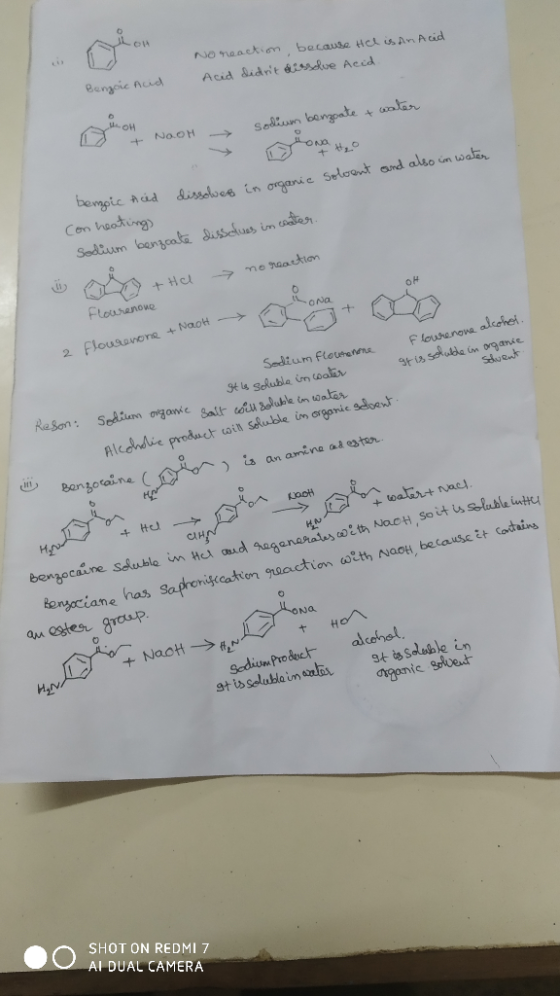
3.) For each of the following compounds, draw the major organic product of reaction with HCl...
draw organic structures for the following Organic acids and bases, to the extent that they are...
 draw organic structures for the following
Organic acids and bases, to the extent that they are relatively non-polar, may be only sparingly soluble in polar water. Benzoic acid, as a predominantly non-polar molecule, is expected to be more soluble in non- polar ether than in water. Benzoic acid, however, can be chemically manipulated to benzoate ion, thus greatly increasing its solubility in water. Since it is an acid, it will react with a base like NAOH (aq) according to the...
draw organic structures for the following
Organic acids and bases, to the extent that they are relatively non-polar, may be only sparingly soluble in polar water. Benzoic acid, as a predominantly non-polar molecule, is expected to be more soluble in non- polar ether than in water. Benzoic acid, however, can be chemically manipulated to benzoate ion, thus greatly increasing its solubility in water. Since it is an acid, it will react with a base like NAOH (aq) according to the...
Draw the products of the reaction of benzoic acid with NaOH (aq) and identify the conjugate...
Draw the products of the reaction of benzoic acid with NaOH (aq) and identify the conjugate acid and base in the products. Determine the direction of the equilibrium for this reaction and use pKa values to justify your answer. Is the organic product of this reaction water soluble? Why or why not? Using the chemicals provided, benzoic acid, Ethyl p-aminobenzoate, Fluorenone, Sodium Hydroxide, Hydrochloric Acid, Anhydrous Sodium Sulfate, Diethyl Ether , how might you convert this product back to the...
Draw the structure(s) of the major organic product(s) of the following reaction. H2N Trace of acetic...
 Draw the structure(s) of the major organic product(s) of the following reaction. H2N Trace of acetic acid ethanol + • You do not have to consider stereochemistry. • Draw one structure per sketcher. Add additional sketchers using the drop-down menu in the bottom right corner. • Separate multiple products using the + sign from the drop-down menu. Draw the structure(s) of the major organic product(s) of the following reaction. CON 1. ethanol / reflux 2. aqueous HCI • You do...
im not sure if im doing these correctly, but if i could get help would them...
 im not sure if im doing these correctly, but if i could get
help would them that would be extremely helpful. thank you
HN c. Write a balanced reaction using HCl that makes ethyl aminobenzoate into a water-soluble salt. For your products, show STRUCTURES and appropriate formal charges. (1 pts) Rön + H-C: a NO a 23. a. Mass of isolated Benzoic Acid b. Draw the structure of Benzoic Acid (pt) c. Write a balanced reaction using NaOH that makes...
im not sure if im doing these correctly, but if i could get
help would them that would be extremely helpful. thank you
HN c. Write a balanced reaction using HCl that makes ethyl aminobenzoate into a water-soluble salt. For your products, show STRUCTURES and appropriate formal charges. (1 pts) Rön + H-C: a NO a 23. a. Mass of isolated Benzoic Acid b. Draw the structure of Benzoic Acid (pt) c. Write a balanced reaction using NaOH that makes...
13. Draw the organic product(s) of each reaction below. If no reaction will occur, then indicate...
 13. Draw the organic product(s) of each reaction below. If no reaction will occur, then indicate that. (8 points) CN HCI, H2O + HO 25 °C H2N. NY + -H20 (2 equiv.) NH 1. NaOH, H2O, heat 2. Acid work-up
Draw the structure of the major organic product of the following reaction. Predict whether the product...
 Draw the structure of the major organic product of the following reaction. Predict whether the product will be an aldol or an enone. 10% aqueous NaOH 25° You do not have to consider stereochemistry. You do not have to explicitly draw H atoms. Do not include lone pairs in your answer. They will not be considered in the grading. .If no reaction occurs, draw the organic starting material C P astered
13. Draw the organic product(s) of each reaction below. If no reaction will occur, then indicate...
 13. Draw the organic product(s) of each reaction below. If no reaction will occur, then indicate that. (8 points) CN HCI, H20 + но 25 °C H2N 'Y -H20 (2 equiv.) NH D 1. NaOH, H20, heat 2. Acid work-up
Extraction Complete the separation scheme for the following compounds that are dissolved in an ether solution:...
 Extraction
Complete the separation scheme for the following compounds
that are dissolved in an ether solution: benzoic acid (AH), ethyl
4-aminobenzoate (:B), and napthalene (Neu). You may complete the
separation scheme using the abbreviations.
Week One Post-Lab Question 2. Separation Scheme. AH bende acid B ethy H-aminobenzoate Neu naplatene Nooreen indien IM HCI Write balanced equations for the reaction of each species with HIC soluble in Circle the major species. Indicate the solubility of cach of the major species in...
Extraction
Complete the separation scheme for the following compounds
that are dissolved in an ether solution: benzoic acid (AH), ethyl
4-aminobenzoate (:B), and napthalene (Neu). You may complete the
separation scheme using the abbreviations.
Week One Post-Lab Question 2. Separation Scheme. AH bende acid B ethy H-aminobenzoate Neu naplatene Nooreen indien IM HCI Write balanced equations for the reaction of each species with HIC soluble in Circle the major species. Indicate the solubility of cach of the major species in...
Draw the major organic product for each reaction sequence. Noinorganic by-product.Draw the major organic...
 Draw the major organic product for each reaction sequence. No
inorganic by-product.Draw the major organic product for each reaction sequence. Do not add inorganic by-products: only show the transformation for the starting organic compound. 1. PBr3, pyridene 2. Mg, THF 3. dilute H3O^+ 1. Na^0 2. dilute H3O^+
Draw the major organic product for each reaction sequence. No
inorganic by-product.Draw the major organic product for each reaction sequence. Do not add inorganic by-products: only show the transformation for the starting organic compound. 1. PBr3, pyridene 2. Mg, THF 3. dilute H3O^+ 1. Na^0 2. dilute H3O^+
3. Complete each of the following reactions. Draw the structure of the organic product or products...
 3. Complete each of the following reactions. Draw the structure of the organic product or products in the space provided. Show stereochemistry if appropriate. (3 points each) SN2 reaction (a) (CH3)CHCH2Cl + NaCN Sn1 reaction (b) (CH3)CHCH,CI + NaCN (C) M Sn2 reaction ¢l + NaOH - ACH. E1 reaction (d) (CH3)3CCH,OH + HCI major product Ez reaction Cl + NaOH - LCH3 н Ereaction Cl + H20
 draw organic structures for the following
Organic acids and bases, to the extent that they are relatively non-polar, may be only sparingly soluble in polar water. Benzoic acid, as a predominantly non-polar molecule, is expected to be more soluble in non- polar ether than in water. Benzoic acid, however, can be chemically manipulated to benzoate ion, thus greatly increasing its solubility in water. Since it is an acid, it will react with a base like NAOH (aq) according to the...
draw organic structures for the following
Organic acids and bases, to the extent that they are relatively non-polar, may be only sparingly soluble in polar water. Benzoic acid, as a predominantly non-polar molecule, is expected to be more soluble in non- polar ether than in water. Benzoic acid, however, can be chemically manipulated to benzoate ion, thus greatly increasing its solubility in water. Since it is an acid, it will react with a base like NAOH (aq) according to the...
 Draw the structure(s) of the major organic product(s) of the following reaction. H2N Trace of acetic acid ethanol + • You do not have to consider stereochemistry. • Draw one structure per sketcher. Add additional sketchers using the drop-down menu in the bottom right corner. • Separate multiple products using the + sign from the drop-down menu. Draw the structure(s) of the major organic product(s) of the following reaction. CON 1. ethanol / reflux 2. aqueous HCI • You do...
 im not sure if im doing these correctly, but if i could get
help would them that would be extremely helpful. thank you
HN c. Write a balanced reaction using HCl that makes ethyl aminobenzoate into a water-soluble salt. For your products, show STRUCTURES and appropriate formal charges. (1 pts) Rön + H-C: a NO a 23. a. Mass of isolated Benzoic Acid b. Draw the structure of Benzoic Acid (pt) c. Write a balanced reaction using NaOH that makes...
im not sure if im doing these correctly, but if i could get
help would them that would be extremely helpful. thank you
HN c. Write a balanced reaction using HCl that makes ethyl aminobenzoate into a water-soluble salt. For your products, show STRUCTURES and appropriate formal charges. (1 pts) Rön + H-C: a NO a 23. a. Mass of isolated Benzoic Acid b. Draw the structure of Benzoic Acid (pt) c. Write a balanced reaction using NaOH that makes...
 13. Draw the organic product(s) of each reaction below. If no reaction will occur, then indicate that. (8 points) CN HCI, H2O + HO 25 °C H2N. NY + -H20 (2 equiv.) NH 1. NaOH, H2O, heat 2. Acid work-up
 Draw the structure of the major organic product of the following reaction. Predict whether the product will be an aldol or an enone. 10% aqueous NaOH 25° You do not have to consider stereochemistry. You do not have to explicitly draw H atoms. Do not include lone pairs in your answer. They will not be considered in the grading. .If no reaction occurs, draw the organic starting material C P astered
 13. Draw the organic product(s) of each reaction below. If no reaction will occur, then indicate that. (8 points) CN HCI, H20 + но 25 °C H2N 'Y -H20 (2 equiv.) NH D 1. NaOH, H20, heat 2. Acid work-up
 Extraction
Complete the separation scheme for the following compounds
that are dissolved in an ether solution: benzoic acid (AH), ethyl
4-aminobenzoate (:B), and napthalene (Neu). You may complete the
separation scheme using the abbreviations.
Week One Post-Lab Question 2. Separation Scheme. AH bende acid B ethy H-aminobenzoate Neu naplatene Nooreen indien IM HCI Write balanced equations for the reaction of each species with HIC soluble in Circle the major species. Indicate the solubility of cach of the major species in...
Extraction
Complete the separation scheme for the following compounds
that are dissolved in an ether solution: benzoic acid (AH), ethyl
4-aminobenzoate (:B), and napthalene (Neu). You may complete the
separation scheme using the abbreviations.
Week One Post-Lab Question 2. Separation Scheme. AH bende acid B ethy H-aminobenzoate Neu naplatene Nooreen indien IM HCI Write balanced equations for the reaction of each species with HIC soluble in Circle the major species. Indicate the solubility of cach of the major species in...
 Draw the major organic product for each reaction sequence. No
inorganic by-product.Draw the major organic product for each reaction sequence. Do not add inorganic by-products: only show the transformation for the starting organic compound. 1. PBr3, pyridene 2. Mg, THF 3. dilute H3O^+ 1. Na^0 2. dilute H3O^+
Draw the major organic product for each reaction sequence. No
inorganic by-product.Draw the major organic product for each reaction sequence. Do not add inorganic by-products: only show the transformation for the starting organic compound. 1. PBr3, pyridene 2. Mg, THF 3. dilute H3O^+ 1. Na^0 2. dilute H3O^+
 3. Complete each of the following reactions. Draw the structure of the organic product or products in the space provided. Show stereochemistry if appropriate. (3 points each) SN2 reaction (a) (CH3)CHCH2Cl + NaCN Sn1 reaction (b) (CH3)CHCH,CI + NaCN (C) M Sn2 reaction ¢l + NaOH - ACH. E1 reaction (d) (CH3)3CCH,OH + HCI major product Ez reaction Cl + NaOH - LCH3 н Ereaction Cl + H20
Most questions answered within 3 hours.
-
Where is the error in this code sequence?
String s1 = "Hello";
String s2 = "ello";...
asked 11 months ago -
Financial data for Joel de Paris, Inc., for last year
follow:
Joel de Paris, Inc.
Balance...
asked 11 months ago -
Consider this reaction:
Al2(SO4)3 (aq)+ BaCl3
(aq) Al2Cl6 (aq)- +
3BaSO4(s) . What is the...
asked 11 months ago -
Suppose that Savneet is considering increasing her
recent random sample from 20 car rentals to 40...
asked 11 months ago -
Trucks arrive at an unloading terminal at an average rate of 120
per hour.
Trucks arrive...
asked 11 months ago -
Why are methanol and ethanol completely soluble in water while
octanol is not very little soluble....
asked 11 months ago -
A facilities manager at a university reads in a research report
that the mean amount of...
asked 11 months ago -
When the CuSO4 is rehydrated by adding water to the anhydrous
compound, is this an endothermic...
asked 11 months ago -
A ray of sunlight is passing from diamond into crown glass; the
angle of incidence is...
asked 11 months ago -
A block of mass 0.249 kg is placed on top of a light, vertical
spring of...
asked 11 months ago -
how do the kidneys compensate in the presences of acidosis
a) trigger hyperventilate
b) reserve acid...
asked 11 months ago -
Question 501 pts
The rental rate of capital to the firm increases. Which of the
following...
asked 11 months ago