
Not sure how to answer this question.
Homework Answers
For A, the horizontal component of both the forces are equal (6*cos(45)), and act in opposite directions
hence the net force is
FA= 6*sin(45) + 6*sin(45) = 8.485 N
Similarly for B, the horizontal component of all the four forces cancel each other out
net force,FB = 3*sin(45) + 3*sin(45) + 3*cos(22.5) + 3*sin(22.5) = 9.78 N
Add Answer to:
Not sure how to answer this question. Part I Object A has two forces of magnitude...
Problem 4 (6.25 pts): The forces acting on two different objets are shown below. Is the...
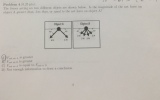 Problem 4 (6.25 pts): The forces acting on two different objets are shown below. Is the magnitude of the net force on object A greater than, less than, or equal to the net force on object A? Object A Object B 六11 45* 45 3 N 3 N 3N 3 N 6 N 6 N net on A Is greater B) Fret on IB is greater C) Fhet on A is equal to Fret on B D) Not enongh information...
Spreading forces over surfaces I. Block that floats when released A cubical block is observed to...
 Spreading forces over surfaces I. Block that floats when released A cubical block is observed to float in a beaker of water. The block is then held near the center of the beaker as shown and released. A. Describe the motion of the block after it is released. Lab section B. Draw a free-body diagram for the block at the instant that it is Free-body diagram for block at instant it is released released. Rather than drawing a single force...
Four forces are acting on an object in static equilibrium: Force 1 has a magnitude of...
Four forces are acting on an object in static equilibrium: Force 1 has a magnitude of 46.0 N and is acting at an angle of (45 + A) degrees above the positive x-axis. Force 2 has a magnitude of (15+B) N and is acting along the positive x-axis. Force 3 has a magnitude of 54.5 N and is acting along the negative y-axis. Find the magnitude of the last force, F4. Give your answer in newtons (N) and with 3...
Two forces are acting on an object. Force 1 on the object is 6.0 N and...
Two forces are acting on an object. Force 1 on the object is 6.0 N and to the right. Force 2 on the object is 8.0 N upwards. The magnitude of the net force on the object is ___________ N.
These two questions are part of the same question. I am not sure on to solve...
 These two questions are part of the same question. I am not sure
on to solve this. Please help!
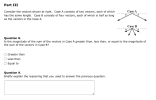
Part III Case A Consider the vectors shown at right. Case A consists of two vectors, each of which has the same length. Case B consists of four vectors, each of which is half as long as the vectors in the Case A. .-___ Case B Question 8 Is the magnitude of the sum of the vectors in Case A greater...
These two questions are part of the same question. I am not sure
on to solve this. Please help!
Part III Case A Consider the vectors shown at right. Case A consists of two vectors, each of which has the same length. Case B consists of four vectors, each of which is half as long as the vectors in the Case A. .-___ Case B Question 8 Is the magnitude of the sum of the vectors in Case A greater...
As shown in the figure below, seven forces all with magnitude |F| = 57 N are applied to an irregularly shaped object.
 As shown in the figure below, seven forces all with magnitude |F| = 57 N are applied to an irregularly shaped object. Each force is applied at a different location on the object, indicated by the tail of the arrow; the directions of the forces differ. The distances shown in the diagram have these values: w=7m, h=16 m, and d=12 m.For each force, calculate the z component of the torque due to that force, relative to location A (x to...
1) An object feels the impact of 3 forces. The mass of the object is 2.82...
1) An object feels the impact of 3 forces. The mass of the object is 2.82 kg. The object has an acceleration of 1.93 m/s2 at 28.6 degrees N of E. Force 1 is 11.0 N at 62.4 degrees S of E and Force 2 is 18.8 N at 57.5 degrees S of W. What is the magnitude and direction of Force 3? (Assume that no additional forces act on the object.)Do not use energy ideas in your solution. 2)...
understanding newton's law 1. An object cannot remain at rest unless which of the following holds? a. The net force act...
understanding newton's law 1. An object cannot remain at rest unless which of the following holds? a. The net force acting on it is zero. b. The net force acting on it is constant and nonzero. c. There are no forces at all acting on it. d. There is only one force acting on it. which one is the answer? there can be more than one answer.... 2. If a block is moving to the left at a constant velocity,...
I need help with all these please! Thanks! 1. Two identical metal balls are suspended by...
 I need help with all these please! Thanks!
1. Two identical metal balls are suspended by insulating threads. Both balls have the same net charge. In this problem, do not assume the balls are point charges Ball 2 a. Draw a separate free-body diagram for each ball. Label the forces to indicate: . the object exerting the force, the object on which the force is exerted, • the type of force (gravitational, normal etc.), and • whether the force is...
I need help with all these please! Thanks!
1. Two identical metal balls are suspended by insulating threads. Both balls have the same net charge. In this problem, do not assume the balls are point charges Ball 2 a. Draw a separate free-body diagram for each ball. Label the forces to indicate: . the object exerting the force, the object on which the force is exerted, • the type of force (gravitational, normal etc.), and • whether the force is...
Is it possible to have 3 Forces of equal magnitude acting on an object such that...
Is it possible to have 3 Forces of equal magnitude acting on an object such that the net force is 0?
 Problem 4 (6.25 pts): The forces acting on two different objets are shown below. Is the magnitude of the net force on object A greater than, less than, or equal to the net force on object A? Object A Object B 六11 45* 45 3 N 3 N 3N 3 N 6 N 6 N net on A Is greater B) Fret on IB is greater C) Fhet on A is equal to Fret on B D) Not enongh information...
 Spreading forces over surfaces I. Block that floats when released A cubical block is observed to float in a beaker of water. The block is then held near the center of the beaker as shown and released. A. Describe the motion of the block after it is released. Lab section B. Draw a free-body diagram for the block at the instant that it is Free-body diagram for block at instant it is released released. Rather than drawing a single force...
 These two questions are part of the same question. I am not sure
on to solve this. Please help!
Part III Case A Consider the vectors shown at right. Case A consists of two vectors, each of which has the same length. Case B consists of four vectors, each of which is half as long as the vectors in the Case A. .-___ Case B Question 8 Is the magnitude of the sum of the vectors in Case A greater...
These two questions are part of the same question. I am not sure
on to solve this. Please help!
Part III Case A Consider the vectors shown at right. Case A consists of two vectors, each of which has the same length. Case B consists of four vectors, each of which is half as long as the vectors in the Case A. .-___ Case B Question 8 Is the magnitude of the sum of the vectors in Case A greater...
 I need help with all these please! Thanks!
1. Two identical metal balls are suspended by insulating threads. Both balls have the same net charge. In this problem, do not assume the balls are point charges Ball 2 a. Draw a separate free-body diagram for each ball. Label the forces to indicate: . the object exerting the force, the object on which the force is exerted, • the type of force (gravitational, normal etc.), and • whether the force is...
I need help with all these please! Thanks!
1. Two identical metal balls are suspended by insulating threads. Both balls have the same net charge. In this problem, do not assume the balls are point charges Ball 2 a. Draw a separate free-body diagram for each ball. Label the forces to indicate: . the object exerting the force, the object on which the force is exerted, • the type of force (gravitational, normal etc.), and • whether the force is...
Most questions answered within 3 hours.
-
Where is the error in this code sequence?
String s1 = "Hello";
String s2 = "ello";...
asked 10 months ago -
Financial data for Joel de Paris, Inc., for last year
follow:
Joel de Paris, Inc.
Balance...
asked 10 months ago -
Consider this reaction:
Al2(SO4)3 (aq)+ BaCl3
(aq) Al2Cl6 (aq)- +
3BaSO4(s) . What is the...
asked 10 months ago -
Suppose that Savneet is considering increasing her
recent random sample from 20 car rentals to 40...
asked 10 months ago -
Trucks arrive at an unloading terminal at an average rate of 120
per hour.
Trucks arrive...
asked 10 months ago -
Why are methanol and ethanol completely soluble in water while
octanol is not very little soluble....
asked 10 months ago -
A facilities manager at a university reads in a research report
that the mean amount of...
asked 10 months ago -
When the CuSO4 is rehydrated by adding water to the anhydrous
compound, is this an endothermic...
asked 10 months ago -
A ray of sunlight is passing from diamond into crown glass; the
angle of incidence is...
asked 10 months ago -
A block of mass 0.249 kg is placed on top of a light, vertical
spring of...
asked 10 months ago -
how do the kidneys compensate in the presences of acidosis
a) trigger hyperventilate
b) reserve acid...
asked 10 months ago -
Question 501 pts
The rental rate of capital to the firm increases. Which of the
following...
asked 10 months ago