How can I plot this function in MATLAB?? trap( -5, 5, 50) function area = trap(x0,...
How can I plot this function in MATLAB??
trap( -5, 5, 50)
function area = trap(x0, xn, N)
f=@(x) (6.*(exp(-x)).*(cos(x)).^2);
h = ((xn-x0)/N);
area=0;
while (x0
area = area+(h/2)*(f(x0)+f(x0+h));
x0= x0+h;
end
fprintf('area of trap', area);
end
Homework Answers
Code:
function area = trap(x0, xn, N)
xSpan = linspace(x0, xn, N);
f=@(x) (6.*(exp(-x)).*(cos(x)).^2);

h = ((xn-x0)/N);

area=0;

while (x0 < xn)
area = area+(h/2)*(f(x0)+f(x0+h));
x0= x0+h;
end

fprintf('area of trap', area);
plot(xSpan, f(xSpan))
title("area of f(x) = "+num2str(area))
end
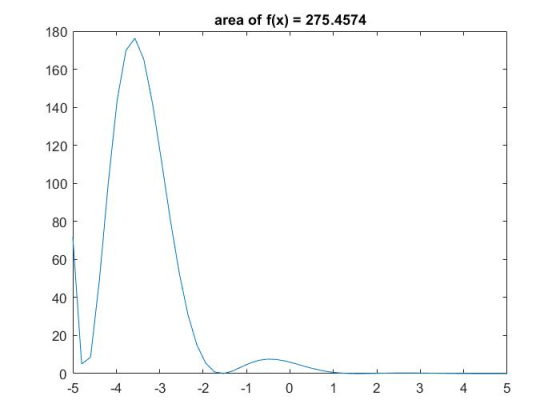
Output:
run area = trap( -5, 5, 50) in command line and press enter
Add Answer to:
How can I plot this function in MATLAB?? trap( -5, 5, 50) function area = trap(x0,...
help me please , By using MATLAB How can I plot the solution of linear diffrential...
 help me please , By using MATLAB
How can I plot the solution of linear diffrential system ? I
want the code in general case
We were unable to transcribe this imageclose all clear MATLAB Code: clc A= [1 0 1; 0 0 0;00-1]; % Coefficient Matrix Xo = [5 76]'; % Initial condition V, D = eig(A); % Get the Eigen values and Eigen vectors % General Solution: X=Sum of {c_i*exp(L_i*t) *V_i % where c_i are constants, L_i are...
help me please , By using MATLAB
How can I plot the solution of linear diffrential system ? I
want the code in general case
We were unable to transcribe this imageclose all clear MATLAB Code: clc A= [1 0 1; 0 0 0;00-1]; % Coefficient Matrix Xo = [5 76]'; % Initial condition V, D = eig(A); % Get the Eigen values and Eigen vectors % General Solution: X=Sum of {c_i*exp(L_i*t) *V_i % where c_i are constants, L_i are...
(a) (4 points) Fill in the blanks in the following MATLAB function M file trap so...
 (a) (4 points) Fill in the blanks in the following MATLAB function M file trap so that it implements the composilu trapezidul rulo, using a soquence of w -1,2, 4, 8, 16,... trapezoids, to approximatel d . This M file uses the MATLAB built-in function trapz. If 401) and y=() f(!)..... fr. 1)). 3= ($1, then the execution of z = trapz(x, y) approximates using the composite trapezoidal rule (with trapezoids). (Note that the entries of are labeled starting at...
The first two parts should be solved by Matlab. This is from an intro to Numerical...
 The first two parts should be solved by Matlab. This is from an
intro to Numerical Analysis Class and I have provided the Alog 3.2
in below. Please write the whole codes for me.
Alog3.2
% NEWTONS INTERPOLATORY DIVIDED-DIFFERENCE FORMULA ALGORITHM
3.2
% To obtain the divided-difference coefficients of the
% interpolatory polynomial P on the (n+1) distinct numbers
x(0),
% x(1), ..., x(n) for the function f:
% INPUT: numbers x(0), x(1), ..., x(n); values f(x(0)),
f(x(1)),
% ...,...
The first two parts should be solved by Matlab. This is from an
intro to Numerical Analysis Class and I have provided the Alog 3.2
in below. Please write the whole codes for me.
Alog3.2
% NEWTONS INTERPOLATORY DIVIDED-DIFFERENCE FORMULA ALGORITHM
3.2
% To obtain the divided-difference coefficients of the
% interpolatory polynomial P on the (n+1) distinct numbers
x(0),
% x(1), ..., x(n) for the function f:
% INPUT: numbers x(0), x(1), ..., x(n); values f(x(0)),
f(x(1)),
% ...,...
Programming Language: MATLAB Problem 3: (5 Points) Write a function with the header: function [R] -myNewtonRaphson...
 Programming Language: MATLAB
Problem 3: (5 Points) Write a function with the header: function [R] -myNewtonRaphson (f, fp, x0, tol) which takes as input f: a function handle fp: a function handle to the derivative of f (note how I do it in the test case). x0: the initial guess of the root tol: a tolerance above which the algorithm will keep iterating. Tips: . Be sure to include an iteration counter which will stop the while-loop if the number...
Programming Language: MATLAB
Problem 3: (5 Points) Write a function with the header: function [R] -myNewtonRaphson (f, fp, x0, tol) which takes as input f: a function handle fp: a function handle to the derivative of f (note how I do it in the test case). x0: the initial guess of the root tol: a tolerance above which the algorithm will keep iterating. Tips: . Be sure to include an iteration counter which will stop the while-loop if the number...
Need help with MATLAB, what code should be added to print the graph of the trapezoid rule code be...
 Need help with MATLAB, what code should be added to
print the graph of the trapezoid rule code below?
%%Matlab code for Question 5. syms X y intlx exp(x),0,2); %integration of x*exp(x) fprintf("htlntegration of x"2*exp(x) for [O 3] is %2.5f.\n,y) %Integration using Trapizoidal rule nn [100 1000]; for ii 1:2 a:0; b-3; %Integration limit ns-1:nn(i) integral Values-zeros(size(ns)); ourFunction-@(x) x.*2.*exp(x); for n-ns val(n)-trapizoidal (ourFunction,a,b,nn(i); end fprintf nlntegration of x 2*exp(x) using Trapizoidal rule for [O 3]\n') fprintf('1tTrapizoidal integration value for n-%d...
Need help with MATLAB, what code should be added to
print the graph of the trapezoid rule code below?
%%Matlab code for Question 5. syms X y intlx exp(x),0,2); %integration of x*exp(x) fprintf("htlntegration of x"2*exp(x) for [O 3] is %2.5f.\n,y) %Integration using Trapizoidal rule nn [100 1000]; for ii 1:2 a:0; b-3; %Integration limit ns-1:nn(i) integral Values-zeros(size(ns)); ourFunction-@(x) x.*2.*exp(x); for n-ns val(n)-trapizoidal (ourFunction,a,b,nn(i); end fprintf nlntegration of x 2*exp(x) using Trapizoidal rule for [O 3]\n') fprintf('1tTrapizoidal integration value for n-%d...
DO THIS IN MATLAB PLEASE DO THIS IN MATLAB Create a script file that performs the...
 DO THIS IN MATLAB PLEASE
DO THIS IN MATLAB
Create a script file that performs the following calculations. Your script will use the functions you create. Label all graphs appropriately. For this project, do not have your homemade functions fprintf anything, instead have all your fprintf commands within your script. Attach your published script file along with .m files for your functions. Exercise 1. A fundamental iterative method for finding the roots of equations of one-variable is known as Newton's...
DO THIS IN MATLAB PLEASE
DO THIS IN MATLAB
Create a script file that performs the following calculations. Your script will use the functions you create. Label all graphs appropriately. For this project, do not have your homemade functions fprintf anything, instead have all your fprintf commands within your script. Attach your published script file along with .m files for your functions. Exercise 1. A fundamental iterative method for finding the roots of equations of one-variable is known as Newton's...
The function should starts as: function [x,fs,k]=Newton1(x0) % enter your code here end >> ...
 The function should starts as:
function [x,fs,k]=Newton1(x0)
% enter your code here
end
>> [x,f,k]=Newton1(0) x = 1.1641, f = -1.6653e-16, k =
7
>> [x,f,k]=Newton1(0.1) x = 0.1972, f = 1.1102e-16, k =
5
>> [x,f,k]=Newton1(1.5) x = 1.3111, f = -1.1102e-16, k =
6
>> [x,f,k]=Newton1(2) Warning iteration diverged, x =
2.8808, f = -0.5624, k = 1000
Let the mathematical function f(x) be defined as: f(x) = exp(-0.5x) cos(5x)-0.5 , x 〉 0...
The function should starts as:
function [x,fs,k]=Newton1(x0)
% enter your code here
end
>> [x,f,k]=Newton1(0) x = 1.1641, f = -1.6653e-16, k =
7
>> [x,f,k]=Newton1(0.1) x = 0.1972, f = 1.1102e-16, k =
5
>> [x,f,k]=Newton1(1.5) x = 1.3111, f = -1.1102e-16, k =
6
>> [x,f,k]=Newton1(2) Warning iteration diverged, x =
2.8808, f = -0.5624, k = 1000
Let the mathematical function f(x) be defined as: f(x) = exp(-0.5x) cos(5x)-0.5 , x 〉 0...
Observations X1, ..., Xn come from the density function f(x; 6) = c(x) exp{x0 – b(0)},...
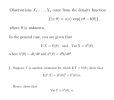 Observations X1, ..., Xn come from the density function f(x; 6) = c(x) exp{x0 – b(0)}, where 0 is unknown. In the general case, you are given that E X = b'(@) and Var X = 6"(0), where 5'(O) = db/do and V"(O) = d+b/202. 1. Suppose T is another estimator for which ET = V(@); show that E[T X] = [b'(O)]2 +6"(C)/n. Hence, show that Var T > 6"(0)/n.
Numerical method For matlab For the following equation 20 Marks fx)-1-(5 log1o x)-x2 a. Plot the...
 Numerical method
For
matlab
For the following equation 20 Marks fx)-1-(5 log1o x)-x2 a. Plot the function graphically from 0 to 2 using fplot. b. Find out the average value of f(x) for x -0 to 8 and display it using fprintf. Show final result with 2 decimal digits. Hint: You have to use a for loop, mean0, log100 functions of Matlab. Vrite a function which returns determinant, transpose and square of a matrix as output. To I file for...
Numerical method
For
matlab
For the following equation 20 Marks fx)-1-(5 log1o x)-x2 a. Plot the function graphically from 0 to 2 using fplot. b. Find out the average value of f(x) for x -0 to 8 and display it using fprintf. Show final result with 2 decimal digits. Hint: You have to use a for loop, mean0, log100 functions of Matlab. Vrite a function which returns determinant, transpose and square of a matrix as output. To I file for...
Let the mathematical function flu) be defined as: f(x)-exp-0.5x)cos(5x) - 0.5 .x>0 Write a Matlab...
 Please follow the instructions
without using other solutions. Thank you in advance
Let the mathematical function flu) be defined as: f(x)-exp-0.5x)cos(5x) - 0.5 .x>0 Write a Matlab function called Newton1 that would find the zero based on a passing initial guess as an input argument x0. The function returns the estimated zero location x, the function value at the zero location (f) and the number of iteration k. The iteration function converges if f(%) < 5"eps and it should diverge...
Please follow the instructions
without using other solutions. Thank you in advance
Let the mathematical function flu) be defined as: f(x)-exp-0.5x)cos(5x) - 0.5 .x>0 Write a Matlab function called Newton1 that would find the zero based on a passing initial guess as an input argument x0. The function returns the estimated zero location x, the function value at the zero location (f) and the number of iteration k. The iteration function converges if f(%) < 5"eps and it should diverge...
 help me please , By using MATLAB
How can I plot the solution of linear diffrential system ? I
want the code in general case
We were unable to transcribe this imageclose all clear MATLAB Code: clc A= [1 0 1; 0 0 0;00-1]; % Coefficient Matrix Xo = [5 76]'; % Initial condition V, D = eig(A); % Get the Eigen values and Eigen vectors % General Solution: X=Sum of {c_i*exp(L_i*t) *V_i % where c_i are constants, L_i are...
help me please , By using MATLAB
How can I plot the solution of linear diffrential system ? I
want the code in general case
We were unable to transcribe this imageclose all clear MATLAB Code: clc A= [1 0 1; 0 0 0;00-1]; % Coefficient Matrix Xo = [5 76]'; % Initial condition V, D = eig(A); % Get the Eigen values and Eigen vectors % General Solution: X=Sum of {c_i*exp(L_i*t) *V_i % where c_i are constants, L_i are...
 (a) (4 points) Fill in the blanks in the following MATLAB function M file trap so that it implements the composilu trapezidul rulo, using a soquence of w -1,2, 4, 8, 16,... trapezoids, to approximatel d . This M file uses the MATLAB built-in function trapz. If 401) and y=() f(!)..... fr. 1)). 3= ($1, then the execution of z = trapz(x, y) approximates using the composite trapezoidal rule (with trapezoids). (Note that the entries of are labeled starting at...
 The first two parts should be solved by Matlab. This is from an
intro to Numerical Analysis Class and I have provided the Alog 3.2
in below. Please write the whole codes for me.
Alog3.2
% NEWTONS INTERPOLATORY DIVIDED-DIFFERENCE FORMULA ALGORITHM
3.2
% To obtain the divided-difference coefficients of the
% interpolatory polynomial P on the (n+1) distinct numbers
x(0),
% x(1), ..., x(n) for the function f:
% INPUT: numbers x(0), x(1), ..., x(n); values f(x(0)),
f(x(1)),
% ...,...
The first two parts should be solved by Matlab. This is from an
intro to Numerical Analysis Class and I have provided the Alog 3.2
in below. Please write the whole codes for me.
Alog3.2
% NEWTONS INTERPOLATORY DIVIDED-DIFFERENCE FORMULA ALGORITHM
3.2
% To obtain the divided-difference coefficients of the
% interpolatory polynomial P on the (n+1) distinct numbers
x(0),
% x(1), ..., x(n) for the function f:
% INPUT: numbers x(0), x(1), ..., x(n); values f(x(0)),
f(x(1)),
% ...,...
 Programming Language: MATLAB
Problem 3: (5 Points) Write a function with the header: function [R] -myNewtonRaphson (f, fp, x0, tol) which takes as input f: a function handle fp: a function handle to the derivative of f (note how I do it in the test case). x0: the initial guess of the root tol: a tolerance above which the algorithm will keep iterating. Tips: . Be sure to include an iteration counter which will stop the while-loop if the number...
Programming Language: MATLAB
Problem 3: (5 Points) Write a function with the header: function [R] -myNewtonRaphson (f, fp, x0, tol) which takes as input f: a function handle fp: a function handle to the derivative of f (note how I do it in the test case). x0: the initial guess of the root tol: a tolerance above which the algorithm will keep iterating. Tips: . Be sure to include an iteration counter which will stop the while-loop if the number...
 Need help with MATLAB, what code should be added to
print the graph of the trapezoid rule code below?
%%Matlab code for Question 5. syms X y intlx exp(x),0,2); %integration of x*exp(x) fprintf("htlntegration of x"2*exp(x) for [O 3] is %2.5f.\n,y) %Integration using Trapizoidal rule nn [100 1000]; for ii 1:2 a:0; b-3; %Integration limit ns-1:nn(i) integral Values-zeros(size(ns)); ourFunction-@(x) x.*2.*exp(x); for n-ns val(n)-trapizoidal (ourFunction,a,b,nn(i); end fprintf nlntegration of x 2*exp(x) using Trapizoidal rule for [O 3]\n') fprintf('1tTrapizoidal integration value for n-%d...
Need help with MATLAB, what code should be added to
print the graph of the trapezoid rule code below?
%%Matlab code for Question 5. syms X y intlx exp(x),0,2); %integration of x*exp(x) fprintf("htlntegration of x"2*exp(x) for [O 3] is %2.5f.\n,y) %Integration using Trapizoidal rule nn [100 1000]; for ii 1:2 a:0; b-3; %Integration limit ns-1:nn(i) integral Values-zeros(size(ns)); ourFunction-@(x) x.*2.*exp(x); for n-ns val(n)-trapizoidal (ourFunction,a,b,nn(i); end fprintf nlntegration of x 2*exp(x) using Trapizoidal rule for [O 3]\n') fprintf('1tTrapizoidal integration value for n-%d...
 DO THIS IN MATLAB PLEASE
DO THIS IN MATLAB
Create a script file that performs the following calculations. Your script will use the functions you create. Label all graphs appropriately. For this project, do not have your homemade functions fprintf anything, instead have all your fprintf commands within your script. Attach your published script file along with .m files for your functions. Exercise 1. A fundamental iterative method for finding the roots of equations of one-variable is known as Newton's...
DO THIS IN MATLAB PLEASE
DO THIS IN MATLAB
Create a script file that performs the following calculations. Your script will use the functions you create. Label all graphs appropriately. For this project, do not have your homemade functions fprintf anything, instead have all your fprintf commands within your script. Attach your published script file along with .m files for your functions. Exercise 1. A fundamental iterative method for finding the roots of equations of one-variable is known as Newton's...
 The function should starts as:
function [x,fs,k]=Newton1(x0)
% enter your code here
end
>> [x,f,k]=Newton1(0) x = 1.1641, f = -1.6653e-16, k =
7
>> [x,f,k]=Newton1(0.1) x = 0.1972, f = 1.1102e-16, k =
5
>> [x,f,k]=Newton1(1.5) x = 1.3111, f = -1.1102e-16, k =
6
>> [x,f,k]=Newton1(2) Warning iteration diverged, x =
2.8808, f = -0.5624, k = 1000
Let the mathematical function f(x) be defined as: f(x) = exp(-0.5x) cos(5x)-0.5 , x 〉 0...
The function should starts as:
function [x,fs,k]=Newton1(x0)
% enter your code here
end
>> [x,f,k]=Newton1(0) x = 1.1641, f = -1.6653e-16, k =
7
>> [x,f,k]=Newton1(0.1) x = 0.1972, f = 1.1102e-16, k =
5
>> [x,f,k]=Newton1(1.5) x = 1.3111, f = -1.1102e-16, k =
6
>> [x,f,k]=Newton1(2) Warning iteration diverged, x =
2.8808, f = -0.5624, k = 1000
Let the mathematical function f(x) be defined as: f(x) = exp(-0.5x) cos(5x)-0.5 , x 〉 0...
 Observations X1, ..., Xn come from the density function f(x; 6) = c(x) exp{x0 – b(0)}, where 0 is unknown. In the general case, you are given that E X = b'(@) and Var X = 6"(0), where 5'(O) = db/do and V"(O) = d+b/202. 1. Suppose T is another estimator for which ET = V(@); show that E[T X] = [b'(O)]2 +6"(C)/n. Hence, show that Var T > 6"(0)/n.
 Numerical method
For
matlab
For the following equation 20 Marks fx)-1-(5 log1o x)-x2 a. Plot the function graphically from 0 to 2 using fplot. b. Find out the average value of f(x) for x -0 to 8 and display it using fprintf. Show final result with 2 decimal digits. Hint: You have to use a for loop, mean0, log100 functions of Matlab. Vrite a function which returns determinant, transpose and square of a matrix as output. To I file for...
Numerical method
For
matlab
For the following equation 20 Marks fx)-1-(5 log1o x)-x2 a. Plot the function graphically from 0 to 2 using fplot. b. Find out the average value of f(x) for x -0 to 8 and display it using fprintf. Show final result with 2 decimal digits. Hint: You have to use a for loop, mean0, log100 functions of Matlab. Vrite a function which returns determinant, transpose and square of a matrix as output. To I file for...
 Please follow the instructions
without using other solutions. Thank you in advance
Let the mathematical function flu) be defined as: f(x)-exp-0.5x)cos(5x) - 0.5 .x>0 Write a Matlab function called Newton1 that would find the zero based on a passing initial guess as an input argument x0. The function returns the estimated zero location x, the function value at the zero location (f) and the number of iteration k. The iteration function converges if f(%) < 5"eps and it should diverge...
Please follow the instructions
without using other solutions. Thank you in advance
Let the mathematical function flu) be defined as: f(x)-exp-0.5x)cos(5x) - 0.5 .x>0 Write a Matlab function called Newton1 that would find the zero based on a passing initial guess as an input argument x0. The function returns the estimated zero location x, the function value at the zero location (f) and the number of iteration k. The iteration function converges if f(%) < 5"eps and it should diverge...
Most questions answered within 3 hours.
-
Where is the error in this code sequence?
String s1 = "Hello";
String s2 = "ello";...
asked 11 months ago -
Financial data for Joel de Paris, Inc., for last year
follow:
Joel de Paris, Inc.
Balance...
asked 11 months ago -
Consider this reaction:
Al2(SO4)3 (aq)+ BaCl3
(aq) Al2Cl6 (aq)- +
3BaSO4(s) . What is the...
asked 11 months ago -
Suppose that Savneet is considering increasing her
recent random sample from 20 car rentals to 40...
asked 11 months ago -
Trucks arrive at an unloading terminal at an average rate of 120
per hour.
Trucks arrive...
asked 11 months ago -
Why are methanol and ethanol completely soluble in water while
octanol is not very little soluble....
asked 11 months ago -
A facilities manager at a university reads in a research report
that the mean amount of...
asked 11 months ago -
When the CuSO4 is rehydrated by adding water to the anhydrous
compound, is this an endothermic...
asked 11 months ago -
A ray of sunlight is passing from diamond into crown glass; the
angle of incidence is...
asked 11 months ago -
A block of mass 0.249 kg is placed on top of a light, vertical
spring of...
asked 11 months ago -
how do the kidneys compensate in the presences of acidosis
a) trigger hyperventilate
b) reserve acid...
asked 11 months ago -
Question 501 pts
The rental rate of capital to the firm increases. Which of the
following...
asked 11 months ago