A compact disc varies it’s angular velocity so that the linear velocity of the location currently...
A compact disc varies it’s angular velocity so that the linear velocity of the location currently scanned is 1.2 m/s.
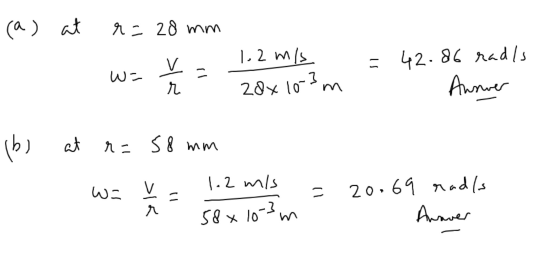
What is the angular velocity at the inner part of the disc (r = `28mm) at the start?
What is the angular velocity at the outer part of the disc (r = 58mm) at the end?
Homework Answers
Add Answer to:
A compact disc varies it’s angular velocity so that the linear velocity of the location currently...
On a compact disc (CD), music is coded in a pattern of tiny pits arranged in...
On a compact disc (CD), music is coded in a pattern of tiny pits arranged in a track that spirals outward toward the rim of the disc. As the disc spins inside a CD player, the track is scanned at a constant linear speed of v = 1.25 m/s. Because the radius of the track varies as it spirals outward, the angular speed of the disc must change as the CD is played. Let's see what angular acceleration is required...
Exercise 9.20 Constant Part A A compact disc (CD) stores music in a coded pattern of...
 Exercise 9.20 Constant Part A A compact disc (CD) stores music in a coded pattern of tiny pits 107 m deep. The pits are arranged in a track that spirals outward toward the rim of the disc the inner and outer radil of this spiral are 25.0 mm and 58.0 mm, respectively. As the disc spins inside a CD player, the track is scanned at a constant linear speed of 1.25 m/s. What is the angular speed of the CD...
The angular speed of digital video discs (DVDs) varies with whether the inner or outer part...
The angular speed of digital video discs (DVDs) varies with whether the inner or outer part of the disc is being read. (CDs function in the same way.) Over a 129 min playing time, the angular speed varies from 564 rpm to 1610 rpm . Assuming it to be constant, what is the angular acceleration (in rad/s2) of such a DVD?
1 Moment of inertia of a solid uniform sphere around its axis of symmetry a) What...
 1 Moment of inertia of a solid uniform sphere around its axis of symmetry a) What is the volume element dV of a sphere? b) Assume a constant density p MIV, calculate the moment of inertia, remember that r is measured from the rotation axis for each volume element Use the volume of a sphere to get a solution that only depends on the mass M and radius R of the sphere. c) 2) Spinning DVD On a DVD, data...
The outside diameter of the playing area of an optical Blu-ray disc is 11.75 cm, and...
The outside diameter of the playing area of an optical Blu-ray disc is 11.75 cm, and the inside diameter is 4.50 cm. When viewing movies, the disc rotates so that a laser maintains a constant linear speed relative to the disc of 7.30 m/s as it tracks over the playing area. 1) What is the average angular acceleration of a Blu-ray disc as it plays an 6.0-h set of movies? (Assume the disk is scanned starting at its inner radius...
Recall your experimental setup from Lab 05A: a constant force was applied to a disc by...
Recall your experimental setup from Lab 05A: a constant force was applied to a disc by attaching a mass to a light string wrapped around a mass-less pulley and hanging the mass over the edge of the apparatus. In the lab, you used energy conservation arguments to derive an expression for the angular velocity of the disc after the mass had fallen a distance x. Your goal now is to use kinematics and dynamics to confirm your expression. Use the...
A wheel spins at a constant angular velocity of 6.5 rad/s about its axle for 3.3s....
A wheel spins at a constant angular velocity of 6.5 rad/s about its axle for 3.3s. 5) What is the angular displacement (in radians)? 6) What is the angular displacement (in degrees)? 7) If the diameter of the wheel in the previous problem is 0.65 m, then what is the linear velocity (in m/s) of a point on the outer rim of the wheel?
A ladybug crawls along the radius of a rotating compact disk of mass M = 0.015...
 A ladybug crawls along the radius of a rotating compact disk of mass M = 0.015 kg and radius r = 0.06 m (ldisk = Mr²/2). The pivot is frictionless and the disk is initially rotating with angular speed wa = 31.416 rad/s. The ladybug starts at the outer edge (Figure A) and ends at center (Figure B). At the end of the ladybug's travel the disk rotates with angular speed wg = 31.510 rad/s. WB Figure A Figure B...
A hammer thrower spins with an angular velocity of 1200°/s. The distance from his axis of...
A hammer thrower spins with an angular velocity of 1200°/s. The distance from his axis of rotation to the hammer head is 1.2 m. What is the centripetal acceleration of the hammer head? What is the linear velocity of the hammer head? *Convert 1200 degrees/s to rad/s. 1200 / 57.3 = 20.94 rad/s
Calculate the linear acceleration of a car, the 0.210-m radius tires of which have an angular...
Calculate the linear acceleration of a car, the 0.210-m radius tires of which have an angular acceleration of 11.0 rad/s2. Assume no slippage and give your answer in m/s2. (b). How many revolutions do the tires make in 2.50 s if they start from rest? (c). What is their final angular velocity in rad/s? (d). What is the final velocity of the car in m/s?
 Exercise 9.20 Constant Part A A compact disc (CD) stores music in a coded pattern of tiny pits 107 m deep. The pits are arranged in a track that spirals outward toward the rim of the disc the inner and outer radil of this spiral are 25.0 mm and 58.0 mm, respectively. As the disc spins inside a CD player, the track is scanned at a constant linear speed of 1.25 m/s. What is the angular speed of the CD...
 1 Moment of inertia of a solid uniform sphere around its axis of symmetry a) What is the volume element dV of a sphere? b) Assume a constant density p MIV, calculate the moment of inertia, remember that r is measured from the rotation axis for each volume element Use the volume of a sphere to get a solution that only depends on the mass M and radius R of the sphere. c) 2) Spinning DVD On a DVD, data...
 A ladybug crawls along the radius of a rotating compact disk of mass M = 0.015 kg and radius r = 0.06 m (ldisk = Mr²/2). The pivot is frictionless and the disk is initially rotating with angular speed wa = 31.416 rad/s. The ladybug starts at the outer edge (Figure A) and ends at center (Figure B). At the end of the ladybug's travel the disk rotates with angular speed wg = 31.510 rad/s. WB Figure A Figure B...
Most questions answered within 3 hours.
-
Where is the error in this code sequence?
String s1 = "Hello";
String s2 = "ello";...
asked 10 months ago -
Financial data for Joel de Paris, Inc., for last year
follow:
Joel de Paris, Inc.
Balance...
asked 10 months ago -
Consider this reaction:
Al2(SO4)3 (aq)+ BaCl3
(aq) Al2Cl6 (aq)- +
3BaSO4(s) . What is the...
asked 10 months ago -
Suppose that Savneet is considering increasing her
recent random sample from 20 car rentals to 40...
asked 10 months ago -
Trucks arrive at an unloading terminal at an average rate of 120
per hour.
Trucks arrive...
asked 10 months ago -
Why are methanol and ethanol completely soluble in water while
octanol is not very little soluble....
asked 10 months ago -
A facilities manager at a university reads in a research report
that the mean amount of...
asked 10 months ago -
When the CuSO4 is rehydrated by adding water to the anhydrous
compound, is this an endothermic...
asked 10 months ago -
A ray of sunlight is passing from diamond into crown glass; the
angle of incidence is...
asked 10 months ago -
A block of mass 0.249 kg is placed on top of a light, vertical
spring of...
asked 10 months ago -
how do the kidneys compensate in the presences of acidosis
a) trigger hyperventilate
b) reserve acid...
asked 10 months ago -
Question 501 pts
The rental rate of capital to the firm increases. Which of the
following...
asked 10 months ago