


Homework Answers
Add Answer to:
< Trabajo C Exercise 5.8 A block on a level frictionless surface has two horizontal forces...
IP A 2.8 kg block slides with a speed of 2.1 m/s on a frictionless horizontal...
 IP A 2.8 kg block slides with a speed of 2.1 m/s on a frictionless horizontal surface until it encounters a spring. Part A If the block compresses the spring 5.6 cm before coning to rest, what is the force constant of the spring? Express your answer using two significant figures. N/m Submit Request Answer Part B What initial speed should the block have to compress the spring by 1.4 cm? Express your answer using two significant figures. UE m/s...
constants Submit Previous Answers A small block on a frictionless, horizontal surface has a mass of...
 constants Submit Previous Answers A small block on a frictionless, horizontal surface has a mass of 2.90*10-2 kg. It is attached to a massless cord passing through a hole in the surface (Figure 1). The block is originally revolving at a distance of 0.300 m from the hole with an angular speed of 2.25 rad/s. The cord is then pulled from below, shortening the radius of the circle in which the block revolves to 0.150 m. Model the block as...
Determine the horizontal and vertical components of force that pins A and B exert on the...
 Determine the horizontal and vertical components of force that pins
A and B exert on the two-member frame. Set F = 545 N
Determine the horizontal and veral components of force that is A and Besort on the two member frame Set 545 N. 1) Part A Determine the horizontal and vertical components of force that in een on the frame Express your answers using three significant figures separated by a cona Assume that the positive respectively Submit Figure 1...
Determine the horizontal and vertical components of force that pins
A and B exert on the two-member frame. Set F = 545 N
Determine the horizontal and veral components of force that is A and Besort on the two member frame Set 545 N. 1) Part A Determine the horizontal and vertical components of force that in een on the frame Express your answers using three significant figures separated by a cona Assume that the positive respectively Submit Figure 1...
A small block on a frictionless, horizontal surface has a mass of 2.40x10⁻² kg . It...
 A small block on a frictionless, horizontal surface has a mass of 2.40x10⁻² kg . It is attached to a massless cord passing through a hole in the surface (Figure 1). The block is originally revolving at a distance of 0.300 m from the hole with an angular speed of 2.39 rad/s. The cord is then pulled from below, shortening the radius of the circle in which the block revolves to 0.150 m. Model the block as a particle. Figure...
A block of weight w = 15.0 N sits on a frictionless inclined plane, which makes...
 A block of weight w = 15.0 N sits on a frictionless inclined plane, which makes an angle @ = 33.0° with respect to the horizontal, as shown in the figure. (Figure 1)A force of magnitude F = 8.17 N, applied parallel to the incline, is just sufficient to pull the block up the plane at constant speed. Review The block moves up an incline with constant speed. What is the total work Wtotal done on the block by all...
Fisica 9A Cerros < Trabajo C Exercise 5.16 (IE) Part A A student could either pull or push, at an angle of 30"...
 Fisica 9A Cerros < Trabajo C Exercise 5.16 (IE) Part A A student could either pull or push, at an angle of 30" from the horizontal, a 45 kg crate on a horizontal surface, where the coefficient of kinetic friction between the crate and surface is 0.15. The crate is to be moved a horizontal distance of 22 Compared with pushing, pulling requires the student to do work less the same Submit Request Answer Part B Calculate the minimum work...
In the system shown in the figure, suppose the block has a mass of 3.4 kg...
 In the system shown in the figure, suppose
the block has a mass of 3.4 kg , the spring has a force constant of
530 N/m , and the coefficient of kinetic friction between the block
and the floor is 0.19.
A) Find the work done on the block by the spring and by friction
as the block is moved from point A to point B along path 2. Express
your answers using two significant figures separated by a comma....
In the system shown in the figure, suppose
the block has a mass of 3.4 kg , the spring has a force constant of
530 N/m , and the coefficient of kinetic friction between the block
and the floor is 0.19.
A) Find the work done on the block by the spring and by friction
as the block is moved from point A to point B along path 2. Express
your answers using two significant figures separated by a comma....
A block of weight w = 40.0 N sits on a frictionless inclined plane, which makes...
A block of weight w = 40.0 N sits on a frictionless inclined plane, which makes an angle θ = 22.0 ∘ with respect to the horizontal, as shown in the figure. (Figure 1)A force of magnitude F = 15.0 N , applied parallel to the incline, is just sufficient to pull the block up the plane at constant speed. part A The block moves up an incline with constant speed. What is the total work Wtotal done on the...
Problem 2.78 Part A The two forces Fi and F2 acting at A have a resultant force of FR={-180 k lb. (Figure 1) Determine...
 Problem 2.78 Part A The two forces Fi and F2 acting at A have a resultant force of FR={-180 k lb. (Figure 1) Determine the magnitude of F2. Express your answer to three significant figures and include the appropriate units. Value Units Submit Request Answer Figure 1 of 1 Part B Determine the coordinate direction angle a of F2. Express your answer using three significant figures. VA Tvec 30 ? 40 F 60 lb Submit Request Answer Part C Determine...
The diagram below shows a block of mass m=2.00kg on a frictionless horizontal surface, as seen...
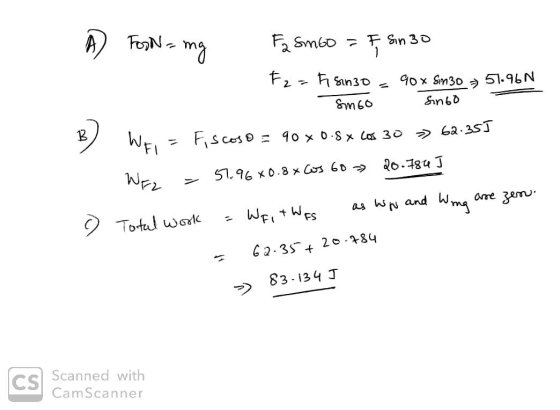
The diagram below shows a block of mass m=2.00kg on a frictionless horizontal surface, as seen from above. Three forces of magnitudes F1=4.00N, F2=6.00N, and F3=8.00N are applied to the block, initially at rest on the surface, at angles shown on the diagram. (Figure 1) In this problem, you will determine the resultant (total) force vector from the combination of the three individual force vectors. All angles should be measured counterclockwise from the positive x axis (i.e., all angles are...
 IP A 2.8 kg block slides with a speed of 2.1 m/s on a frictionless horizontal surface until it encounters a spring. Part A If the block compresses the spring 5.6 cm before coning to rest, what is the force constant of the spring? Express your answer using two significant figures. N/m Submit Request Answer Part B What initial speed should the block have to compress the spring by 1.4 cm? Express your answer using two significant figures. UE m/s...
 constants Submit Previous Answers A small block on a frictionless, horizontal surface has a mass of 2.90*10-2 kg. It is attached to a massless cord passing through a hole in the surface (Figure 1). The block is originally revolving at a distance of 0.300 m from the hole with an angular speed of 2.25 rad/s. The cord is then pulled from below, shortening the radius of the circle in which the block revolves to 0.150 m. Model the block as...
 Determine the horizontal and vertical components of force that pins
A and B exert on the two-member frame. Set F = 545 N
Determine the horizontal and veral components of force that is A and Besort on the two member frame Set 545 N. 1) Part A Determine the horizontal and vertical components of force that in een on the frame Express your answers using three significant figures separated by a cona Assume that the positive respectively Submit Figure 1...
Determine the horizontal and vertical components of force that pins
A and B exert on the two-member frame. Set F = 545 N
Determine the horizontal and veral components of force that is A and Besort on the two member frame Set 545 N. 1) Part A Determine the horizontal and vertical components of force that in een on the frame Express your answers using three significant figures separated by a cona Assume that the positive respectively Submit Figure 1...
 A small block on a frictionless, horizontal surface has a mass of 2.40x10⁻² kg . It is attached to a massless cord passing through a hole in the surface (Figure 1). The block is originally revolving at a distance of 0.300 m from the hole with an angular speed of 2.39 rad/s. The cord is then pulled from below, shortening the radius of the circle in which the block revolves to 0.150 m. Model the block as a particle. Figure...
 A block of weight w = 15.0 N sits on a frictionless inclined plane, which makes an angle @ = 33.0° with respect to the horizontal, as shown in the figure. (Figure 1)A force of magnitude F = 8.17 N, applied parallel to the incline, is just sufficient to pull the block up the plane at constant speed. Review The block moves up an incline with constant speed. What is the total work Wtotal done on the block by all...
 Fisica 9A Cerros < Trabajo C Exercise 5.16 (IE) Part A A student could either pull or push, at an angle of 30" from the horizontal, a 45 kg crate on a horizontal surface, where the coefficient of kinetic friction between the crate and surface is 0.15. The crate is to be moved a horizontal distance of 22 Compared with pushing, pulling requires the student to do work less the same Submit Request Answer Part B Calculate the minimum work...
 In the system shown in the figure, suppose
the block has a mass of 3.4 kg , the spring has a force constant of
530 N/m , and the coefficient of kinetic friction between the block
and the floor is 0.19.
A) Find the work done on the block by the spring and by friction
as the block is moved from point A to point B along path 2. Express
your answers using two significant figures separated by a comma....
In the system shown in the figure, suppose
the block has a mass of 3.4 kg , the spring has a force constant of
530 N/m , and the coefficient of kinetic friction between the block
and the floor is 0.19.
A) Find the work done on the block by the spring and by friction
as the block is moved from point A to point B along path 2. Express
your answers using two significant figures separated by a comma....
 Problem 2.78 Part A The two forces Fi and F2 acting at A have a resultant force of FR={-180 k lb. (Figure 1) Determine the magnitude of F2. Express your answer to three significant figures and include the appropriate units. Value Units Submit Request Answer Figure 1 of 1 Part B Determine the coordinate direction angle a of F2. Express your answer using three significant figures. VA Tvec 30 ? 40 F 60 lb Submit Request Answer Part C Determine...
Most questions answered within 3 hours.
-
Where is the error in this code sequence?
String s1 = "Hello";
String s2 = "ello";...
asked 10 months ago -
Financial data for Joel de Paris, Inc., for last year
follow:
Joel de Paris, Inc.
Balance...
asked 10 months ago -
Consider this reaction:
Al2(SO4)3 (aq)+ BaCl3
(aq) Al2Cl6 (aq)- +
3BaSO4(s) . What is the...
asked 10 months ago -
Suppose that Savneet is considering increasing her
recent random sample from 20 car rentals to 40...
asked 10 months ago -
Trucks arrive at an unloading terminal at an average rate of 120
per hour.
Trucks arrive...
asked 10 months ago -
Why are methanol and ethanol completely soluble in water while
octanol is not very little soluble....
asked 10 months ago -
A facilities manager at a university reads in a research report
that the mean amount of...
asked 10 months ago -
When the CuSO4 is rehydrated by adding water to the anhydrous
compound, is this an endothermic...
asked 10 months ago -
A ray of sunlight is passing from diamond into crown glass; the
angle of incidence is...
asked 10 months ago -
A block of mass 0.249 kg is placed on top of a light, vertical
spring of...
asked 10 months ago -
how do the kidneys compensate in the presences of acidosis
a) trigger hyperventilate
b) reserve acid...
asked 10 months ago -
Question 501 pts
The rental rate of capital to the firm increases. Which of the
following...
asked 10 months ago