
Homework Answers

Add Answer to:
13 Figure 12-31 shows the anatomical structures in the lower leg and foot that are involved...
The figure shows the anatomical structures in the lower leg and foot that are involved in...
The figure shows the anatomical structures in the lower leg and foot that are involved in standing on tiptoe, with the heel raised slightly off the floor so that the foot effectively contacts the floor at only at point P. Assume distance a = 5.6 cm, distance b = 16 cm, and the person's weight W = 610 N. Take the upward direction to be positive. Of the forces acting on the foot, what are (a) the force at point...
Chapter 12, Problem 013 The figure shows the anatomical structures in the lower leg and foot...
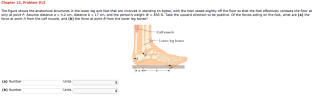 Chapter 12, Problem 013 The figure shows the anatomical structures in the lower leg and foot that are involved in standing on tiptoe, with the heel raised slightly off the floor so that the foot effectively contacts the floor at only at point P. Assume distance a 4.2 cm, distance b- 17 cm, and the person's weight W 830 N. Take the upward direction to be positive. Of the forces acting on the foot, what are (a) the force at...
PROBLEM 2 Knee Extension - The angular motion of the lower leg about the knee joint,...
 PROBLEM 2 Knee Extension - The angular motion of the lower leg about the knee joint, and the forces and torques produced by the muscles crossing the knee joint during knee flexions and extensions have been investigated by a number of researchers utilizing different experimental techniques. One of these techniques is discussed here. Consider the person illustrated in Fig. 10.12. The test subject is sitting on a table, with the back placed against a back rest and the lower legs...
12 31. Predict/Calculate The 12 point charges in FIGURE 19-42 have the following values: qi =...
 12 31. Predict/Calculate The 12 point charges in FIGURE 19-42 have the following values: qi = +2.1 μC, q2= +6.3 pC, 90.89 HC (a) Given that the distance d in Figure 19-42 is 4.35 cm, find the direction and mag- nitude of the net electro- static force exerted on the point charge q1, (b) How qi④ would your answers to part (a) change if the distance d FIGURE 19-42 Problems 31, 32, 46, and 55 were doubled? Explain. ЕЗ
The figure below shows a human arm that weighs 39.3 N. The arm is extended outward...
 The figure below shows a human arm that weighs 39.3 N. The arm
is extended outward and is motionless. The gravitational force
Fg
on the arm acts at point A, a distance of 0.290 m from
the shoulder joint, which is represented by point O. The
shoulder pushes down and to the right on the humerus bone of the
arm with a force
Fs
at point O, at an angle θ as shown. The
deltoid muscle pulls back on the...
The figure below shows a human arm that weighs 39.3 N. The arm
is extended outward and is motionless. The gravitational force
Fg
on the arm acts at point A, a distance of 0.290 m from
the shoulder joint, which is represented by point O. The
shoulder pushes down and to the right on the humerus bone of the
arm with a force
Fs
at point O, at an angle θ as shown. The
deltoid muscle pulls back on the...
i got 1.4 but it was incorrect and i am not sure why. Please help! READING 2 Materials fracture when the force per unit area, called STRESS, exceeds a critical value. In general, the critical stress...
 i got 1.4 but it was incorrect
and i am not sure why. Please help!
READING 2 Materials fracture when the force per unit area, called STRESS, exceeds a critical value. In general, the critical stress depends on the direction as well as the magnitude of the force. For example, bones break differently when subjected to torsional (twisting) stress than when subjected to compressional (or squeezing) stress. Let us consider compressional stress. Wet human bone for 20-39 year olds has...
i got 1.4 but it was incorrect
and i am not sure why. Please help!
READING 2 Materials fracture when the force per unit area, called STRESS, exceeds a critical value. In general, the critical stress depends on the direction as well as the magnitude of the force. For example, bones break differently when subjected to torsional (twisting) stress than when subjected to compressional (or squeezing) stress. Let us consider compressional stress. Wet human bone for 20-39 year olds has...
Materials fracture when the force per unit area, called STRESS, exceeds a critical value. In general, the critical stress depends on the direction as well as the magnitude of the force. For example,...
 Materials fracture when the force per unit area, called STRESS, exceeds a critical value. In general, the critical stress depends on the direction as well as the magnitude of the force. For example, bones break differently when subjected to torsional (twisting) stress than when subjected to compressional (or squeezing) stress. Let us consider compressional stress. Wet human bone for 20-39 year olds has an ultimate compressive strength of 1.6x10⁴N/cm2 [8]. Consider a person who falls from a height to the...
1. Kinetics is the study of forces acting on a system. True False 2. Kinematics is...
 1. Kinetics is the study of forces acting on a system.
True
False
2. Kinematics is the study of motion without regard to its
causes (forces).
True
False
3. The similarity between the Macrocycle Flowchart, the Training
Pyramid and the Goals for Performance pyramid can be best described
as an athlete should have a structured foundation and not proceed
too early.
True
False
4. When should static stretching be performed?
Minutes before event performance
Hours prior to event or the...
1. Kinetics is the study of forces acting on a system.
True
False
2. Kinematics is the study of motion without regard to its
causes (forces).
True
False
3. The similarity between the Macrocycle Flowchart, the Training
Pyramid and the Goals for Performance pyramid can be best described
as an athlete should have a structured foundation and not proceed
too early.
True
False
4. When should static stretching be performed?
Minutes before event performance
Hours prior to event or the...
3. Which of the following methods should be used to check an athlete’s responsiveness? a. Slap...
3. Which of the following methods should be used to check an athlete’s responsiveness? a. Slap the athlete’s face while calling his name. b. Wiggle the athlete’s foot. c. Tap or squeeze the athlete’s shoulder and ask, Are you all right? d. Poke the athlete’s arm or leg. e. Place smelling salts under the athlete’s nose. 4. If the AED indicates "No shock indicated/advised," you should leave the AED pads on. a. true b. false 5. You coach a women’s...
 Chapter 12, Problem 013 The figure shows the anatomical structures in the lower leg and foot that are involved in standing on tiptoe, with the heel raised slightly off the floor so that the foot effectively contacts the floor at only at point P. Assume distance a 4.2 cm, distance b- 17 cm, and the person's weight W 830 N. Take the upward direction to be positive. Of the forces acting on the foot, what are (a) the force at...
 PROBLEM 2 Knee Extension - The angular motion of the lower leg about the knee joint, and the forces and torques produced by the muscles crossing the knee joint during knee flexions and extensions have been investigated by a number of researchers utilizing different experimental techniques. One of these techniques is discussed here. Consider the person illustrated in Fig. 10.12. The test subject is sitting on a table, with the back placed against a back rest and the lower legs...
 12 31. Predict/Calculate The 12 point charges in FIGURE 19-42 have the following values: qi = +2.1 μC, q2= +6.3 pC, 90.89 HC (a) Given that the distance d in Figure 19-42 is 4.35 cm, find the direction and mag- nitude of the net electro- static force exerted on the point charge q1, (b) How qi④ would your answers to part (a) change if the distance d FIGURE 19-42 Problems 31, 32, 46, and 55 were doubled? Explain. ЕЗ
 The figure below shows a human arm that weighs 39.3 N. The arm
is extended outward and is motionless. The gravitational force
Fg
on the arm acts at point A, a distance of 0.290 m from
the shoulder joint, which is represented by point O. The
shoulder pushes down and to the right on the humerus bone of the
arm with a force
Fs
at point O, at an angle θ as shown. The
deltoid muscle pulls back on the...
The figure below shows a human arm that weighs 39.3 N. The arm
is extended outward and is motionless. The gravitational force
Fg
on the arm acts at point A, a distance of 0.290 m from
the shoulder joint, which is represented by point O. The
shoulder pushes down and to the right on the humerus bone of the
arm with a force
Fs
at point O, at an angle θ as shown. The
deltoid muscle pulls back on the...
 i got 1.4 but it was incorrect
and i am not sure why. Please help!
READING 2 Materials fracture when the force per unit area, called STRESS, exceeds a critical value. In general, the critical stress depends on the direction as well as the magnitude of the force. For example, bones break differently when subjected to torsional (twisting) stress than when subjected to compressional (or squeezing) stress. Let us consider compressional stress. Wet human bone for 20-39 year olds has...
i got 1.4 but it was incorrect
and i am not sure why. Please help!
READING 2 Materials fracture when the force per unit area, called STRESS, exceeds a critical value. In general, the critical stress depends on the direction as well as the magnitude of the force. For example, bones break differently when subjected to torsional (twisting) stress than when subjected to compressional (or squeezing) stress. Let us consider compressional stress. Wet human bone for 20-39 year olds has...
 Materials fracture when the force per unit area, called STRESS, exceeds a critical value. In general, the critical stress depends on the direction as well as the magnitude of the force. For example, bones break differently when subjected to torsional (twisting) stress than when subjected to compressional (or squeezing) stress. Let us consider compressional stress. Wet human bone for 20-39 year olds has an ultimate compressive strength of 1.6x10⁴N/cm2 [8]. Consider a person who falls from a height to the...
 1. Kinetics is the study of forces acting on a system.
True
False
2. Kinematics is the study of motion without regard to its
causes (forces).
True
False
3. The similarity between the Macrocycle Flowchart, the Training
Pyramid and the Goals for Performance pyramid can be best described
as an athlete should have a structured foundation and not proceed
too early.
True
False
4. When should static stretching be performed?
Minutes before event performance
Hours prior to event or the...
1. Kinetics is the study of forces acting on a system.
True
False
2. Kinematics is the study of motion without regard to its
causes (forces).
True
False
3. The similarity between the Macrocycle Flowchart, the Training
Pyramid and the Goals for Performance pyramid can be best described
as an athlete should have a structured foundation and not proceed
too early.
True
False
4. When should static stretching be performed?
Minutes before event performance
Hours prior to event or the...
Most questions answered within 3 hours.
-
Where is the error in this code sequence?
String s1 = "Hello";
String s2 = "ello";...
asked 10 months ago -
Financial data for Joel de Paris, Inc., for last year
follow:
Joel de Paris, Inc.
Balance...
asked 10 months ago -
Consider this reaction:
Al2(SO4)3 (aq)+ BaCl3
(aq) Al2Cl6 (aq)- +
3BaSO4(s) . What is the...
asked 10 months ago -
Suppose that Savneet is considering increasing her
recent random sample from 20 car rentals to 40...
asked 10 months ago -
Trucks arrive at an unloading terminal at an average rate of 120
per hour.
Trucks arrive...
asked 10 months ago -
Why are methanol and ethanol completely soluble in water while
octanol is not very little soluble....
asked 10 months ago -
A facilities manager at a university reads in a research report
that the mean amount of...
asked 10 months ago -
When the CuSO4 is rehydrated by adding water to the anhydrous
compound, is this an endothermic...
asked 10 months ago -
A ray of sunlight is passing from diamond into crown glass; the
angle of incidence is...
asked 10 months ago -
A block of mass 0.249 kg is placed on top of a light, vertical
spring of...
asked 10 months ago -
how do the kidneys compensate in the presences of acidosis
a) trigger hyperventilate
b) reserve acid...
asked 10 months ago -
Question 501 pts
The rental rate of capital to the firm increases. Which of the
following...
asked 10 months ago