
Homework Answers

Add Answer to:
Your answer is partially correct. Try again. A moving particle encounters an external electric field that...
A moving particle encounters an external electric field that decreases its kinetic energy from 9320 eV...
 A moving particle encounters an external electric field that decreases its kinetic energy from 9320 eV to 7530 eV as the particle moves from position A to position B. The electric potential at A is -57.0 V, and that at B is +21.0 V. Determine the charge of the particle. Include the algebraic sign (or - with your answer. Higher potential Lower potential VA
10. MV-HINT A moving particle encounters an external electric field that decreases its kinetic energy from...
 10. MV-HINT A moving particle encounters an external electric field that decreases its kinetic energy from 9520 eV to 7060 eV as the particle moves from position A to position B. The electric potential at A is -55.0 V, and the electric potential at B is +27.0 V. Determine the charge of the particle. Include the algebraic sign (+ or -) with your answer.
A moving particle encounters an external electric field that decreases its kinetic energy from 9640 eV...
A moving particle encounters an external electric field that decreases its kinetic energy from 9640 eV to 7470 eV as the particle moves from position A to position B. The electric potential at A is -57.0V, and the electric potential at B is +28.3 V. Determine the charge of the particle. Include the algebraic sign (+ or −) with your answer. (in Coulombs) (Please include all significant figures possible)
A moving partide encounters an external electric field that decreases its kinetic energy from 9940 eV...
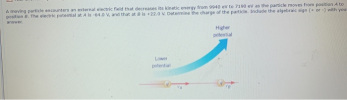 A moving partide encounters an external electric field that decreases its kinetic energy from 9940 eV to 7190 eV as the particle moves from position A to position B. The electric potential at A is -64.0 V, and that at B is +22.0 V. Determine the charge of the particle. Include the algebraic sign (+ or -) with you answer Higher potential Lower potential
Need help with the following 2 questions 4. Chapter 19 Problems 10 A moving particle encounters...
 Need help with the following 2 questions
4. Chapter 19 Problems 10 A moving particle encounters an external electric field that decreases its kinetic energy from 9520 eV to 7060 eV as the particle moves from position A to position B. The electric potential at Ais-55.0 V, and the electric potential at B is +27.0 V. Determine the charge of the particle. Include the algebraic sign +or-with your answer. 5. Chapter 19 Problems 26 Four identical charges (+2.00 /C each)...
Need help with the following 2 questions
4. Chapter 19 Problems 10 A moving particle encounters an external electric field that decreases its kinetic energy from 9520 eV to 7060 eV as the particle moves from position A to position B. The electric potential at Ais-55.0 V, and the electric potential at B is +27.0 V. Determine the charge of the particle. Include the algebraic sign +or-with your answer. 5. Chapter 19 Problems 26 Four identical charges (+2.00 /C each)...
I don't know why the answer is wrong, I got K(final) = 1.1072x10^-15 J and K(initial)...
 I don't know why the answer is
wrong, I got K(final) = 1.1072x10^-15 J and K(initial) =
1.4576x10^-15J, with the work energy theorm I got q=(Kf-Ki)/(Vi-Vf)
= +5.48x10^-18 C
Your answer is partially correct. Try again. A moving particle encounters an external electric field that decreases its kinetic energy from 9100 eV to 6990 eV as the particle moves from position A to position B. The electric potential at A is-41.0 V, and that at B is +23.0 V. Determine...
I don't know why the answer is
wrong, I got K(final) = 1.1072x10^-15 J and K(initial) =
1.4576x10^-15J, with the work energy theorm I got q=(Kf-Ki)/(Vi-Vf)
= +5.48x10^-18 C
Your answer is partially correct. Try again. A moving particle encounters an external electric field that decreases its kinetic energy from 9100 eV to 6990 eV as the particle moves from position A to position B. The electric potential at A is-41.0 V, and that at B is +23.0 V. Determine...
PRINTER VERSION BACK NEXT Question 4 Your answer is partially correct. Try again. Two particles are...
 PRINTER VERSION BACK NEXT Question 4 Your answer is partially correct. Try again. Two particles are fixed to an x axis: particle 1 of charge 91 = 2.47 x 10⁻⁸ C at x = 19.0 cm and particle 2 of charge 92 = -4.0091 at x = 78.0 cm. At what coordinate on the x axis is the electric field produced by the particles equal to zero? Number Units 3.70 cm the tolerance is +/-2% PRINTER VERSION BACK NE Question...
* Question 13 Your answer is partially correct. Try again. What is the magnitude of the...
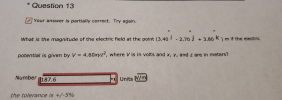 * Question 13 Your answer is partially correct. Try again. What is the magnitude of the electric field at the point (3.40 İ -2.70 j + 3.80 k ) mifthe electric potential is given by V 4.60xyz, where V is in volts and x, y, and z are in meters? Number 1187.6 the tolerance is +/-5%
Your answer is partially correct. Try again Identical +8.71 HC charges are fixed to adjacent corners...
 Your answer is partially correct. Try again Identical +8.71 HC charges are fixed to adjacent corners of a square. What charge (magnitude and algebraic sign) should be fixed to one of the empty corners, so that the total potential at the remaining empty corner is 0 V? NumberT-14.93 UnitsTC the tolerance is +/-3%
Problem 20.70 Your answer is partially correct. Try again. A proton moves with speed v in the +x ...
 Problem 20.70 Your answer is partially correct. Try again. A proton moves with speed v in the +x direction. In the lab (stationary) reference frame, what electric and magnetic fields would you observe a distance r above the proton (in the +y direction)? Electric field: (Use the following as necessary: q, ,, c, and r.) magnitude E Edit direction+Y Magnetic field: (Use the following as necessary: q,Ho, V, c, and r.) magnitude B Edit 兀 direction +z In a reference...
 A moving particle encounters an external electric field that decreases its kinetic energy from 9320 eV to 7530 eV as the particle moves from position A to position B. The electric potential at A is -57.0 V, and that at B is +21.0 V. Determine the charge of the particle. Include the algebraic sign (or - with your answer. Higher potential Lower potential VA
 10. MV-HINT A moving particle encounters an external electric field that decreases its kinetic energy from 9520 eV to 7060 eV as the particle moves from position A to position B. The electric potential at A is -55.0 V, and the electric potential at B is +27.0 V. Determine the charge of the particle. Include the algebraic sign (+ or -) with your answer.
 A moving partide encounters an external electric field that decreases its kinetic energy from 9940 eV to 7190 eV as the particle moves from position A to position B. The electric potential at A is -64.0 V, and that at B is +22.0 V. Determine the charge of the particle. Include the algebraic sign (+ or -) with you answer Higher potential Lower potential
 Need help with the following 2 questions
4. Chapter 19 Problems 10 A moving particle encounters an external electric field that decreases its kinetic energy from 9520 eV to 7060 eV as the particle moves from position A to position B. The electric potential at Ais-55.0 V, and the electric potential at B is +27.0 V. Determine the charge of the particle. Include the algebraic sign +or-with your answer. 5. Chapter 19 Problems 26 Four identical charges (+2.00 /C each)...
Need help with the following 2 questions
4. Chapter 19 Problems 10 A moving particle encounters an external electric field that decreases its kinetic energy from 9520 eV to 7060 eV as the particle moves from position A to position B. The electric potential at Ais-55.0 V, and the electric potential at B is +27.0 V. Determine the charge of the particle. Include the algebraic sign +or-with your answer. 5. Chapter 19 Problems 26 Four identical charges (+2.00 /C each)...
 I don't know why the answer is
wrong, I got K(final) = 1.1072x10^-15 J and K(initial) =
1.4576x10^-15J, with the work energy theorm I got q=(Kf-Ki)/(Vi-Vf)
= +5.48x10^-18 C
Your answer is partially correct. Try again. A moving particle encounters an external electric field that decreases its kinetic energy from 9100 eV to 6990 eV as the particle moves from position A to position B. The electric potential at A is-41.0 V, and that at B is +23.0 V. Determine...
I don't know why the answer is
wrong, I got K(final) = 1.1072x10^-15 J and K(initial) =
1.4576x10^-15J, with the work energy theorm I got q=(Kf-Ki)/(Vi-Vf)
= +5.48x10^-18 C
Your answer is partially correct. Try again. A moving particle encounters an external electric field that decreases its kinetic energy from 9100 eV to 6990 eV as the particle moves from position A to position B. The electric potential at A is-41.0 V, and that at B is +23.0 V. Determine...
 PRINTER VERSION BACK NEXT Question 4 Your answer is partially correct. Try again. Two particles are fixed to an x axis: particle 1 of charge 91 = 2.47 x 10⁻⁸ C at x = 19.0 cm and particle 2 of charge 92 = -4.0091 at x = 78.0 cm. At what coordinate on the x axis is the electric field produced by the particles equal to zero? Number Units 3.70 cm the tolerance is +/-2% PRINTER VERSION BACK NE Question...
 * Question 13 Your answer is partially correct. Try again. What is the magnitude of the electric field at the point (3.40 İ -2.70 j + 3.80 k ) mifthe electric potential is given by V 4.60xyz, where V is in volts and x, y, and z are in meters? Number 1187.6 the tolerance is +/-5%
 Your answer is partially correct. Try again Identical +8.71 HC charges are fixed to adjacent corners of a square. What charge (magnitude and algebraic sign) should be fixed to one of the empty corners, so that the total potential at the remaining empty corner is 0 V? NumberT-14.93 UnitsTC the tolerance is +/-3%
 Problem 20.70 Your answer is partially correct. Try again. A proton moves with speed v in the +x direction. In the lab (stationary) reference frame, what electric and magnetic fields would you observe a distance r above the proton (in the +y direction)? Electric field: (Use the following as necessary: q, ,, c, and r.) magnitude E Edit direction+Y Magnetic field: (Use the following as necessary: q,Ho, V, c, and r.) magnitude B Edit 兀 direction +z In a reference...
Most questions answered within 3 hours.
-
Where is the error in this code sequence?
String s1 = "Hello";
String s2 = "ello";...
asked 10 months ago -
Financial data for Joel de Paris, Inc., for last year
follow:
Joel de Paris, Inc.
Balance...
asked 10 months ago -
Consider this reaction:
Al2(SO4)3 (aq)+ BaCl3
(aq) Al2Cl6 (aq)- +
3BaSO4(s) . What is the...
asked 10 months ago -
Suppose that Savneet is considering increasing her
recent random sample from 20 car rentals to 40...
asked 10 months ago -
Trucks arrive at an unloading terminal at an average rate of 120
per hour.
Trucks arrive...
asked 10 months ago -
Why are methanol and ethanol completely soluble in water while
octanol is not very little soluble....
asked 10 months ago -
A facilities manager at a university reads in a research report
that the mean amount of...
asked 10 months ago -
When the CuSO4 is rehydrated by adding water to the anhydrous
compound, is this an endothermic...
asked 10 months ago -
A ray of sunlight is passing from diamond into crown glass; the
angle of incidence is...
asked 10 months ago -
A block of mass 0.249 kg is placed on top of a light, vertical
spring of...
asked 10 months ago -
how do the kidneys compensate in the presences of acidosis
a) trigger hyperventilate
b) reserve acid...
asked 10 months ago -
Question 501 pts
The rental rate of capital to the firm increases. Which of the
following...
asked 10 months ago