Part A Consider the situation in the figure below, where two charged rods are placed a...
Part A
Consider the situation in the figure below, where two charged rods are placed a distance d on either side of an aluminum can. What does the can do?
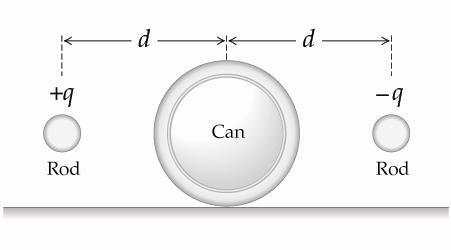
Consider the situation in the figure below, where two charged rods are placed a distance on either side of an aluminum can. What does the can do?
| Rolls to the right | |
| Rolls to the left | |
| Stays still |
SubmitHintsMy AnswersGive UpReview Part
Part B
Now, consider the situation shown in the figure below. What does the can do?
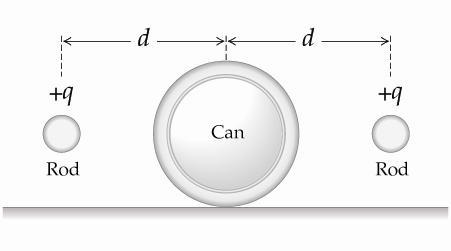
Now, consider the situation shown in the figure below. What does the can do?
| Rolls to the left | |
| Stays still | |
| Rolls to the right |
SubmitMy AnswersGive Up
Part C
Using the setup from the first question, imagine that you briefly touch the negatively charged rod to the can. You then hold the two rods at equal distances on either side of the can. What does the can do?
Using the setup from the first question, imagine that you briefly touch the negatively charged rod to the can. You then hold the two rods at equal distances on either side of the can. What does the can do?
| Rolls toward the positively charged rod | |
| Rolls away from the positively charged rod | |
| Does not move |
Homework Answers
The concepts required to solve this problem are the Coulomb’s law and the charging by induction.
Initially, find the charge induced on the can due to the charged rod present on the left side of the can. Then, determine the nature of the force present between can and the rod present on the left hand side of the can. Then, find the charge induced on the can due to the charged rod present on the right side of the can. Then, determine the nature of the force present between the can and the rod on the right side. Finally, find the net force on the can. Similarly follows the above step for part B. Finally, touch the negatively charged rod to the can so, that the can gets charged and then using type of charges, determine the electrostatic force between the can and the charges.
When an uncharged object is brought near to a charged object but not in contact, the uncharged object gets charged by induction from the charged object and this process of charging is known as charging by induction.
When an uncharged object is brought in contact with a charged object, the uncharged object gets charged by the transfer of electrons from the charged object and this process of the charging is known as charging by conduction.
The expression of the coulomb’s law is,
Here, F is the electrostatic force, and are the charges and d is the distance between these charges.
The electrostatic force between the like charges is repulsive in nature and the electrostatic force between the unlike charges is attractive in nature.
(A)
The charge on rod present on the left side of the can is q which is positive. Due to this positive charge, negative charge is induced on the left side of the can. So, the charge on the left side of the can is . Therefore, the electrostatic force is attractive in nature.
The force between the charge on the rod present left side of the can and the charge on the left side of the can is,
The charge on rod present on the right side of the can is which is negative. Due to this negative charge, positive charge is induced on the right side of the can. So, the charge on the right side of the can is . Therefore, the electrostatic force is attractive in nature.
The force between the charge on the rod present right side of the can and the charge on the left side of the can is,
The forces and are equal in magnitude but opposite in direction. So, the net force on the can is zero.
Thus, the can neither rolls to the left nor to the left. It remains still, does not move.
(B)
The charge on rod present on the left side of the can is q which is positive. Due to this positive charge, negative charge is induced on the left side of the can. So, the charge on the left side of the can is . Therefore, the electrostatic force is attractive in nature between them.
The force between the charge on the rod present left side of the can and the charge on the left side of the can is,
The charge on rod present on the right side of the can is which is positive. Due to this positive charge, negative charge is induced on the right side of the can. So, the charge on the right side of the can is . Therefore, the electrostatic force is attractive in nature.
The force between the charge on the rod present right side of the can and the charge on the left side of the can is,
The forces and are equal in magnitude but opposite in direction. So, the net force on the can is zero.
Thus, the can neither rolls to the left nor to the left. It remains still, does not move.
(C)
Refer the figure given in part A of the question.
A positive charged rod is present on the left side of the can and a negative charged rod is present on the right side of the can.
When a negatively charged rod is brought in contact with the can, the can gets negatively charged due to the contact with the negatively charged rod due to charging by conduction.
Now, the can is negatively charged. The can will be attracted to the positively charged rod present on the left side of the can and the can will be repulsive in nature to the negatively charged rod present on the right side of the can.
Thus, the can neither stays still nor move towards the negatively charged rod. The can will rolls toward the positively charged rod due to attractive force present between them.
Ans: Part AThe can stays still.
Add Answer to:
Part A
Consider the situation in the figure below, where two charged
rods are placed a...
Two 19 cm -long thin glass rods uniformly charged to +20nC are placed side by side,...
Two 19 cm -long thin glass rods uniformly charged to +20nC are placed side by side, 4.0 cm apart. What are the electric field strengths E1, E2, and E3 at distances 1.0 cm, 2.0 cm, and 3.0 cm to the right of the rod on the left, along the line connecting the midpoints of the two rods? (Can you please explain your reasoning for your steps if possible? thanks! :) ) Part A Specify the electric field strength E1. E1...
Two 16 cm -long thin glass rods uniformly charged to +18nC are placed side by side,...
Two 16 cm -long thin glass rods uniformly charged to +18nC are placed side by side, 4.0 cm apart. What are the electric field strengths E1, E2, and E3 at distances 1.0 cm, 2.0 cm, and 3.0 cm to the right of the rod on the left, along the line connecting the midpoints of the two rods?
Two 16 cm -long thin glass rods uniformly charged to +18nC are placed side by side,...
Two 16 cm -long thin glass rods uniformly charged to +18nC are placed side by side, 4.0 cm apart. What are the electric field strengths E1, E2, and E3 at distances 1.0 cm, 2.0 cm, and 3.0 cm to the right of the rod on the left, along the line connecting the midpoints of the two rods?
Two 10 cm -long thin glass rods uniformly charged to +10 nC are placed side by...
 Two 10 cm -long thin glass rods uniformly charged to +10 nC are placed side by side, 4.0 cm apart. What are the electric field strengths E1, E2, and Es at distances 1.0 cm, 2.0 cm, and 3.0 cm to the right of the rod on the left, along the line connecting the midpoints of the two rods?
Two 14 cm -long thin glass rods uniformly charged to +20nC are placed side by side,...
Two 14 cm -long thin glass rods uniformly charged to +20nC are placed side by side, 4.0 cm apart. What are the electric field strengths E1, E2, and E3 at distances 1.0 cm, 2.0 cm, and 3.0 cm to the right of the rod on the left, along the line connecting the midpoints of the two rods? Specify the electric field strength E1. Specify the electric field strength E2. Specify the electric field strength E3.
Two 18 cm -long thin glass rods uniformly charged to +18nC are placed side by side,...
Two 18 cm -long thin glass rods uniformly charged to +18nC are placed side by side, 4.0 cm apart. What are the electric field strengths E1, E2, and E3 at distances 1.0 cm, 2.0 cm, and 3.0 cm to the right of the rod on the left, along the line connecting the midpoints of the two rods? Part A Specify the electric field strength E1. Express your answer to two significant figures and include the appropriate units. Part B Specify...
Two 14 cm -long thin glass rods uniformly charged to +20nC are placed side by side,...
Two 14 cm -long thin glass rods uniformly charged to +20nC are placed side by side, 4.0 cm apart. What are the electric field strengths E1, E2, and E3 at distances 1.0 cm, 2.0 cm, and 3.0 cm to the right of the rod on the left, along the line connecting the midpoints of the two rods? Specify the electric field strength E1. (The answer is NOT 1.7 x 10^5 N/C) Specify the electric field strength E2. Specify the electric...
Please explain. Part A The figure below (from the textbook) shows a negatively charged plastic rod approaching...
 Please explain.
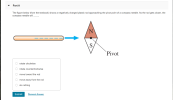
Part A The figure below (from the textbook) shows a negatively charged plastic rod approaching the pivot point of a compass needle. As the rod gets closer, the compass needle will _______rotate clockwise rotate counterclockwise move toward the rod move away from the rod do nothing
Please explain.
Part A The figure below (from the textbook) shows a negatively charged plastic rod approaching the pivot point of a compass needle. As the rod gets closer, the compass needle will _______rotate clockwise rotate counterclockwise move toward the rod move away from the rod do nothing
Problem 23.10 Two 11 cm -long thin glass rods uniformly charged to +10nC are placed side...
 Problem 23.10 Two 11 cm -long thin glass rods uniformly charged to +10nC are placed side by side, 4.0 cm apart. What are the electric field strengths E1, E2, and E3 at distances 1.0 cm, 2.0 cm, and 3.0 cm to the right of the rod on the left, along the line connecting the midpoints of the two rods? Part A Specify the electric field strength E1 Express your answer to two significant figures and include the appropriate units. E...
Q4. The figure below shows two negatively charged objects (with the same charge) and one positively...
 Q4. The figure below shows two negatively charged objects (with the same charge) and one positively charged object. What is the direction of the net electric force on the positively charged object? A. Horizontal to the Left B. Horizontal to the Right C. Force is zero D. None of the above
 Two 10 cm -long thin glass rods uniformly charged to +10 nC are placed side by side, 4.0 cm apart. What are the electric field strengths E1, E2, and Es at distances 1.0 cm, 2.0 cm, and 3.0 cm to the right of the rod on the left, along the line connecting the midpoints of the two rods?
 Please explain.
Part A The figure below (from the textbook) shows a negatively charged plastic rod approaching the pivot point of a compass needle. As the rod gets closer, the compass needle will _______rotate clockwise rotate counterclockwise move toward the rod move away from the rod do nothing
Please explain.
Part A The figure below (from the textbook) shows a negatively charged plastic rod approaching the pivot point of a compass needle. As the rod gets closer, the compass needle will _______rotate clockwise rotate counterclockwise move toward the rod move away from the rod do nothing
 Problem 23.10 Two 11 cm -long thin glass rods uniformly charged to +10nC are placed side by side, 4.0 cm apart. What are the electric field strengths E1, E2, and E3 at distances 1.0 cm, 2.0 cm, and 3.0 cm to the right of the rod on the left, along the line connecting the midpoints of the two rods? Part A Specify the electric field strength E1 Express your answer to two significant figures and include the appropriate units. E...
 Q4. The figure below shows two negatively charged objects (with the same charge) and one positively charged object. What is the direction of the net electric force on the positively charged object? A. Horizontal to the Left B. Horizontal to the Right C. Force is zero D. None of the above
Most questions answered within 3 hours.
-
Where is the error in this code sequence?
String s1 = "Hello";
String s2 = "ello";...
asked 10 months ago -
Financial data for Joel de Paris, Inc., for last year
follow:
Joel de Paris, Inc.
Balance...
asked 10 months ago -
Consider this reaction:
Al2(SO4)3 (aq)+ BaCl3
(aq) Al2Cl6 (aq)- +
3BaSO4(s) . What is the...
asked 10 months ago -
Suppose that Savneet is considering increasing her
recent random sample from 20 car rentals to 40...
asked 10 months ago -
Trucks arrive at an unloading terminal at an average rate of 120
per hour.
Trucks arrive...
asked 10 months ago -
Why are methanol and ethanol completely soluble in water while
octanol is not very little soluble....
asked 10 months ago -
A facilities manager at a university reads in a research report
that the mean amount of...
asked 10 months ago -
When the CuSO4 is rehydrated by adding water to the anhydrous
compound, is this an endothermic...
asked 10 months ago -
A ray of sunlight is passing from diamond into crown glass; the
angle of incidence is...
asked 10 months ago -
A block of mass 0.249 kg is placed on top of a light, vertical
spring of...
asked 10 months ago -
how do the kidneys compensate in the presences of acidosis
a) trigger hyperventilate
b) reserve acid...
asked 10 months ago -
Question 501 pts
The rental rate of capital to the firm increases. Which of the
following...
asked 10 months ago