(Figure 1) Consider three plastic balls (A, B, and C), each carrying a uniformly distributed charge...
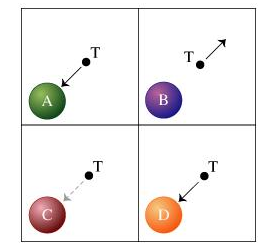
(Figure 1) Consider three plastic balls (A, B, and C), each carrying a uniformly distributed charge equal to either +Q, -Q or zero, and an uncharged (neutral) copper ball (D). A positive test charge (T) experiences the forces shown in the figure when brought very near to the individual balls. The test charge T is strongly attracted to A, strongly repelled from B, weakly attracted to C, and strongly attracted to D.
| strongly attractive | |
| strongly repulsive | |
| weakly attractive | |
| neither attractive nor repulsive |
Homework Answers
The concept required to solve the given problem is nature of electrostatic force between two charges.
Find out the nature of force between balls A and B by identifying the sign of each charge with the help of nature of force on test charge due to these two charges individually.
Properties of Coulomb force between two charges: Two unlike charges attract each other whereas two like charges repel each other.
According to Coulomb’s law, the magnitude of electrostatic force between two charges is given as follows:
Here, q1 and q2 are charges, is the permittivity of free space, and r is the distance between the charges.
According to the properties of Coulomb force, two unlike charges attract each other, while two like charges repel each other.
As the positive test charge T is strongly attracted to A, therefore, the charge on the ball A is negative.
As the positive test charge T is strongly repelled by B, therefore, Ball B must be positive, since two like charges repel each other.
The charges on the ball A is negative while charges on the ball is positive. As opposite charges attract each other, while two like charges repel each other, therefore, the interaction between negative ball A and very positive ball B is strongly attractive. Hence, the nature of force between balls A and B is strongly attractive.
Ans:The nature of the force between ball A and ball B is strongly attractive.
Add Answer to:
(Figure 1) Consider three plastic balls (A, B, and C), each
carrying a uniformly distributed charge...
(Figure 1)Consider three plastic balls (A, B, and C), each carrying a uniformly distributed charge equal...
 (Figure 1)Consider three plastic balls (A, B, and C), each
carrying a uniformly distributed charge equal to either +Q, -Q or
zero, and an uncharged copper ball (D). A positive test charge (T)
experiences the forces shown in the figure when brought very near
to the individual balls. The test charge T is strongly attracted to
A, strongly repelled from B, weakly attracted to C, and strongly
attracted to D. Assume throughout this problem that the balls are
brought very...
(Figure 1)Consider three plastic balls (A, B, and C), each
carrying a uniformly distributed charge equal to either +Q, -Q or
zero, and an uncharged copper ball (D). A positive test charge (T)
experiences the forces shown in the figure when brought very near
to the individual balls. The test charge T is strongly attracted to
A, strongly repelled from B, weakly attracted to C, and strongly
attracted to D. Assume throughout this problem that the balls are
brought very...
To understand the electric force between charged and uncharged conductors and insulators. When a test charge...
 To understand the electric force between charged and uncharged conductors and insulators. When a test charge is brought near a charged object, we know from Coulomb's law that it will experience a net force (either attractive or repulsive, depending on the nature of the object's charge). A test charge may also experience an electric force when brought near a neutral object. Any attraction of a neutral insulator or neutral conductor to a test charge must occur through induced polarization. In...
This problem explores the behavior of charge on realistic (i.e. non-ideal) insulators. We take as an...
 This problem explores the behavior of
charge on realistic (i.e. non-ideal) insulators. We take as an
example a long insulating rod suspended by insulating wires. Assume
that the rod is initially electrically neutral. For convenience, we
will refer to the left end of the rod as end A, and the right end
of the rod as end B. In the answer options for this problem,
"weakly attracted/repelled" means "attracted/repelled with a force
of magnitude similar to that which would exist...
This problem explores the behavior of
charge on realistic (i.e. non-ideal) insulators. We take as an
example a long insulating rod suspended by insulating wires. Assume
that the rod is initially electrically neutral. For convenience, we
will refer to the left end of the rod as end A, and the right end
of the rod as end B. In the answer options for this problem,
"weakly attracted/repelled" means "attracted/repelled with a force
of magnitude similar to that which would exist...
What is the nature of the force between balls A and C? What is the nature...
 What is the nature of the force between balls A and C?
strongly attractive
strongly repulsive
weakly attractive
neither attractive nor repulsive
What is the nature of the force between balls A and C?
What is the nature of the force between balls A and C?
strongly attractive
strongly repulsive
weakly attractive
neither attractive nor repulsive
A long insulating rod suspended by insulating wires.Assume that the rod is initially electrically neutral. Forconvenience,...
A long insulating rod suspended by insulating wires.Assume that the rod is initially electrically neutral. Forconvenience, we will refer to the left end of the rod as end A, andthe right end of the rod as end B . In the answer options for thisproblem, "weakly attracted/repelled" means "attracted/repelled witha force of magnitude similar to that which would exist between twoballs, one of which is charged, and the other acquires a smallinduced charge". An attractive/repulsive force greater than thisshould be...
In the figure below, a point charge q is brought near a neutral conducting sphere. Is...
 In the figure below, a point charge q is brought near a neutral
conducting sphere. Is the force of between the sphere and the
charge:
A. Zero
B. Attractive
C. Repulsive
D. Out of the page
E. Into the page
DU A. (5 pts) table abovell! In the figure belov, a point charge q is brought near a neutral conducting sphere. Is the force of between the sphere and the charge: ro B. Attractive C. Repulsive D. Out of the...
In the figure below, a point charge q is brought near a neutral
conducting sphere. Is the force of between the sphere and the
charge:
A. Zero
B. Attractive
C. Repulsive
D. Out of the page
E. Into the page
DU A. (5 pts) table abovell! In the figure belov, a point charge q is brought near a neutral conducting sphere. Is the force of between the sphere and the charge: ro B. Attractive C. Repulsive D. Out of the...
Attemptsr Question 1 Balls 1, 2, 3, and 4 are hanging by strings. A plastic rod,...
 Attemptsr Question 1 Balls 1, 2, 3, and 4 are hanging by strings. A plastic rod, which has been rubbed with wool, is used to touch Ball 1 1. When the balls are brought near each other, but not touching, the Ball 2 is attracted to ball 3 Balls 2 and 4 do not affect one another Balls 2, 3, and 4 are attracted to ball 1 What is ball I's charge state? O Glass O Plastic O Neutral Question...
1. a.) An object carries a charge of -6.1 µC, while another carries a charge of...
 1.
a.) An object carries a charge of -6.1 µC, while
another carries a charge of -2.0 µC. How many electrons
must be transferred from the first to the second object so that
both objects have the same charge?
b.) Suppose a thin conducting wire connects two conducting
spheres. A negatively charged rod is brought near one of the
spheres, the wire between them is cut, and the charged rod is taken
away. Which one of the following is true?...
1.
a.) An object carries a charge of -6.1 µC, while
another carries a charge of -2.0 µC. How many electrons
must be transferred from the first to the second object so that
both objects have the same charge?
b.) Suppose a thin conducting wire connects two conducting
spheres. A negatively charged rod is brought near one of the
spheres, the wire between them is cut, and the charged rod is taken
away. Which one of the following is true?...
Problem 19.86 9 of 10> Review Two small plastic balls hang from threads of negligible mass....
 Problem 19.86 9 of 10> Review Two small plastic balls hang from threads of negligible mass. Each ball has a mass of 0.230 g and a charge of magnitude q. The balls are attracted to each other, and the threads attached to the balls make an angle of 20.0 with the vertical, as shown in the figure.(Figure 1) Part A Find the magnitude of the electric force acting on each ball. Figure 1 of 1 Submit t An Part B...
 (Figure 1)Consider three plastic balls (A, B, and C), each
carrying a uniformly distributed charge equal to either +Q, -Q or
zero, and an uncharged copper ball (D). A positive test charge (T)
experiences the forces shown in the figure when brought very near
to the individual balls. The test charge T is strongly attracted to
A, strongly repelled from B, weakly attracted to C, and strongly
attracted to D. Assume throughout this problem that the balls are
brought very...
(Figure 1)Consider three plastic balls (A, B, and C), each
carrying a uniformly distributed charge equal to either +Q, -Q or
zero, and an uncharged copper ball (D). A positive test charge (T)
experiences the forces shown in the figure when brought very near
to the individual balls. The test charge T is strongly attracted to
A, strongly repelled from B, weakly attracted to C, and strongly
attracted to D. Assume throughout this problem that the balls are
brought very...
 To understand the electric force between charged and uncharged conductors and insulators. When a test charge is brought near a charged object, we know from Coulomb's law that it will experience a net force (either attractive or repulsive, depending on the nature of the object's charge). A test charge may also experience an electric force when brought near a neutral object. Any attraction of a neutral insulator or neutral conductor to a test charge must occur through induced polarization. In...
 This problem explores the behavior of
charge on realistic (i.e. non-ideal) insulators. We take as an
example a long insulating rod suspended by insulating wires. Assume
that the rod is initially electrically neutral. For convenience, we
will refer to the left end of the rod as end A, and the right end
of the rod as end B. In the answer options for this problem,
"weakly attracted/repelled" means "attracted/repelled with a force
of magnitude similar to that which would exist...
This problem explores the behavior of
charge on realistic (i.e. non-ideal) insulators. We take as an
example a long insulating rod suspended by insulating wires. Assume
that the rod is initially electrically neutral. For convenience, we
will refer to the left end of the rod as end A, and the right end
of the rod as end B. In the answer options for this problem,
"weakly attracted/repelled" means "attracted/repelled with a force
of magnitude similar to that which would exist...
 What is the nature of the force between balls A and C?
strongly attractive
strongly repulsive
weakly attractive
neither attractive nor repulsive
What is the nature of the force between balls A and C?
What is the nature of the force between balls A and C?
strongly attractive
strongly repulsive
weakly attractive
neither attractive nor repulsive
 In the figure below, a point charge q is brought near a neutral
conducting sphere. Is the force of between the sphere and the
charge:
A. Zero
B. Attractive
C. Repulsive
D. Out of the page
E. Into the page
DU A. (5 pts) table abovell! In the figure belov, a point charge q is brought near a neutral conducting sphere. Is the force of between the sphere and the charge: ro B. Attractive C. Repulsive D. Out of the...
In the figure below, a point charge q is brought near a neutral
conducting sphere. Is the force of between the sphere and the
charge:
A. Zero
B. Attractive
C. Repulsive
D. Out of the page
E. Into the page
DU A. (5 pts) table abovell! In the figure belov, a point charge q is brought near a neutral conducting sphere. Is the force of between the sphere and the charge: ro B. Attractive C. Repulsive D. Out of the...
 Attemptsr Question 1 Balls 1, 2, 3, and 4 are hanging by strings. A plastic rod, which has been rubbed with wool, is used to touch Ball 1 1. When the balls are brought near each other, but not touching, the Ball 2 is attracted to ball 3 Balls 2 and 4 do not affect one another Balls 2, 3, and 4 are attracted to ball 1 What is ball I's charge state? O Glass O Plastic O Neutral Question...
 1.
a.) An object carries a charge of -6.1 µC, while
another carries a charge of -2.0 µC. How many electrons
must be transferred from the first to the second object so that
both objects have the same charge?
b.) Suppose a thin conducting wire connects two conducting
spheres. A negatively charged rod is brought near one of the
spheres, the wire between them is cut, and the charged rod is taken
away. Which one of the following is true?...
1.
a.) An object carries a charge of -6.1 µC, while
another carries a charge of -2.0 µC. How many electrons
must be transferred from the first to the second object so that
both objects have the same charge?
b.) Suppose a thin conducting wire connects two conducting
spheres. A negatively charged rod is brought near one of the
spheres, the wire between them is cut, and the charged rod is taken
away. Which one of the following is true?...
 Problem 19.86 9 of 10> Review Two small plastic balls hang from threads of negligible mass. Each ball has a mass of 0.230 g and a charge of magnitude q. The balls are attracted to each other, and the threads attached to the balls make an angle of 20.0 with the vertical, as shown in the figure.(Figure 1) Part A Find the magnitude of the electric force acting on each ball. Figure 1 of 1 Submit t An Part B...
Most questions answered within 3 hours.
-
Where is the error in this code sequence?
String s1 = "Hello";
String s2 = "ello";...
asked 10 months ago -
Financial data for Joel de Paris, Inc., for last year
follow:
Joel de Paris, Inc.
Balance...
asked 10 months ago -
Consider this reaction:
Al2(SO4)3 (aq)+ BaCl3
(aq) Al2Cl6 (aq)- +
3BaSO4(s) . What is the...
asked 10 months ago -
Suppose that Savneet is considering increasing her
recent random sample from 20 car rentals to 40...
asked 10 months ago -
Trucks arrive at an unloading terminal at an average rate of 120
per hour.
Trucks arrive...
asked 10 months ago -
Why are methanol and ethanol completely soluble in water while
octanol is not very little soluble....
asked 10 months ago -
A facilities manager at a university reads in a research report
that the mean amount of...
asked 10 months ago -
When the CuSO4 is rehydrated by adding water to the anhydrous
compound, is this an endothermic...
asked 10 months ago -
A ray of sunlight is passing from diamond into crown glass; the
angle of incidence is...
asked 10 months ago -
A block of mass 0.249 kg is placed on top of a light, vertical
spring of...
asked 10 months ago -
how do the kidneys compensate in the presences of acidosis
a) trigger hyperventilate
b) reserve acid...
asked 10 months ago -
Question 501 pts
The rental rate of capital to the firm increases. Which of the
following...
asked 10 months ago