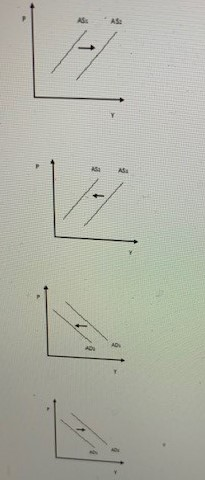
which one illustrates an increase in aggregate supply ? and which one illustrates an increase in aggregate demand?
Homework Answers
Answer
graph 1 shows an increase in aggregate supply
The graph shows price on the vertical axis and the Y(output) on the
horizontal axis
A right shift in the AS curve increases the output supplied at each
level of prices, so the increase in AS is shown by graph 1 where
the AS shifts to the right
------------
graph 4 shows an increase in aggregate demand
the shift of AD curve to right shows the output aggregate demand is
increased at all level of prices as the horizontal axis values
increases at the given price levels.
Add Answer to:
which one illustrates an increase in aggregate supply ? and which one illustrates an increase in...
Which one of the following would cause an increase in the aggregate supply?
QUESTIN 18 Which one of the following would cause an increase in the aggregate supply? a. insecurity about jobs and future income. b. improvements in economic conditions in other countries. C. a decrease in labor supplied d. new discoveries of raw materials QUESTIN 19 Which one of the following statements is correct? I. A drop in the foreign exchange value of the dollar would increase aggregate demand II. A decrease in the amount of money in circulation would increase aggregate demand a. I only b. Il only c. Both I and II d....
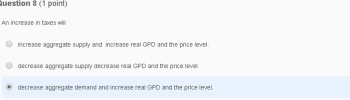
which is right uestion 8 (1 point) An increase in taxes will increase aggregate supply and...
 which is right
uestion 8 (1 point) An increase in taxes will increase aggregate supply and increase real GPD and the price level. O decrease aggregate supply decrease real GPD and the price level. decrease aggregate demand and increase real GPD and the price level.
which is right
uestion 8 (1 point) An increase in taxes will increase aggregate supply and increase real GPD and the price level. O decrease aggregate supply decrease real GPD and the price level. decrease aggregate demand and increase real GPD and the price level.
Which of the following would cause stagflation? Select one: a. aggregate supply shifts right b. aggregate demand shifts...
 Which of the following would cause stagflation? Select one: a. aggregate supply shifts right b. aggregate demand shifts left c. aggregate supply shifts left d. aggregate demand shifts right
A decline in U.S. wealth would tend to cause: a. long-run aggregate supply to increase. b....
A decline in U.S. wealth would tend to cause: a. long-run aggregate supply to increase. b. short-run aggregate supply to increase. c. aggregate demand to decrease. d. long-run aggregate supply to decrease. e. aggregate demand to increase.
Other things equal, an increase in productivity will: 1) reduce aggregate supply and increase real output....
 Other things equal, an increase in productivity will: 1) reduce aggregate supply and increase real output. 2) reduce both the interest rate and the international value of the dollar. 3) increase both aggregate supply and real output. 4) increase net exports, increase investment, and reduce aggregate demand.
In the AD–AS diagram, an increase in money supply growth causes: a shift of the aggregate...
In the AD–AS diagram, an increase in money supply growth causes: a shift of the aggregate demand curve to the left. a shift of the aggregate demand curve to the right. a downward movement along the aggregate demand curve. an upward movement along the aggregate demand curve.
Which of the following will increase both the short-run and long-run aggregate supply curves? A. There...
Which of the following will increase both the short-run and long-run aggregate supply curves? A. There are fewer firms involved in perfectly competitive and monopolistically competitive market structures as the economy features more oligopolies than before. B. The wage rate temporarily decreases throughout the economy. C. Younger workers in the labour force receive better and more training than their predecessors. D. The supply of key raw materials, such as petroleum and bauxite, is reduced. Which of the following is true...
1.Appreciation of the domestic currency will a. increase domestic aggregate demand. b. decrease domestic aggregate supply....
1.Appreciation of the domestic currency will a. increase domestic aggregate demand. b. decrease domestic aggregate supply. c. decrease domestic aggregate demand, and possibly increase domestic aggregate supply. d. cause a deterioration in the trade balance, but have no effect on aggregate supply or demand. 2.In the current exchange rate arrangements of IMF members, a. a substantial number of countries do not have a freely floating exchange rate. b. the European Union countries fix their exchange rates against the US dollar....
In the basic aggregate demand and aggregate supply model, which of the following would cause deflation?...
In the basic aggregate demand and aggregate supply model, which of the following would cause deflation? An increase in A. government purchases B. oil prices C. the expected future price level D. income taxes
If the Fed's policies aim to increase aggregate demand, the Fed must fear A. a supply...
If the Fed's policies aim to increase aggregate demand, the Fed must fear A. a supply shock that increases aggregate supply. B. a supply shock that decreases potential GDP. C. stagflation. D. recession. E. inflation.
 which is right
uestion 8 (1 point) An increase in taxes will increase aggregate supply and increase real GPD and the price level. O decrease aggregate supply decrease real GPD and the price level. decrease aggregate demand and increase real GPD and the price level.
which is right
uestion 8 (1 point) An increase in taxes will increase aggregate supply and increase real GPD and the price level. O decrease aggregate supply decrease real GPD and the price level. decrease aggregate demand and increase real GPD and the price level.
 Which of the following would cause stagflation? Select one: a. aggregate supply shifts right b. aggregate demand shifts left c. aggregate supply shifts left d. aggregate demand shifts right
 Other things equal, an increase in productivity will: 1) reduce aggregate supply and increase real output. 2) reduce both the interest rate and the international value of the dollar. 3) increase both aggregate supply and real output. 4) increase net exports, increase investment, and reduce aggregate demand.
Most questions answered within 3 hours.
-
Where is the error in this code sequence?
String s1 = "Hello";
String s2 = "ello";...
asked 10 months ago -
Financial data for Joel de Paris, Inc., for last year
follow:
Joel de Paris, Inc.
Balance...
asked 10 months ago -
Consider this reaction:
Al2(SO4)3 (aq)+ BaCl3
(aq) Al2Cl6 (aq)- +
3BaSO4(s) . What is the...
asked 10 months ago -
Suppose that Savneet is considering increasing her
recent random sample from 20 car rentals to 40...
asked 10 months ago -
Trucks arrive at an unloading terminal at an average rate of 120
per hour.
Trucks arrive...
asked 10 months ago -
Why are methanol and ethanol completely soluble in water while
octanol is not very little soluble....
asked 10 months ago -
A facilities manager at a university reads in a research report
that the mean amount of...
asked 10 months ago -
When the CuSO4 is rehydrated by adding water to the anhydrous
compound, is this an endothermic...
asked 10 months ago -
A ray of sunlight is passing from diamond into crown glass; the
angle of incidence is...
asked 10 months ago -
A block of mass 0.249 kg is placed on top of a light, vertical
spring of...
asked 10 months ago -
how do the kidneys compensate in the presences of acidosis
a) trigger hyperventilate
b) reserve acid...
asked 10 months ago -
Question 501 pts
The rental rate of capital to the firm increases. Which of the
following...
asked 10 months ago