
Homework Answers
Ans) without changing the combined.......... More CDs and less DVDs
Marginal utility of CDs per dollar = 180/16 = 11.25
Marginal utility of DVDs per dollar = 212/22 = 9.64
Since marginal utility of CDs per dollar exceeds marginal utility of DVDs per dollar so more CDs and less DVDs should be consumed.
Add Answer to:
Assume the price of CDs is $16 and the price of DVDs is $22. At those...
The price of DVDs (D) is $20 and the price of CDs (C) is $10. Philip...
The price of DVDs (D) is $20 and the price of CDs (C) is $10. Philip has a budget of $100 to spend on the two goods. Suppose he has already bought one DVD and one CD. In addition, there are 3 more DVDs and 5 more CDs he would like to buy. a. Given the above prices and income, draw his budget line on a graph with CDs on the horizontal axis and correctly identify where is current market...
(1 point) A store sells CDs at one price and DVDs at another price. The figure...
 (1 point) A store sells CDs at one price and DVDs at another price. The figure below shows the revenue in dollars) of the music store as a function of the number, c, of CDs and the number, d, of DVDs that it sells. The values of the revenue are shown on each line. BODO 10ne-- (Hint: for this problem there are many possible ways to estimate the requisite values, you should be able to find information from the figure...
CDs (per month) 0 2 4 6 8 10 12 Magazines (per month) 16) The above...
 CDs (per month) 0 2 4 6 8 10 12 Magazines (per month) 16) The above figure gives your budget line between CDs and magazines. Which combination of CDs and magazines is NOT affordable? A) combination a B) combination b C) combinationc D) both combinations b and d Quantity of Y Quantity of Y Quantity of X Figure A Quantity of X Figure B Quantity of Y Quantity of Y Quantity of Figure C Quantity of Figure D 17) Consider...
Jill gets a total utility of 22 from consuming her first 4 pieces of pizza. When...
Jill gets a total utility of 22 from consuming her first 4 pieces of pizza. When she consumes 5 pieces of pizza she gets a total utility of 25. What is the marginal utility of the fifth piece of pizza consumed?
Assume that Clark spends his entire income on the purchase of two goods, X and Y....
Assume that Clark spends his entire income on the purchase of two goods, X and Y. If his income and the prices of good X and Y all double, Clark will double the purchase of goods X and Y buy more of good X and less of good Y buy less of good X and more of good Y buy less of both goods X and Y buy the same amounts of goods X and Y According to the law...
16. Marginal utility refers to a. the total satisfaction derived from all the units of the...
 16. Marginal utility refers to a. the total satisfaction derived from all the units of the product consumed. b. the satisfaction that an individual receives from consuming a product. c. the change in satisfaction resulting from consuming one more unit or one less unit of the product. d. the dissatisfaction that is derived from not using an additional unit of the product 17. For a given market price, Jane can increase her total utility by adding to her purchases of...
Marginal utility refers to 16. a. the total satisfaction derived from all the units of the...
 Marginal utility refers to 16. a. the total satisfaction derived from all the units of the product consumed. b. the satisfaction that an individual receives from consuming a product. c. the change in satisfaction resulting from consuming one more unit or one less unit of the product. the dissatisfaction that is derived from not using an additional unit of the product. d. 17. For a given market price, Jane can increase her total utility by adding to her purchases of...
this is a microeconomics question Question 9: What two conditions are met when a consumer in...
 this is a microeconomics question
Question 9: What two conditions are met when a consumer in maximizing utility? Question 10: Sally consumes only two goods, shoes and "everything else”. For five different shopping trips (each with different prices), the prices and Sally's marginal utilities are shown below. Shoes Everything Else MU Prices ($) MU Prices ($) Trip 1 125 250 50 100 Trip 2 100 200 50 100 Trip 3 75 150 50 100 Trip 4 50 100 50 100...
this is a microeconomics question
Question 9: What two conditions are met when a consumer in maximizing utility? Question 10: Sally consumes only two goods, shoes and "everything else”. For five different shopping trips (each with different prices), the prices and Sally's marginal utilities are shown below. Shoes Everything Else MU Prices ($) MU Prices ($) Trip 1 125 250 50 100 Trip 2 100 200 50 100 Trip 3 75 150 50 100 Trip 4 50 100 50 100...
22- Consider the figures to the right. Suppose that the individual currently consumes 4 digital apps....
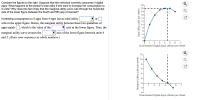 22- Consider the figures to the right. Suppose that the individual currently consumes 4 digital apps. What happens to the person's total utility if she were to increase her consumption to 5 units? Why does this fact imply that the marginal utility curve cuts through the horizontal axis of the lower figure between the fourth and fifth app consumed? 20- O 18- 16-1 at 14- 12- Increasing consumption to 5 apps from 4 apps leaves total utility utils in the...
Suppose Basil is maximizing his utility from consuming tea and crumpets. If the marginal utility of...
Suppose Basil is maximizing his utility from consuming tea and crumpets. If the marginal utility of the last cup of tea was 24 units of utility and that of his last crumpet was 6 units of utility, which of the following is true? The price of tea is six times the price of crumpets The price of crumpets is four times the price of tea The price of tea and crumpets are equal The price of tea is four times...
 (1 point) A store sells CDs at one price and DVDs at another price. The figure below shows the revenue in dollars) of the music store as a function of the number, c, of CDs and the number, d, of DVDs that it sells. The values of the revenue are shown on each line. BODO 10ne-- (Hint: for this problem there are many possible ways to estimate the requisite values, you should be able to find information from the figure...
 CDs (per month) 0 2 4 6 8 10 12 Magazines (per month) 16) The above figure gives your budget line between CDs and magazines. Which combination of CDs and magazines is NOT affordable? A) combination a B) combination b C) combinationc D) both combinations b and d Quantity of Y Quantity of Y Quantity of X Figure A Quantity of X Figure B Quantity of Y Quantity of Y Quantity of Figure C Quantity of Figure D 17) Consider...
 16. Marginal utility refers to a. the total satisfaction derived from all the units of the product consumed. b. the satisfaction that an individual receives from consuming a product. c. the change in satisfaction resulting from consuming one more unit or one less unit of the product. d. the dissatisfaction that is derived from not using an additional unit of the product 17. For a given market price, Jane can increase her total utility by adding to her purchases of...
 Marginal utility refers to 16. a. the total satisfaction derived from all the units of the product consumed. b. the satisfaction that an individual receives from consuming a product. c. the change in satisfaction resulting from consuming one more unit or one less unit of the product. the dissatisfaction that is derived from not using an additional unit of the product. d. 17. For a given market price, Jane can increase her total utility by adding to her purchases of...
 this is a microeconomics question
Question 9: What two conditions are met when a consumer in maximizing utility? Question 10: Sally consumes only two goods, shoes and "everything else”. For five different shopping trips (each with different prices), the prices and Sally's marginal utilities are shown below. Shoes Everything Else MU Prices ($) MU Prices ($) Trip 1 125 250 50 100 Trip 2 100 200 50 100 Trip 3 75 150 50 100 Trip 4 50 100 50 100...
this is a microeconomics question
Question 9: What two conditions are met when a consumer in maximizing utility? Question 10: Sally consumes only two goods, shoes and "everything else”. For five different shopping trips (each with different prices), the prices and Sally's marginal utilities are shown below. Shoes Everything Else MU Prices ($) MU Prices ($) Trip 1 125 250 50 100 Trip 2 100 200 50 100 Trip 3 75 150 50 100 Trip 4 50 100 50 100...
 22- Consider the figures to the right. Suppose that the individual currently consumes 4 digital apps. What happens to the person's total utility if she were to increase her consumption to 5 units? Why does this fact imply that the marginal utility curve cuts through the horizontal axis of the lower figure between the fourth and fifth app consumed? 20- O 18- 16-1 at 14- 12- Increasing consumption to 5 apps from 4 apps leaves total utility utils in the...
Most questions answered within 3 hours.
-
Where is the error in this code sequence?
String s1 = "Hello";
String s2 = "ello";...
asked 11 months ago -
Financial data for Joel de Paris, Inc., for last year
follow:
Joel de Paris, Inc.
Balance...
asked 11 months ago -
Consider this reaction:
Al2(SO4)3 (aq)+ BaCl3
(aq) Al2Cl6 (aq)- +
3BaSO4(s) . What is the...
asked 11 months ago -
Suppose that Savneet is considering increasing her
recent random sample from 20 car rentals to 40...
asked 11 months ago -
Trucks arrive at an unloading terminal at an average rate of 120
per hour.
Trucks arrive...
asked 11 months ago -
Why are methanol and ethanol completely soluble in water while
octanol is not very little soluble....
asked 11 months ago -
A facilities manager at a university reads in a research report
that the mean amount of...
asked 11 months ago -
When the CuSO4 is rehydrated by adding water to the anhydrous
compound, is this an endothermic...
asked 11 months ago -
A ray of sunlight is passing from diamond into crown glass; the
angle of incidence is...
asked 11 months ago -
A block of mass 0.249 kg is placed on top of a light, vertical
spring of...
asked 11 months ago -
how do the kidneys compensate in the presences of acidosis
a) trigger hyperventilate
b) reserve acid...
asked 11 months ago -
Question 501 pts
The rental rate of capital to the firm increases. Which of the
following...
asked 11 months ago