
Homework Answers
Mohr method involves the titration of chloride ion solution with silver nitrate solution in the presence of potassium chromate as indicator, which gives a red silver chromate as end point.
AgNO3 + Cl- AgCl
AgCl
First silver cations reacts with chloride ions present in the solution to form precipitate of silver chloride. When all chloride ions are precipitated, the excess silver ions forms silver chromate complex which is red in colour and it signifies the endpoint.
In volhard's method chloride ion solution is titrated against silver nitrate in the presenxe of free nitric acid with potassium thiocyanide or ammonium thiocyanide solution, iron(III)nitrate or iron (III)sulphate is used as indicator which gives red colour as a end point.
Here in this titration excess of silver nitrate is added to chloride solution and then after silver chloride precipitated the excess remaining amount which is left is determined by back titrating with potassium thiocyanide.
Ag+ + SCN-AgSCN
Fe3+ + SCN-(
FeSCN )2+
As silver thiocyanide is a less soluble salt hence thiocyanide ions may react with silver chloride and determination of chloride ions becomes difficult.
AgCl + SCN-
AgSCN + Cl-
So to reduce the reaction of thiocyanide with silver chloride we will add nitro benzene, so that it coats the AgCl precipitate and remaining excess silver nitrated can be easily determined.
To standardize silver nitrate which is a secondary standard we will use sodium chloride as primary standard.
Add Answer to:
the difference between the Mole method and Vol d a heimation of the chloride ions in...
046. 0.12 g of sample containing chloride ions requires 20 mls of O.IM KSCN when 25...
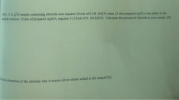 046. 0.12 g of sample containing chloride ions requires 20 mls of O.IM KSCN when 25 mis prepared AgNO, was added to the Sample solution. 25mls of prepared AgNO, requires 31.25mls of 0. IM KSCN. Calculate the percent of chloride in your sample. [8] In the estimation of the chlo on of the chloride why is excess silver nitrate added to the sample?[2]
To determine content of chloride in cheese, a cheese sample is treated with 5.00ml of 0.1...
To determine content of chloride in cheese, a cheese sample is treated with 5.00ml of 0.1 mol/L silver nitrate solution, several milliters of concentrated nitric acid and potassiu permanganate solution are added. The filtrate is then diluted to the mark in a volumetric flask and titrated by a back titration with standard solution of potassium thiocyanate (Volhard method) (a). What is the role of potassium permanganate solution? Could we add potassium permanganate solution before adding silver nitrate solution? Why? (b)....
(5 marks) A solution containing chloride ion was analyzed by the mL sample containing chloride ion...
 (5 marks) A solution containing chloride ion was analyzed by the mL sample containing chloride ion was treated with 25.00 mL of 0.2500 M silver nitrate. The precipitated AgCl was removed from the solution by filtration, and 1.00 mL of 0.1000 M Fe3 was added to the filtrate in order to titrate excess Ag with SCN. A volume of 10.67 mL of 0.2380 M KSCN was required for solution to turn red colour. What is the concentration of chloride ion...
Argentometric Determination of Chloride Using Mohr's Method Experiment 25ml of a solution of AgCl (with an...
Argentometric Determination of Chloride Using Mohr's Method Experiment 25ml of a solution of AgCl (with an unknown concentration) was placed into a 250ml flask. 25ml of distilled water was then added to the flask followed by a few drops of potassium chromate indicator. This solution was then titrated with 0.1012M AgNO3. It was found that 13ml of AgNO3 was needed to be titrated to the solution to reach the reddish/brown endpoint. V of AgNO3 = 13.00ml, [AgNO3] = 0.1012M, V...
Name Part B. Iron un Chloride (FeCl) plus Potassium Thiocyanate (KSCN Prepare a stock solution to...
 Name Part B. Iron un Chloride (FeCl) plus Potassium Thiocyanate (KSCN Prepare a stock solution to be tested by adding 12 drops each of 0.1 M FeCl, and 0.1 MKSON well. Fill each of four medium sized test tubes (all the same size) half full of the stock solution FeSCN'(a) pale yellow colorless 1. The first tube is a control. Always compare to this color. 2. Add 20 drops of 0.1 Miron () chloride solution to the second tube. Observe...
CHM 1210 Final practice Name: Know electrolyte table, 5 solubility rules; 26 polyatomics (name/formula) Write 7...
 CHM 1210 Final practice Name: Know electrolyte table, 5 solubility rules; 26 polyatomics (name/formula) Write 7 naturally occurring diatomic molecules (name; formula, phase , charge) Write rite out strong acids and weak acids by name; formula, phase ,charge Write out the molecular, complete, and net-ionic equations for the following reactions The mixing of Cobalt(IlI) chloride and silver nitrate The mixing of acetic acid and sodium hydroxide The mixing of hydrochloric acid and cakcium hydroxide The mixing of barium chloride and...
4.30. Using solubility rules, predict the solubility in water of the following ionic compounds. a. AI(OH) b. CaN...
 4.30. Using solubility rules, predict the solubility in water of the following ionic compounds. a. AI(OH) b. CaN C. NH4CI d. KOH 4.32. Using solubility rules, decide whether the following ionic solids are soluble or insoluble in water. If they are soluble, write the chemical equation for dissolving in water and indicate what ions you would expect to be present in solution. (NE SO b. BaCO c. Pb(NOs)2 d. Ca(OH) 4.34. Write net ionic equations for the following molecular equations....
Record the following lab data in the table below. If you had to repeat one of...
Record the following lab data in the table below. If you had to repeat one of the titrations, disregard the value that was different. (a) volume of potassium dichromate solution added to the Erlenmeyer flask in mL 5.00mL (b) coarse titration volume of iron (II) solution range in mL 39ml-35mL left with 11-14.90mL admin (c) volume of iron (II) solution delivered from the burette in mL during the first fine titration 14.14mL (d) volume of iron (II) solution delivered from...
1) What chemical is the titrant in this experiment? What chemical is the analyte in this experiment? Experi...
 1) What chemical is the titrant in this experiment? What
chemical is the analyte in this
experiment?
Experiment #8: Measuring the Vitamin C Content of Emergen-C™ Objectives: • Students will learn how to use a burette. • Students will learn how to use the iodine starch indicator system to monitor oxidation/reduction reactions. Students will learn how to conduct a titration to determine the amount of analyte in an unknown solution. • Students will learn about ascorbic acid's role as a...
1) What chemical is the titrant in this experiment? What
chemical is the analyte in this
experiment?
Experiment #8: Measuring the Vitamin C Content of Emergen-C™ Objectives: • Students will learn how to use a burette. • Students will learn how to use the iodine starch indicator system to monitor oxidation/reduction reactions. Students will learn how to conduct a titration to determine the amount of analyte in an unknown solution. • Students will learn about ascorbic acid's role as a...
2) What chemical reaction does the titrant contribute to this experiment? CHEM 1A Experiment #8: Measuring the Vit...
 2)
What chemical reaction does the titrant contribute to this
experiment?
CHEM 1A Experiment #8: Measuring the Vitamin C Content of Emergen-C™ Objectives: Students will learn how to use a burette. Students will learn how to use the iodine starch indicator system to monitor oxidation/reduction reactions. • Students will learn how to conduct a titration to determine the amount of analyte in an unknown solution. • Students will learn about ascorbic acid's role as a biological reducing agent. Introduction: Vitamin...
2)
What chemical reaction does the titrant contribute to this
experiment?
CHEM 1A Experiment #8: Measuring the Vitamin C Content of Emergen-C™ Objectives: Students will learn how to use a burette. Students will learn how to use the iodine starch indicator system to monitor oxidation/reduction reactions. • Students will learn how to conduct a titration to determine the amount of analyte in an unknown solution. • Students will learn about ascorbic acid's role as a biological reducing agent. Introduction: Vitamin...
 046. 0.12 g of sample containing chloride ions requires 20 mls of O.IM KSCN when 25 mis prepared AgNO, was added to the Sample solution. 25mls of prepared AgNO, requires 31.25mls of 0. IM KSCN. Calculate the percent of chloride in your sample. [8] In the estimation of the chlo on of the chloride why is excess silver nitrate added to the sample?[2]
 (5 marks) A solution containing chloride ion was analyzed by the mL sample containing chloride ion was treated with 25.00 mL of 0.2500 M silver nitrate. The precipitated AgCl was removed from the solution by filtration, and 1.00 mL of 0.1000 M Fe3 was added to the filtrate in order to titrate excess Ag with SCN. A volume of 10.67 mL of 0.2380 M KSCN was required for solution to turn red colour. What is the concentration of chloride ion...
 Name Part B. Iron un Chloride (FeCl) plus Potassium Thiocyanate (KSCN Prepare a stock solution to be tested by adding 12 drops each of 0.1 M FeCl, and 0.1 MKSON well. Fill each of four medium sized test tubes (all the same size) half full of the stock solution FeSCN'(a) pale yellow colorless 1. The first tube is a control. Always compare to this color. 2. Add 20 drops of 0.1 Miron () chloride solution to the second tube. Observe...
 CHM 1210 Final practice Name: Know electrolyte table, 5 solubility rules; 26 polyatomics (name/formula) Write 7 naturally occurring diatomic molecules (name; formula, phase , charge) Write rite out strong acids and weak acids by name; formula, phase ,charge Write out the molecular, complete, and net-ionic equations for the following reactions The mixing of Cobalt(IlI) chloride and silver nitrate The mixing of acetic acid and sodium hydroxide The mixing of hydrochloric acid and cakcium hydroxide The mixing of barium chloride and...
 4.30. Using solubility rules, predict the solubility in water of the following ionic compounds. a. AI(OH) b. CaN C. NH4CI d. KOH 4.32. Using solubility rules, decide whether the following ionic solids are soluble or insoluble in water. If they are soluble, write the chemical equation for dissolving in water and indicate what ions you would expect to be present in solution. (NE SO b. BaCO c. Pb(NOs)2 d. Ca(OH) 4.34. Write net ionic equations for the following molecular equations....
 1) What chemical is the titrant in this experiment? What
chemical is the analyte in this
experiment?
Experiment #8: Measuring the Vitamin C Content of Emergen-C™ Objectives: • Students will learn how to use a burette. • Students will learn how to use the iodine starch indicator system to monitor oxidation/reduction reactions. Students will learn how to conduct a titration to determine the amount of analyte in an unknown solution. • Students will learn about ascorbic acid's role as a...
1) What chemical is the titrant in this experiment? What
chemical is the analyte in this
experiment?
Experiment #8: Measuring the Vitamin C Content of Emergen-C™ Objectives: • Students will learn how to use a burette. • Students will learn how to use the iodine starch indicator system to monitor oxidation/reduction reactions. Students will learn how to conduct a titration to determine the amount of analyte in an unknown solution. • Students will learn about ascorbic acid's role as a...
 2)
What chemical reaction does the titrant contribute to this
experiment?
CHEM 1A Experiment #8: Measuring the Vitamin C Content of Emergen-C™ Objectives: Students will learn how to use a burette. Students will learn how to use the iodine starch indicator system to monitor oxidation/reduction reactions. • Students will learn how to conduct a titration to determine the amount of analyte in an unknown solution. • Students will learn about ascorbic acid's role as a biological reducing agent. Introduction: Vitamin...
2)
What chemical reaction does the titrant contribute to this
experiment?
CHEM 1A Experiment #8: Measuring the Vitamin C Content of Emergen-C™ Objectives: Students will learn how to use a burette. Students will learn how to use the iodine starch indicator system to monitor oxidation/reduction reactions. • Students will learn how to conduct a titration to determine the amount of analyte in an unknown solution. • Students will learn about ascorbic acid's role as a biological reducing agent. Introduction: Vitamin...
Most questions answered within 3 hours.
-
Where is the error in this code sequence?
String s1 = "Hello";
String s2 = "ello";...
asked 11 months ago -
Financial data for Joel de Paris, Inc., for last year
follow:
Joel de Paris, Inc.
Balance...
asked 11 months ago -
Consider this reaction:
Al2(SO4)3 (aq)+ BaCl3
(aq) Al2Cl6 (aq)- +
3BaSO4(s) . What is the...
asked 11 months ago -
Suppose that Savneet is considering increasing her
recent random sample from 20 car rentals to 40...
asked 11 months ago -
Trucks arrive at an unloading terminal at an average rate of 120
per hour.
Trucks arrive...
asked 11 months ago -
Why are methanol and ethanol completely soluble in water while
octanol is not very little soluble....
asked 11 months ago -
A facilities manager at a university reads in a research report
that the mean amount of...
asked 11 months ago -
When the CuSO4 is rehydrated by adding water to the anhydrous
compound, is this an endothermic...
asked 11 months ago -
A ray of sunlight is passing from diamond into crown glass; the
angle of incidence is...
asked 11 months ago -
A block of mass 0.249 kg is placed on top of a light, vertical
spring of...
asked 11 months ago -
how do the kidneys compensate in the presences of acidosis
a) trigger hyperventilate
b) reserve acid...
asked 11 months ago -
Question 501 pts
The rental rate of capital to the firm increases. Which of the
following...
asked 11 months ago