
Homework Answers
Answer:
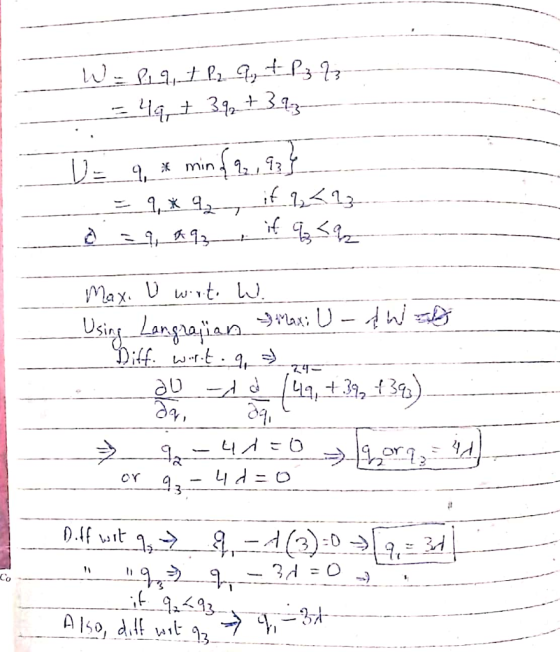
We have the following budget equation
W= 24= p1q1 + p2q2+ p3q3 = 4q1 + 3q2 + 3q3
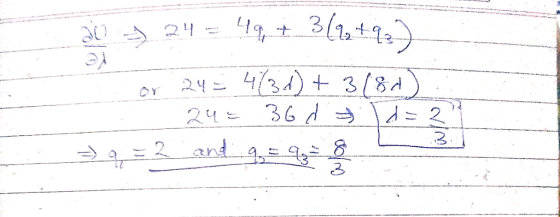
We maximise the utility function, U subject to W using the
Langrajian Multiplier, Lambda
See the attached:
Add Answer to:
4. Suppose an agent has utility function u(1q2.q3)1 min {q2q3), where these goods have respective prices...
4. Suppose an agent has utility function ulgr4ra) min (qz4), where these goods have respective prices...
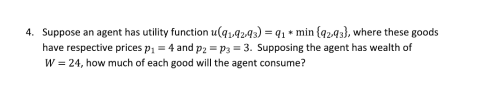 4. Suppose an agent has utility function ulgr4ra) min (qz4), where these goods have respective prices pi = 4 and p,-P3-3. Supposing the agent has wealth of W- 24, how much of each good will the agent consume?
4. Suppose an agent has utility function u(12.93)min1q243), where these goods have respective prices pi-4 and...
 4. Suppose an agent has utility function u(12.93)min1q243), where these goods have respective prices pi-4 and p2-p,-3. Supposing the agent has wealth of W-24, how much of each good will the agent consume?
3. What is the marginal rate of substitution of u-VIn (qa) + In (q2)? 4. Suppose...
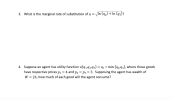 3. What is the marginal rate of substitution of u-VIn (qa) + In (q2)? 4. Suppose an agent has utility function u(1.q2,q3)q min {q2,433, where these goods have respective prices p1-4 and p2 p3 3. Supposing the agent has wealth of W- 24, how much of each good will the agent consume?
The individual has a utility function of u(x1, x2) = min (4x1, 5x2) and faces prices...
The individual has a utility function of u(x1, x2) = min (4x1, 5x2) and faces prices p1=2 and p2=1. We know they consume 20 units of x2 and spend all their income. What is the demand function for x1?
Suppose Alex’s preferences are represented by u(x1,x2) = x1x32. The marginal utilities for this utility function...
Suppose Alex’s preferences are represented by u(x1,x2) = x1x32. The marginal utilities for this utility function are MU1 = x23 and MU2 = 3x1x22. (a) Show that Alex’s utility function belongs to a class of functions that are known to be well-behaved and strictly convex. (b) Find the MRS. [Note: find the MRS for the original utility function, not some monotonic transformation of it.] (c) Write down the tangency condition needed to find an optimal consumption bundle for well-behaved preferences....
Consider a consumer with a utility function u(x1, x2) = min{21, 222}. Suppose the prices of...
 Consider a consumer with a utility function u(x1, x2) = min{21, 222}. Suppose the prices of good 1 and good 2 are p1 = P2 = 4. The consumer's income is m = 120. (a) Find the consumer's preferred bundle. (b) Draw the consumer's budget line. (c) On the same graph, indicate the consumer's preferred bundle and draw the indifference curve through it. (d) Now suppose that the consumer gets a discount on good 1: each unit beyond the 4th...
3. A consumer has a utility function defined over three goods, U(x1,x2,x3). At a given set...
3. A consumer has a utility function defined over three goods, U(x1,x2,x3). At a given set of prices and income (p1,p2,p3), a. Can all three goods be necessities b. Can one good be inferior and the other two luxuries c. Find the income elasticity of good 1 if s2 = 0.2, s3 = 0.5, n2 = 2, and n3 = 1, where sj is the budget share of good j and nj is the income elasticity of good j.
6. Modou has a utility function U(X1,X2) = 2X1 + X2 The prices of X1 &...
6. Modou has a utility function U(X1,X2) = 2X1 + X2 The prices of X1 & X2 are $1 each and Modou has an income of $20 budgeted for this two goods. a. Draw the demand curve for X1 as a function of p1.: b. At a price of p1 = $1, how much X1 and X2 does Modou consume?: c. A per unit tax of $0.60 is placed on X1. How much of good X1 will he consume now?:...
h. U(1, 2 For the utility function above, find the consumer's optimal consumption bundle when prices...
 h. U(1, 2 For the utility function above, find the consumer's optimal consumption bundle when prices of goods 1 and 2 are pl and p2, and the consumer has an income m. 1. 2. For the utility function above, find the consumer's optimal consumption bundle when prices of goods 1 and 2 are pl and p2, and the consumer has an endowment (el, e2) of the two goods. For each of your answers in question 2, write down the consumer...
Suppose a consumer has a utility function U(x1, x2) = Inxi + x2. The consumer takes...
 Suppose a consumer has a utility function U(x1, x2) = Inxi + x2. The consumer takes prices (p1 and p2) and income (I) as given. > 1. What is special about P2 1) Find the demand functions for and x2 assuming these demand functions? Are both goods normal? Are these tastes homothetic? 2) Now find the demand functions for x1 and x2 assuming-<1. You probably P2 assumed the opposite above, so now will you find something different. Explain 3) Graph...
 4. Suppose an agent has utility function ulgr4ra) min (qz4), where these goods have respective prices pi = 4 and p,-P3-3. Supposing the agent has wealth of W- 24, how much of each good will the agent consume?
 4. Suppose an agent has utility function u(12.93)min1q243), where these goods have respective prices pi-4 and p2-p,-3. Supposing the agent has wealth of W-24, how much of each good will the agent consume?
 3. What is the marginal rate of substitution of u-VIn (qa) + In (q2)? 4. Suppose an agent has utility function u(1.q2,q3)q min {q2,433, where these goods have respective prices p1-4 and p2 p3 3. Supposing the agent has wealth of W- 24, how much of each good will the agent consume?
 Consider a consumer with a utility function u(x1, x2) = min{21, 222}. Suppose the prices of good 1 and good 2 are p1 = P2 = 4. The consumer's income is m = 120. (a) Find the consumer's preferred bundle. (b) Draw the consumer's budget line. (c) On the same graph, indicate the consumer's preferred bundle and draw the indifference curve through it. (d) Now suppose that the consumer gets a discount on good 1: each unit beyond the 4th...
 h. U(1, 2 For the utility function above, find the consumer's optimal consumption bundle when prices of goods 1 and 2 are pl and p2, and the consumer has an income m. 1. 2. For the utility function above, find the consumer's optimal consumption bundle when prices of goods 1 and 2 are pl and p2, and the consumer has an endowment (el, e2) of the two goods. For each of your answers in question 2, write down the consumer...
 Suppose a consumer has a utility function U(x1, x2) = Inxi + x2. The consumer takes prices (p1 and p2) and income (I) as given. > 1. What is special about P2 1) Find the demand functions for and x2 assuming these demand functions? Are both goods normal? Are these tastes homothetic? 2) Now find the demand functions for x1 and x2 assuming-<1. You probably P2 assumed the opposite above, so now will you find something different. Explain 3) Graph...
Most questions answered within 3 hours.
-
Where is the error in this code sequence?
String s1 = "Hello";
String s2 = "ello";...
asked 10 months ago -
Financial data for Joel de Paris, Inc., for last year
follow:
Joel de Paris, Inc.
Balance...
asked 10 months ago -
Consider this reaction:
Al2(SO4)3 (aq)+ BaCl3
(aq) Al2Cl6 (aq)- +
3BaSO4(s) . What is the...
asked 10 months ago -
Suppose that Savneet is considering increasing her
recent random sample from 20 car rentals to 40...
asked 10 months ago -
Trucks arrive at an unloading terminal at an average rate of 120
per hour.
Trucks arrive...
asked 10 months ago -
Why are methanol and ethanol completely soluble in water while
octanol is not very little soluble....
asked 10 months ago -
A facilities manager at a university reads in a research report
that the mean amount of...
asked 10 months ago -
When the CuSO4 is rehydrated by adding water to the anhydrous
compound, is this an endothermic...
asked 10 months ago -
A ray of sunlight is passing from diamond into crown glass; the
angle of incidence is...
asked 10 months ago -
A block of mass 0.249 kg is placed on top of a light, vertical
spring of...
asked 10 months ago -
how do the kidneys compensate in the presences of acidosis
a) trigger hyperventilate
b) reserve acid...
asked 10 months ago -
Question 501 pts
The rental rate of capital to the firm increases. Which of the
following...
asked 10 months ago