
Homework Answers
Add Answer to:
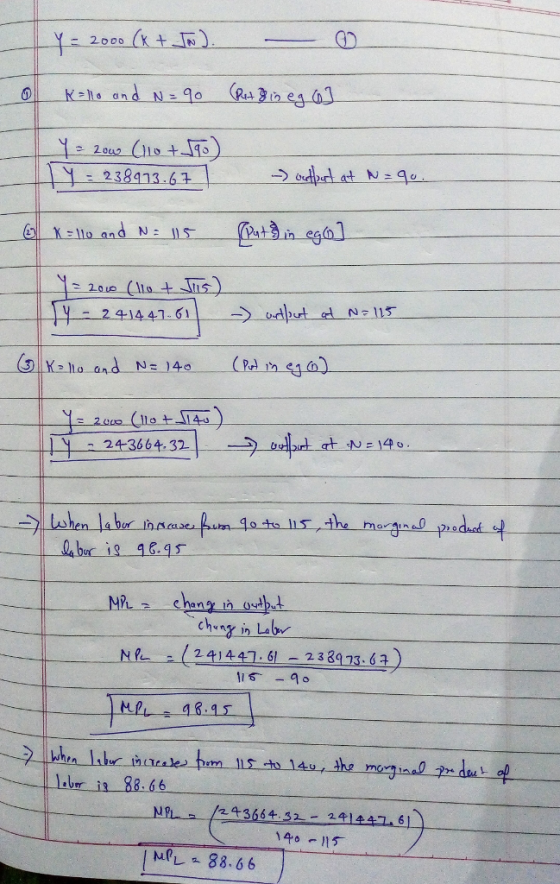
An economy has the production function: 300 y-2000(K N) 280- In the current period, K 110....
Suppose he production function takes the form Y : F KN where Y he quantity of...
 Suppose he production function takes the form Y : F KN where Y he quantity of ou put Kis the quanti o capital goods and is quantity of a Suppose specifically that Recall that the marginal product of labor is the the extra amount of output that results from using one extra unit of labor, while holding constant the amount of capital used. Suppose N-9 and K-16. Then, to two decimal places, the marginal product of labor is K N...
2. Consider an economy which produces output with the following production function: Y = AK 1...
2. Consider an economy which produces output with the following production function: Y = AK 1 3L 2 3 , where K is the level of capital and L is the level of labor. Please answer the following questions, assuming this production function: (a) Please express the marginal product of capital and the marginal product of labor as functions of A, K, L: (b) What fraction of income is rental income from capital? If the level of labor, L, increases,...
3. (55 points total) An economy's aggregate production function is given by Y- A K N-N2....
 3. (55 points total) An economy's aggregate production function is given by Y- A K N-N2. The marginal product of labor for this production function is MPN A K- 2N. (a) (10 points) Assume that A- 8 and K- 10. Suppose that the labor supply function for this economy is given by NS 20+ 2w. Find the equilibrium real wage rate, the full employment level of employment, and the full-employment level of output for this economy Draw a production function...
An economy has a Cobb-Douglas production function: Y = K°(LE)1-a The economy has a capital share...
 An economy has a Cobb-Douglas production function: Y = K°(LE)1-a The economy has a capital share of 0.25, a saving rate of 43 percent, a depreciation rate of 3.00 percent, a rate of population growth of 4.25 percent, and a rate of labor-augmenting technological change of 3.5 percent. It is in steady state. b. Solve for capital per effective worker (k*), output per effective worker (y*), and the marginal product of capital. k* = 2.83 y* * = 1.30 =...
An economy has a Cobb-Douglas production function: Y = K"(LE)!-a The economy has a capital share...
 An economy has a Cobb-Douglas production function: Y = K"(LE)!-a The economy has a capital share of 0.25, a saving rate of 40 percent, a depreciation rate of 3.00 percent, a rate of population growth of 0.75 percent, and a rate of labor- augmenting technological change of 2.0 percent. It is in steady state. b. Solve for capital per effective worker (k*), output per effective worker (y*), and the marginal product of capital.
SHOW WORK 8) Suppose the economy's production function is Y = AK"3 No.7. Suppose K =...
 SHOW WORK
8) Suppose the economy's production function is Y = AK"3 No.7. Suppose K = 200, N and A 1. Calculate the marginal product of capital. A) 1.0 B) 1.5 C) 2.0 D) 2.5 2000
SHOW WORK
8) Suppose the economy's production function is Y = AK"3 No.7. Suppose K = 200, N and A 1. Calculate the marginal product of capital. A) 1.0 B) 1.5 C) 2.0 D) 2.5 2000
A “Cobb–Douglas” production function relates production (Q) to factors of production, capital (K), labor (L), and...
A “Cobb–Douglas” production function relates production (Q) to factors of production, capital (K), labor (L), and raw materials (M), and an error term u using the equation: ? = ???1??2M?3? ?, where ?, ?1, ?2, and ?3 are production parameters. a) Suppose that you have data on production and the factors of production from a random sample of firms with the same Cobb–Douglas production function. How would you propose to use OLS regression analysis to estimate the above production parameters,...
Here we have the production function y=f(K,L)=K3L, where K is capital input and L is labor...
 Here we have the production function y=f(K,L)=K3L, where K is capital input and L is labor input. Let K>0, L>0. 1. What are the marginal products of capital and labor re- spectively? 2. Please compute the technical rate of substitution (we as- sume K is on the horizontal axis). 3. Dose this production function show diminishing technical rate of substitution (in absolute value) when K increases? Please give a brief proof. 4. Please prove that this production function features increas-...
Consider the following production function q= 24LK + 512-6 Assume capital is fixed at K =25....
 Consider the following production function q= 24LK + 512-6 Assume capital is fixed at K =25. In what range of employment does the marginal product of labor exhibit positive but diminishing marginal returns? The marginal product of labor is diminishing but positive when L ranges from to . (Enter numeric responses using integers)
Consider the following model of the economy Production function: Y = A·K·N – N2/2 Marginal produ...
Consider the following model of the economy Production function: Y = A·K·N – N2/2 Marginal product of labor: MPN = A·K – N. where the initial values of A = 10 and K = 10. The initial labor supply curve is given as: NS = 50 + 4w Initial conditions in the goods market Cd = 790 + .50(Y-T) – 500r Id = 1000 – 500r G = 800 T = 100 Md/P = 110 + 0.5Y- 1000(r + πe) ...
 Suppose he production function takes the form Y : F KN where Y he quantity of ou put Kis the quanti o capital goods and is quantity of a Suppose specifically that Recall that the marginal product of labor is the the extra amount of output that results from using one extra unit of labor, while holding constant the amount of capital used. Suppose N-9 and K-16. Then, to two decimal places, the marginal product of labor is K N...
 3. (55 points total) An economy's aggregate production function is given by Y- A K N-N2. The marginal product of labor for this production function is MPN A K- 2N. (a) (10 points) Assume that A- 8 and K- 10. Suppose that the labor supply function for this economy is given by NS 20+ 2w. Find the equilibrium real wage rate, the full employment level of employment, and the full-employment level of output for this economy Draw a production function...
 An economy has a Cobb-Douglas production function: Y = K°(LE)1-a The economy has a capital share of 0.25, a saving rate of 43 percent, a depreciation rate of 3.00 percent, a rate of population growth of 4.25 percent, and a rate of labor-augmenting technological change of 3.5 percent. It is in steady state. b. Solve for capital per effective worker (k*), output per effective worker (y*), and the marginal product of capital. k* = 2.83 y* * = 1.30 =...
 An economy has a Cobb-Douglas production function: Y = K"(LE)!-a The economy has a capital share of 0.25, a saving rate of 40 percent, a depreciation rate of 3.00 percent, a rate of population growth of 0.75 percent, and a rate of labor- augmenting technological change of 2.0 percent. It is in steady state. b. Solve for capital per effective worker (k*), output per effective worker (y*), and the marginal product of capital.
 SHOW WORK
8) Suppose the economy's production function is Y = AK"3 No.7. Suppose K = 200, N and A 1. Calculate the marginal product of capital. A) 1.0 B) 1.5 C) 2.0 D) 2.5 2000
SHOW WORK
8) Suppose the economy's production function is Y = AK"3 No.7. Suppose K = 200, N and A 1. Calculate the marginal product of capital. A) 1.0 B) 1.5 C) 2.0 D) 2.5 2000
 Here we have the production function y=f(K,L)=K3L, where K is capital input and L is labor input. Let K>0, L>0. 1. What are the marginal products of capital and labor re- spectively? 2. Please compute the technical rate of substitution (we as- sume K is on the horizontal axis). 3. Dose this production function show diminishing technical rate of substitution (in absolute value) when K increases? Please give a brief proof. 4. Please prove that this production function features increas-...
 Consider the following production function q= 24LK + 512-6 Assume capital is fixed at K =25. In what range of employment does the marginal product of labor exhibit positive but diminishing marginal returns? The marginal product of labor is diminishing but positive when L ranges from to . (Enter numeric responses using integers)
Most questions answered within 3 hours.
-
Where is the error in this code sequence?
String s1 = "Hello";
String s2 = "ello";...
asked 10 months ago -
Financial data for Joel de Paris, Inc., for last year
follow:
Joel de Paris, Inc.
Balance...
asked 10 months ago -
Consider this reaction:
Al2(SO4)3 (aq)+ BaCl3
(aq) Al2Cl6 (aq)- +
3BaSO4(s) . What is the...
asked 10 months ago -
Suppose that Savneet is considering increasing her
recent random sample from 20 car rentals to 40...
asked 10 months ago -
Trucks arrive at an unloading terminal at an average rate of 120
per hour.
Trucks arrive...
asked 10 months ago -
Why are methanol and ethanol completely soluble in water while
octanol is not very little soluble....
asked 10 months ago -
A facilities manager at a university reads in a research report
that the mean amount of...
asked 10 months ago -
When the CuSO4 is rehydrated by adding water to the anhydrous
compound, is this an endothermic...
asked 10 months ago -
A ray of sunlight is passing from diamond into crown glass; the
angle of incidence is...
asked 10 months ago -
A block of mass 0.249 kg is placed on top of a light, vertical
spring of...
asked 10 months ago -
how do the kidneys compensate in the presences of acidosis
a) trigger hyperventilate
b) reserve acid...
asked 10 months ago -
Question 501 pts
The rental rate of capital to the firm increases. Which of the
following...
asked 10 months ago