
Homework Answers
![AGE-RT los keg Given. [a CAGIT) /at] = - AMIT? => [a (Ago/T)/dt), - - 44°/T2. » [a GRX bon Kea (7) 127] =- A4/72. 5) - R [ a](http://img.homeworklib.com/questions/c6cf9db0-41ac-11ea-a049-992ed1e33c99.png?x-oss-process=image/resize,w_560)
Add Answer to:
In General Chemistry we learned that the equilibrium constant for a reaction is related to AG,...
In General Chemistry we learned that the equilibrium constant for a reaction is related to AG,...
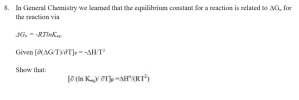 In General Chemistry we learned that the equilibrium constant for a reaction is related to AG, for 8. the reaction via AGo RTlnKeq- Given [0(AG/T)/aT]p = -AH/T2 Show that: [ (In Keg Tp-AH (RT)
5) For a particular chemical reaction it is found that the value for the equilibrium constant...
 5) For a particular chemical reaction it is found that the value for the equilibrium constant for the reaction decreases as temperature increases. Based on this we can conclude a) AH> 0 b) AH 0 c) ASºren > 0 d) AS p < 0 e) AGO
Consider a general reaction czyme A(aq) = B(aq The AG of the reaction is - 7.190...
 Consider a general reaction czyme A(aq) = B(aq The AG of the reaction is - 7.190 kJ. mol. Calculate the equilibrium constant for the reaction at 25 °C. Kg = .00126 What is AG for the reaction at body temperature (37.0 °C) if the concentration of A is 1.7 M and the concentration of B is 0.75 M? AG = -9,3 kl. mol-
A process at constant T and P can be described as spontaneous if AG <0 and...
 A process at constant T and P can be described as spontaneous if AG <0 and nonspontaneous if AG> 0. Over what range of temperatures is the following process spontaneous? Assume that gases are at a pressure of 1 atm. (Hint: Use the data below to calculate AH and AS [assumed independent of temperature and equal to AH° and AS°, respectively] and then use the definition of AG.) 2 MnO2(s) 02(g) 2 MnO(s) AH (kJ mol) -520.0 -385.2 s° (J...
The equilibrium constant, K, for a redox reaction is related to the standard potential, Eº, by...
 The equilibrium constant, K, for a redox reaction is related to the standard potential, Eº, by the equation In K = nFE° RT where n is the number of moles of electrons transferred, F (the Faraday constant) is equal to 96,500 C/(mol e), R (the gas constant) is equal to 8.314 J/(mol · K), and T is the Kelvin temperature. Standard reduction potentials Reduction half-reaction E° (V) Ag+ (aq) + e +Ag(s) 0.80 Cu²+ (aq) + 2e + Cu(s) 0.34...
Several groups of general chemistry lab students measured the equilibrium constant for the same chemical equilibrium....
 Several groups of general chemistry lab students measured the equilibrium constant for the same chemical equilibrium. In comparing their results, they found that they had different values because the temperatures of the experiments were different. Everyone was disappointed by the inconsistency, except for Dexter when he realized the measurements were made at different measured temperatures: "My esteemed colleagues," he said, "together we have sufficient data to determine two additional thermodynamic parameters and show the lab instructor what we know!" What...
Consider a general reaction enzyme в(аg) A aq) mol Calculate the equilibrium constant for the reaction....
 Consider a general reaction enzyme в(аg) A aq) mol Calculate the equilibrium constant for the reaction. (Assume a The AG" of the reaction is -7.150 kJ temperature of 25° C.) Number к. 17.9 eq What is AG at body temperature (37.0° C) if the concentration of A is 1.7 M and the concentration of B is 0.50 M? Number Incorrect. You may have inverted the natural logarithm in your equation. The equation relating AG" and AG is - 3.99 kJ....
Consider a general reaction A(aq) = B(aq) The AG of the reaction is -3.490 kJ -...
 Consider a general reaction A(aq) = B(aq) The AG of the reaction is -3.490 kJ - mol. Calculate the equilibrium constant for the reaction at 25°C. Kin= 0.333 What is AG for the reaction at body temperature (37.0 °C) if the concentration of Ais 1.8 M and the concentration of Bis 0.65 M? AG -9.561 kJ mol
General Chemistry II b) Would you expect AE to be the same as AH for this...
 General Chemistry II b) Would you expect AE to be the same as AH for this reaction? Explain. (.5 pt) 3. Calculate AG for the reaction C(diamond) + O2(g) → CO2(g) Given the result of your calculation, postulate a reason for why we dont protect diamonds from atmospheric oxygen? (1.5 pt) 4. Consider the dimerization reaction 2 NO2) = N20.g) at 298 K. If the starting pressure of NO2(g) 0.011 atm and that of N:0.9) was 0.065 atm, would this...
Consider a general reaction enzyme A(aq) = B(aq) The AG*' of the reaction is –5.650 kJ....
 Consider a general reaction enzyme A(aq) = B(aq) The AG*' of the reaction is –5.650 kJ. mol-?. Calculate the equilibrium constant for the reaction at 25 °C. Keq = What is AG for the reaction at body temperature (37.0 °C) if the concentration of A is 1.9 M and the concentration of B is 0.60 M? AG= kJ. mol-1
 In General Chemistry we learned that the equilibrium constant for a reaction is related to AG, for 8. the reaction via AGo RTlnKeq- Given [0(AG/T)/aT]p = -AH/T2 Show that: [ (In Keg Tp-AH (RT)
 5) For a particular chemical reaction it is found that the value for the equilibrium constant for the reaction decreases as temperature increases. Based on this we can conclude a) AH> 0 b) AH 0 c) ASºren > 0 d) AS p < 0 e) AGO
 Consider a general reaction czyme A(aq) = B(aq The AG of the reaction is - 7.190 kJ. mol. Calculate the equilibrium constant for the reaction at 25 °C. Kg = .00126 What is AG for the reaction at body temperature (37.0 °C) if the concentration of A is 1.7 M and the concentration of B is 0.75 M? AG = -9,3 kl. mol-
 A process at constant T and P can be described as spontaneous if AG <0 and nonspontaneous if AG> 0. Over what range of temperatures is the following process spontaneous? Assume that gases are at a pressure of 1 atm. (Hint: Use the data below to calculate AH and AS [assumed independent of temperature and equal to AH° and AS°, respectively] and then use the definition of AG.) 2 MnO2(s) 02(g) 2 MnO(s) AH (kJ mol) -520.0 -385.2 s° (J...
 The equilibrium constant, K, for a redox reaction is related to the standard potential, Eº, by the equation In K = nFE° RT where n is the number of moles of electrons transferred, F (the Faraday constant) is equal to 96,500 C/(mol e), R (the gas constant) is equal to 8.314 J/(mol · K), and T is the Kelvin temperature. Standard reduction potentials Reduction half-reaction E° (V) Ag+ (aq) + e +Ag(s) 0.80 Cu²+ (aq) + 2e + Cu(s) 0.34...
 Several groups of general chemistry lab students measured the equilibrium constant for the same chemical equilibrium. In comparing their results, they found that they had different values because the temperatures of the experiments were different. Everyone was disappointed by the inconsistency, except for Dexter when he realized the measurements were made at different measured temperatures: "My esteemed colleagues," he said, "together we have sufficient data to determine two additional thermodynamic parameters and show the lab instructor what we know!" What...
 Consider a general reaction enzyme в(аg) A aq) mol Calculate the equilibrium constant for the reaction. (Assume a The AG" of the reaction is -7.150 kJ temperature of 25° C.) Number к. 17.9 eq What is AG at body temperature (37.0° C) if the concentration of A is 1.7 M and the concentration of B is 0.50 M? Number Incorrect. You may have inverted the natural logarithm in your equation. The equation relating AG" and AG is - 3.99 kJ....
 Consider a general reaction A(aq) = B(aq) The AG of the reaction is -3.490 kJ - mol. Calculate the equilibrium constant for the reaction at 25°C. Kin= 0.333 What is AG for the reaction at body temperature (37.0 °C) if the concentration of Ais 1.8 M and the concentration of Bis 0.65 M? AG -9.561 kJ mol
 General Chemistry II b) Would you expect AE to be the same as AH for this reaction? Explain. (.5 pt) 3. Calculate AG for the reaction C(diamond) + O2(g) → CO2(g) Given the result of your calculation, postulate a reason for why we dont protect diamonds from atmospheric oxygen? (1.5 pt) 4. Consider the dimerization reaction 2 NO2) = N20.g) at 298 K. If the starting pressure of NO2(g) 0.011 atm and that of N:0.9) was 0.065 atm, would this...
 Consider a general reaction enzyme A(aq) = B(aq) The AG*' of the reaction is –5.650 kJ. mol-?. Calculate the equilibrium constant for the reaction at 25 °C. Keq = What is AG for the reaction at body temperature (37.0 °C) if the concentration of A is 1.9 M and the concentration of B is 0.60 M? AG= kJ. mol-1
Most questions answered within 3 hours.
-
Where is the error in this code sequence?
String s1 = "Hello";
String s2 = "ello";...
asked 10 months ago -
Financial data for Joel de Paris, Inc., for last year
follow:
Joel de Paris, Inc.
Balance...
asked 10 months ago -
Consider this reaction:
Al2(SO4)3 (aq)+ BaCl3
(aq) Al2Cl6 (aq)- +
3BaSO4(s) . What is the...
asked 10 months ago -
Suppose that Savneet is considering increasing her
recent random sample from 20 car rentals to 40...
asked 10 months ago -
Trucks arrive at an unloading terminal at an average rate of 120
per hour.
Trucks arrive...
asked 10 months ago -
Why are methanol and ethanol completely soluble in water while
octanol is not very little soluble....
asked 10 months ago -
A facilities manager at a university reads in a research report
that the mean amount of...
asked 10 months ago -
When the CuSO4 is rehydrated by adding water to the anhydrous
compound, is this an endothermic...
asked 10 months ago -
A ray of sunlight is passing from diamond into crown glass; the
angle of incidence is...
asked 10 months ago -
A block of mass 0.249 kg is placed on top of a light, vertical
spring of...
asked 10 months ago -
how do the kidneys compensate in the presences of acidosis
a) trigger hyperventilate
b) reserve acid...
asked 10 months ago -
Question 501 pts
The rental rate of capital to the firm increases. Which of the
following...
asked 10 months ago