Homework Answers
rocket follows newtons third law of motion.
the thrust due to the fuel give the force to move forward.
The rocket used for the human lunar missions was the Saturn V rocket. At liftoff the...
The rocket used for the human lunar missions was the Saturn V rocket. At liftoff the mass of the rocket was 2.80 x 10⁶ kg and the thrust of the five F1 engines is 3.45 x 10⁷ N. (a) Draw the force diagram of the rocket. (b) What is the initial acceleration of the spacecraft? (c) The rocket uses 1.81 x 10⁵ kg of fuel per second. What would be the acceleration of the mass of the rocket 0.5 and...
Rocket A leaves a space station with a speed of 0.80c. Later, rocket B leaves in...
Rocket A leaves a space station with a speed of 0.80c. Later, rocket B leaves in the same direction with a speed of 0.50c. What the velocity of rocket A is as observed from rocket B?
Rocket A leaves a space station with a speed of 0.80c. Later, rocket B leaves in...
Rocket A leaves a space station with a speed of 0.80c. Later, rocket B leaves in the same direction with a speed of 0.50c. What the velocity of rocket A is as observed from rocket B?
A small rocket is attached to a stiff wire as shown. The rocket rests on a...
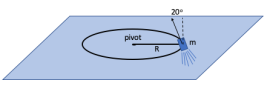 A small rocket is attached to a stiff wire as shown. The rocket
rests on a frictionless table. At t=0, the rocket is lit, and it
produces a thrust magnitude F. Note that the Thrust is not
tangential to the circular trajectory. At t=0, the rocket is at
rest.
a) What is the angular velocity after 2 revolutions?
b) What is the magnitude of the force by the wire after 2
revolutions?
pivot
A small rocket is attached to a stiff wire as shown. The rocket
rests on a frictionless table. At t=0, the rocket is lit, and it
produces a thrust magnitude F. Note that the Thrust is not
tangential to the circular trajectory. At t=0, the rocket is at
rest.
a) What is the angular velocity after 2 revolutions?
b) What is the magnitude of the force by the wire after 2
revolutions?
pivot
At launch, the new rocket became the most powerful rocket in operation. It is capable of...
 At launch, the new rocket became the most powerful rocket in operation. It is capable of producing 5 million pounds of thrust (about 2.22 × 10⁷ newtons). At launch, the rocket has a mass of about 1.42 × 10⁶ kg. Estimate the acceleration of the rocket while it is still near the surface of the Earth and its engines must work against Earth's gravitational force. 2.
A rocket travels horizontally, close to the earth. The centripetal acceleration of the rocket is the...
A rocket travels horizontally, close to the earth. The centripetal acceleration of the rocket is the earth's gravity (9.8 m/s2). If the earth's radius is 6.3 x 10⁶ m and we neglect air resistance, how fast must the rocket be going to keep a constant height above the earth's surface?
5. Rocket A is traveling at velo -0.8 c. Rocket A fires a projectile with velocity vp 0.9 cit 0.8 c toward rocket B...
 5. Rocket A is traveling at velo -0.8 c. Rocket A fires a projectile with velocity vp 0.9 cit 0.8 c toward rocket B, which itself is traveling at velocity vB as observed by ship A which fired it. B Earth a. What does an observer on Earth measure for the projectile's velocity vp b. What does the spaceling in Rocket B measure for projectile's velocity vp
5. Rocket A is traveling at velo -0.8 c. Rocket A fires a...
5. Rocket A is traveling at velo -0.8 c. Rocket A fires a projectile with velocity vp 0.9 cit 0.8 c toward rocket B, which itself is traveling at velocity vB as observed by ship A which fired it. B Earth a. What does an observer on Earth measure for the projectile's velocity vp b. What does the spaceling in Rocket B measure for projectile's velocity vp
5. Rocket A is traveling at velo -0.8 c. Rocket A fires a...
A rocket expels exhaust at a rate of 50 m/s for 50 seconds. The rocket weighs...
A rocket expels exhaust at a rate of 50 m/s for 50 seconds. The rocket weighs 15,000 kg when empty. The rocket can hold 120,000 kg of fuel. At rest, weightless: 1. What speed is the rocket traveling when all the fuel is gone 2. How fast is the rocket traveling when only 30,000 kg of fuel has been used 3. When the rocket reaches 40 m/s how much fuel is left
A 10.0 kg rocket produces a thrust of 150 N. The rocket is pointed upward and...
A 10.0 kg rocket produces a thrust of 150 N. The rocket is pointed upward and the bottom of the rocket is attached to, and is resting on, a spring with a spring constant of 305 N/m. If the spring compressed 0.321 m prior to launch, what is the rocket's speed when the rocket is launched and the spring has stretched 0.417 m? clear steps please
A rocket has a weight of 263,000 Ibs on earth. If the rocket is on the...
 A rocket has a weight of 263,000 Ibs on earth. If the rocket is on the moon, where the acceleration of gravity is gm 5.30 m/sec2, determine its weight and mass on the moon in SI units.
 A small rocket is attached to a stiff wire as shown. The rocket
rests on a frictionless table. At t=0, the rocket is lit, and it
produces a thrust magnitude F. Note that the Thrust is not
tangential to the circular trajectory. At t=0, the rocket is at
rest.
a) What is the angular velocity after 2 revolutions?
b) What is the magnitude of the force by the wire after 2
revolutions?
pivot
A small rocket is attached to a stiff wire as shown. The rocket
rests on a frictionless table. At t=0, the rocket is lit, and it
produces a thrust magnitude F. Note that the Thrust is not
tangential to the circular trajectory. At t=0, the rocket is at
rest.
a) What is the angular velocity after 2 revolutions?
b) What is the magnitude of the force by the wire after 2
revolutions?
pivot
 At launch, the new rocket became the most powerful rocket in operation. It is capable of producing 5 million pounds of thrust (about 2.22 × 10⁷ newtons). At launch, the rocket has a mass of about 1.42 × 10⁶ kg. Estimate the acceleration of the rocket while it is still near the surface of the Earth and its engines must work against Earth's gravitational force. 2.
 5. Rocket A is traveling at velo -0.8 c. Rocket A fires a projectile with velocity vp 0.9 cit 0.8 c toward rocket B, which itself is traveling at velocity vB as observed by ship A which fired it. B Earth a. What does an observer on Earth measure for the projectile's velocity vp b. What does the spaceling in Rocket B measure for projectile's velocity vp
5. Rocket A is traveling at velo -0.8 c. Rocket A fires a...
5. Rocket A is traveling at velo -0.8 c. Rocket A fires a projectile with velocity vp 0.9 cit 0.8 c toward rocket B, which itself is traveling at velocity vB as observed by ship A which fired it. B Earth a. What does an observer on Earth measure for the projectile's velocity vp b. What does the spaceling in Rocket B measure for projectile's velocity vp
5. Rocket A is traveling at velo -0.8 c. Rocket A fires a...
 A rocket has a weight of 263,000 Ibs on earth. If the rocket is on the moon, where the acceleration of gravity is gm 5.30 m/sec2, determine its weight and mass on the moon in SI units.
Most questions answered within 3 hours.
-
Where is the error in this code sequence?
String s1 = "Hello";
String s2 = "ello";...
asked 10 months ago -
Financial data for Joel de Paris, Inc., for last year
follow:
Joel de Paris, Inc.
Balance...
asked 10 months ago -
Consider this reaction:
Al2(SO4)3 (aq)+ BaCl3
(aq) Al2Cl6 (aq)- +
3BaSO4(s) . What is the...
asked 10 months ago -
Suppose that Savneet is considering increasing her
recent random sample from 20 car rentals to 40...
asked 10 months ago -
Trucks arrive at an unloading terminal at an average rate of 120
per hour.
Trucks arrive...
asked 10 months ago -
Why are methanol and ethanol completely soluble in water while
octanol is not very little soluble....
asked 10 months ago -
A facilities manager at a university reads in a research report
that the mean amount of...
asked 10 months ago -
When the CuSO4 is rehydrated by adding water to the anhydrous
compound, is this an endothermic...
asked 10 months ago -
A ray of sunlight is passing from diamond into crown glass; the
angle of incidence is...
asked 10 months ago -
A block of mass 0.249 kg is placed on top of a light, vertical
spring of...
asked 10 months ago -
how do the kidneys compensate in the presences of acidosis
a) trigger hyperventilate
b) reserve acid...
asked 10 months ago -
Question 501 pts
The rental rate of capital to the firm increases. Which of the
following...
asked 10 months ago