A small charged object of mass m = 0.200 kg and charge q = + 10.0...
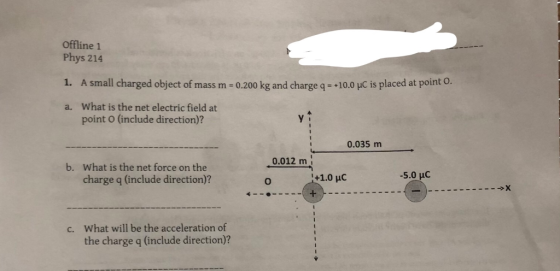
A small charged object of mass m = 0.200 kg and charge q = + 10.0 microC is placed at point O.
Homework Answers
 Allowed to solve only one
question.
Allowed to solve only one
question.Add Answer to:
A small charged object of mass m = 0.200 kg and charge q = + 10.0...
Offline 1 Name: Phys 214 1. A small charged object of mass m-0.200 kg and charge...
 Offline 1 Name: Phys 214 1. A small charged object of mass m-0.200 kg and charge q-+10.0 HC is placed at point o. a. What is the net electric field at point O (include direction)? 0.035 m 0.012 m b. What is the net force on the charge q (include direction)? -5.0 μC What will be the acceleration of the charge q (include direction)? c.
Offline 1 Name: Phys 214 1. A small charged object of mass m-0.200 kg and charge...
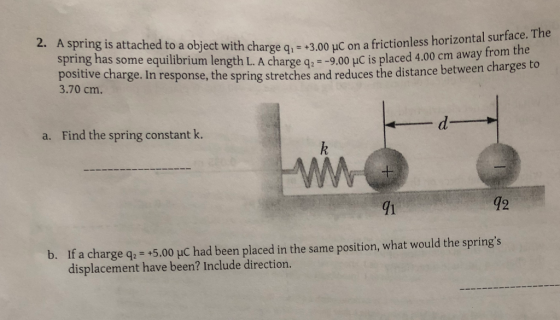
 Offline 1 Name: Phys 214 1. A small charged object of mass m-0.200 kg and charge q·+10.0 μc is placed at point 0. a. What is the net electric field at point O (include direction)? 0.035 m b. 0.012 m What is the net force on the charge q (include direction)? What will be the acceleration of the charge q (include direction)? c. A spring is attached to a object with charge q, +3.00 HC on a frictionless horizontal surface....
A small object with a charge of q = 10.0 pC travels from the origin to...
 A small object with a charge of q = 10.0 pC travels from the origin to the point (x, y) = (20.0 cm, 50.0 cm) in the presence of a uniform electric field E = 240İ V/m. Determine the following (a) the change in the electric potential energy (in J) of the object-field system (b) the electric potential difference (in V) through which the object moves
+ -12 points SerPSE10 24.1.OP001 A small object with a charge of q = 10.0 μС...
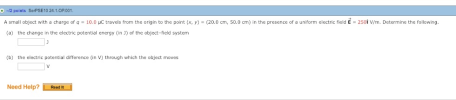 + -12 points SerPSE10 24.1.OP001 A small object with a charge of q = 10.0 μС travels from the origin to the point x, y = 20.0 cm, 50.0 cm in the presence of a uniform electric field E = 250 V/m. Determine the following. (a) the change in the electric potential energy (in J) of the object-field system (b) the electric potential difference (in V) through which the object moves Need Help? Readt
Two small spheres, each with mass m 10.0 g and charge q, are suspended from a...
 Two small spheres, each with mass m 10.0 g and charge q, are suspended from a point by threads of length L-0.30 m. What is the charge on each sphere if the threads make an angle θ = 20° with the vertical? WI 69 О 7.98 10- О 2.98 10% с 7.5 x 10² C 6.3 x 10⁻¹³ c 3.96 x 10 C
A small charged object hangs by a thread in equilibrium in a uniform electric field (50...
 A small charged object hangs by a thread in equilibrium in a uniform electric field (50 N/C), as shown in the figure. If the mass of the object is 9.3E-6 kg, and its charge is 5 C, what is the angle é? E Q, m O 27 degrees 17 degrees 4.5 degrees 48 degrees 70 degrees
A small object has a mass of 4.0 × 10⁻³ kg and a charge of -29C....
A small object has a mass of 4.0 × 10⁻³ kg and a charge of -29C. It is placed at a certain spot where there is an electric field. When released, the object experiences an acceleration of 3.8 × 10³ m/s2 in the direction of the +x axis. Determine the electric field, including sign, relative to the +x axis.
A small object has a mass of 3.2 10-3 kg and a charge of -30 µC....
A small object has a mass of 3.2 10-3 kg and a charge of -30 µC. It is placed at a certain spot where there is an electric field. When released, the object experiences an acceleration of 2.65 103 m/s2 in the direction of the +x axis. Determine the magnitude and direction of the electric field.
A small electrically charged bead with the mass m and charge Q can slide on a...
 A small electrically charged bead with the mass m and charge Q can slide on a circular insulating string without friction. The radius of the circle is r. A point-like electric dipole is at the center of the circle with the dipole moment P lying in the plane of the circle. Initially the bead is at an angle θ = 플 +6, where δ is infinitely small, as shown schematically in the figure below. Figure 3: Bead on a string...
Please answer these questions and show all work and reasoning :) Thank you!! 1. A small...
 Please answer these questions and show all work and reasoning :)
Thank you!!
1. A small charged object of mass m-0,200 kg and charge q -100 HC is placed at point o What is the net electric field at point O (include direction)? a. 0.035 m b. 0.012 m What is the net force on the charge q (include direction)? ntro 0 HC -5.0 uC What will be the acceleration of the charge q (include direction)? c.
Please answer these questions and show all work and reasoning :)
Thank you!!
1. A small charged object of mass m-0,200 kg and charge q -100 HC is placed at point o What is the net electric field at point O (include direction)? a. 0.035 m b. 0.012 m What is the net force on the charge q (include direction)? ntro 0 HC -5.0 uC What will be the acceleration of the charge q (include direction)? c.
 Offline 1 Name: Phys 214 1. A small charged object of mass m-0.200 kg and charge q-+10.0 HC is placed at point o. a. What is the net electric field at point O (include direction)? 0.035 m 0.012 m b. What is the net force on the charge q (include direction)? -5.0 μC What will be the acceleration of the charge q (include direction)? c.
 Offline 1 Name: Phys 214 1. A small charged object of mass m-0.200 kg and charge q·+10.0 μc is placed at point 0. a. What is the net electric field at point O (include direction)? 0.035 m b. 0.012 m What is the net force on the charge q (include direction)? What will be the acceleration of the charge q (include direction)? c. A spring is attached to a object with charge q, +3.00 HC on a frictionless horizontal surface....
 A small object with a charge of q = 10.0 pC travels from the origin to the point (x, y) = (20.0 cm, 50.0 cm) in the presence of a uniform electric field E = 240İ V/m. Determine the following (a) the change in the electric potential energy (in J) of the object-field system (b) the electric potential difference (in V) through which the object moves
 + -12 points SerPSE10 24.1.OP001 A small object with a charge of q = 10.0 μС travels from the origin to the point x, y = 20.0 cm, 50.0 cm in the presence of a uniform electric field E = 250 V/m. Determine the following. (a) the change in the electric potential energy (in J) of the object-field system (b) the electric potential difference (in V) through which the object moves Need Help? Readt
 Two small spheres, each with mass m 10.0 g and charge q, are suspended from a point by threads of length L-0.30 m. What is the charge on each sphere if the threads make an angle θ = 20° with the vertical? WI 69 О 7.98 10- О 2.98 10% с 7.5 x 10² C 6.3 x 10⁻¹³ c 3.96 x 10 C
 A small charged object hangs by a thread in equilibrium in a uniform electric field (50 N/C), as shown in the figure. If the mass of the object is 9.3E-6 kg, and its charge is 5 C, what is the angle é? E Q, m O 27 degrees 17 degrees 4.5 degrees 48 degrees 70 degrees
 A small electrically charged bead with the mass m and charge Q can slide on a circular insulating string without friction. The radius of the circle is r. A point-like electric dipole is at the center of the circle with the dipole moment P lying in the plane of the circle. Initially the bead is at an angle θ = 플 +6, where δ is infinitely small, as shown schematically in the figure below. Figure 3: Bead on a string...
 Please answer these questions and show all work and reasoning :)
Thank you!!
1. A small charged object of mass m-0,200 kg and charge q -100 HC is placed at point o What is the net electric field at point O (include direction)? a. 0.035 m b. 0.012 m What is the net force on the charge q (include direction)? ntro 0 HC -5.0 uC What will be the acceleration of the charge q (include direction)? c.
Please answer these questions and show all work and reasoning :)
Thank you!!
1. A small charged object of mass m-0,200 kg and charge q -100 HC is placed at point o What is the net electric field at point O (include direction)? a. 0.035 m b. 0.012 m What is the net force on the charge q (include direction)? ntro 0 HC -5.0 uC What will be the acceleration of the charge q (include direction)? c.
Most questions answered within 3 hours.
-
Where is the error in this code sequence?
String s1 = "Hello";
String s2 = "ello";...
asked 11 months ago -
Financial data for Joel de Paris, Inc., for last year
follow:
Joel de Paris, Inc.
Balance...
asked 11 months ago -
Consider this reaction:
Al2(SO4)3 (aq)+ BaCl3
(aq) Al2Cl6 (aq)- +
3BaSO4(s) . What is the...
asked 11 months ago -
Suppose that Savneet is considering increasing her
recent random sample from 20 car rentals to 40...
asked 11 months ago -
Trucks arrive at an unloading terminal at an average rate of 120
per hour.
Trucks arrive...
asked 11 months ago -
Why are methanol and ethanol completely soluble in water while
octanol is not very little soluble....
asked 11 months ago -
A facilities manager at a university reads in a research report
that the mean amount of...
asked 11 months ago -
When the CuSO4 is rehydrated by adding water to the anhydrous
compound, is this an endothermic...
asked 11 months ago -
A ray of sunlight is passing from diamond into crown glass; the
angle of incidence is...
asked 11 months ago -
A block of mass 0.249 kg is placed on top of a light, vertical
spring of...
asked 11 months ago -
how do the kidneys compensate in the presences of acidosis
a) trigger hyperventilate
b) reserve acid...
asked 11 months ago -
Question 501 pts
The rental rate of capital to the firm increases. Which of the
following...
asked 11 months ago