
Homework Answers
Summary - it is basic problem so I have shown step by step
solution for it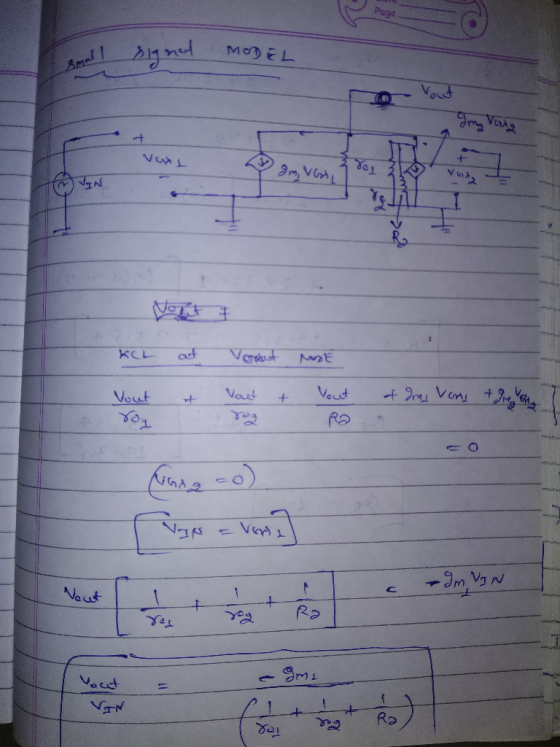
Add Answer to:
Q1 element, small signal parame ter, gm, rol, rn The size between the parameters is <<...
QUESTION 7 Following circuit is the small-signal equivalent circuit of a common-emitter amplifier. Assume Ri 10...
 QUESTION 7 Following circuit is the small-signal equivalent circuit of a common-emitter amplifier. Assume Ri 10 kn, RB - 93 KO, RL - 8.5 kn. Small signal parameters are gm = 100 m, 5k and ro - 10 kn. Calculate the voltage gain Avvo/ Re & m} ube gmbe 3 ro " vo
Q2: In the following BUT circuit, small signal parameters for Q1 and Q2 are labeled symbolically...
 Q2: In the following BUT circuit, small signal parameters for Q1 and Q2 are labeled symbolically (8., and B). Assuming V, - . Please derive the symbolie mathematical expressions for (a) Small signal voltage gain 4 =. .(b) input resistance R. (e) output resistance R . Hints: (1) This problem has identical requirements as Quiz!20. (2) Use the techniques discussed in Lecture#21. Vcc Q : 8MPL B Q2: 8m2» !-2,B2 Vin La te Vout
2. (36% ) In Fig. 2, the device parameters and (W/L) ratios for Q1-Q3 are given...
 2. (36% ) In Fig. 2, the device parameters and (W/L) ratios for Q1-Q3 are given below (WIL), 2 (W/L)2-2 (W/L); (a) (10%) If IREF-2nA, find VD3 and VS3 and verify if Q3 is in saturation. Ignore the channel length modulation for DC analysis. Note: DC Vc30 (b) (12%) Draw the "small signal" circuit for the complete +10 V amplifier. Based on the circuit, derive the AC voltage gain vo/vi in terms gm, ro and RD (please use appropriate subscripts...
The NMOS transistor in the circuit below has the following parameters: (W/L).(KP2)-826pA/V2, and VA-50V. ,-0.9V, K...
 The NMOS transistor in the circuit below has the following parameters: (W/L).(KP2)-826pA/V2, and VA-50V. ,-0.9V, K a. Calculate the drain-to-source resistance (rds) value. (Hint: VA- 1/) b. What is the value of the transconductance (gm)? (ignore A ONLY for this part) C. What is the value of the DC voltage Vo? (ignore λ ONLY for this part) d. Draw the small-signal equivalent circuit (including rds) e. Find the equation of the small-signal voltage gain Av-Vo/vi. This equation should be in...
The circuit below is a common collector (CC) circuit. Assuming VBEON VA, and ß - 100, , VCE.SAT 0.2V, VA 00 Calculate the transistor operating point. a. 1 b. Find the small signal voltage gain, 。 Fi...
 The circuit below is a common collector (CC) circuit.
Assuming VBEON VA, and ß - 100, , VCE.SAT 0.2V, VA 00 Calculate the transistor operating point. a. 1 b. Find the small signal voltage gain, 。 Find the driving point input resistance. c. d. If the input is a sinewave, find the maximum output voltage amplitude before clıpping sets in. B1 CO Q1 RE v,RB2
Assuming VBEON VA, and ß - 100, , VCE.SAT 0.2V, VA 00 Calculate the transistor...
The circuit below is a common collector (CC) circuit.
Assuming VBEON VA, and ß - 100, , VCE.SAT 0.2V, VA 00 Calculate the transistor operating point. a. 1 b. Find the small signal voltage gain, 。 Find the driving point input resistance. c. d. If the input is a sinewave, find the maximum output voltage amplitude before clıpping sets in. B1 CO Q1 RE v,RB2
Assuming VBEON VA, and ß - 100, , VCE.SAT 0.2V, VA 00 Calculate the transistor...
Please Solve ALL parts. For the amplifier below, the MOSFET has the following parameters: VIV, k...
 Please Solve ALL parts.
For the amplifier below, the MOSFET has the following parameters: VIV, k 1) Show (prove) that the transistor operates in the saturation mode 2) Determine the operating point by finding In and VDs 3) Assume infinite values for the coupling capacitors and draw a small signal model for this amplifier ) Find gm and ro 5) Find the voltage gain (vo/vi) Find Ri 7) Find the current gain (ioli) VDD +12V RD- 10k2 Vo Vi lmA...
Please Solve ALL parts.
For the amplifier below, the MOSFET has the following parameters: VIV, k 1) Show (prove) that the transistor operates in the saturation mode 2) Determine the operating point by finding In and VDs 3) Assume infinite values for the coupling capacitors and draw a small signal model for this amplifier ) Find gm and ro 5) Find the voltage gain (vo/vi) Find Ri 7) Find the current gain (ioli) VDD +12V RD- 10k2 Vo Vi lmA...
Given the circuit below with the following parameters: - M1: Vt,n = 0.48 V, Un Cox...
 Given the circuit below with the following parameters: - M1: Vt,n = 0.48 V, Un Cox = 90 UA/V2, W/L = 10 um/4 um, VdD+Vad 1 = 0.01 [1/V] - Supply voltage: Vpp = 3.3 V, vad = 10 mV > R a. Find the value of resistor R so that the bias current is 10uA. (Hint: Channel length modulation should be considered.) Ipi M1 Use the resistor value in (a) for the following calculations: b. What configuration (connection) M1...
Q6. An amplifier circuit using an n-MOSFET is shown in Fig. Q6. The n-MOSFET has the...
 Q6. An amplifier circuit using an n-MOSFET is shown in Fig. Q6. The n-MOSFET has the following parameters: K'-1 mA/V2 and λ-0.02 w. v°' is a small signal AC voltage ource 8V 8V Vout Ra 2.56 mA Fig. Q6 (a) Calculate the DC gate voltage, Va. (b) Assuming that the n-MOSFET is operating in the saturation region and neglecting channel length modulation, calculate the threshold voltage, VrHN, given that the voltage drop across the de current sorce, Inas, has been...
Problem 2: BJT Small-Signal Voltage Amplifiers in the lectures, we covered in detail the analysis of an npn BJT amplifier that utilizes a single-supply DC biasing. In this problem, you will meet...
 Problem 2: BJT Small-Signal Voltage Amplifiers in the lectures, we covered in detail the analysis of an npn BJT amplifier that utilizes a single-supply DC biasing. In this problem, you will meet two additional amplifier architectures- one that is based on dual DC supplies combined with a DC current source, and the other that utilizes a pnp BJT with single-supply biasing. In both problems (below) you need to manually find the amplifier's Q-point (that is, the DC values of Ic...
Please show neat, detailed work, including all small signal analysis if necessary, diagrams and c...
 Please show neat, detailed work, including all small signal
analysis if necessary, diagrams and complete algebra steps. Thanks
!!!
Answer all parts clearly !!!
NOTICE THERE MUST BE 4 VOLTAGE GAINS MULTIPLIED TO GET THE FINAL
GAIN. THE ANSWER IS
We were unable to transcribe this image2) VDD Ideal R3 R7 C5 C3 Vout RI R5 Q4 Rsig C1 Vbia Q1 02 R11 Q3 R2 R4 C2 R6 R8 R10 Rout-? Rin-? Assume all the capacitors are reasonably large at...
Please show neat, detailed work, including all small signal
analysis if necessary, diagrams and complete algebra steps. Thanks
!!!
Answer all parts clearly !!!
NOTICE THERE MUST BE 4 VOLTAGE GAINS MULTIPLIED TO GET THE FINAL
GAIN. THE ANSWER IS
We were unable to transcribe this image2) VDD Ideal R3 R7 C5 C3 Vout RI R5 Q4 Rsig C1 Vbia Q1 02 R11 Q3 R2 R4 C2 R6 R8 R10 Rout-? Rin-? Assume all the capacitors are reasonably large at...
 QUESTION 7 Following circuit is the small-signal equivalent circuit of a common-emitter amplifier. Assume Ri 10 kn, RB - 93 KO, RL - 8.5 kn. Small signal parameters are gm = 100 m, 5k and ro - 10 kn. Calculate the voltage gain Avvo/ Re & m} ube gmbe 3 ro " vo
 Q2: In the following BUT circuit, small signal parameters for Q1 and Q2 are labeled symbolically (8., and B). Assuming V, - . Please derive the symbolie mathematical expressions for (a) Small signal voltage gain 4 =. .(b) input resistance R. (e) output resistance R . Hints: (1) This problem has identical requirements as Quiz!20. (2) Use the techniques discussed in Lecture#21. Vcc Q : 8MPL B Q2: 8m2» !-2,B2 Vin La te Vout
 2. (36% ) In Fig. 2, the device parameters and (W/L) ratios for Q1-Q3 are given below (WIL), 2 (W/L)2-2 (W/L); (a) (10%) If IREF-2nA, find VD3 and VS3 and verify if Q3 is in saturation. Ignore the channel length modulation for DC analysis. Note: DC Vc30 (b) (12%) Draw the "small signal" circuit for the complete +10 V amplifier. Based on the circuit, derive the AC voltage gain vo/vi in terms gm, ro and RD (please use appropriate subscripts...
 The NMOS transistor in the circuit below has the following parameters: (W/L).(KP2)-826pA/V2, and VA-50V. ,-0.9V, K a. Calculate the drain-to-source resistance (rds) value. (Hint: VA- 1/) b. What is the value of the transconductance (gm)? (ignore A ONLY for this part) C. What is the value of the DC voltage Vo? (ignore λ ONLY for this part) d. Draw the small-signal equivalent circuit (including rds) e. Find the equation of the small-signal voltage gain Av-Vo/vi. This equation should be in...
 The circuit below is a common collector (CC) circuit.
Assuming VBEON VA, and ß - 100, , VCE.SAT 0.2V, VA 00 Calculate the transistor operating point. a. 1 b. Find the small signal voltage gain, 。 Find the driving point input resistance. c. d. If the input is a sinewave, find the maximum output voltage amplitude before clıpping sets in. B1 CO Q1 RE v,RB2
Assuming VBEON VA, and ß - 100, , VCE.SAT 0.2V, VA 00 Calculate the transistor...
The circuit below is a common collector (CC) circuit.
Assuming VBEON VA, and ß - 100, , VCE.SAT 0.2V, VA 00 Calculate the transistor operating point. a. 1 b. Find the small signal voltage gain, 。 Find the driving point input resistance. c. d. If the input is a sinewave, find the maximum output voltage amplitude before clıpping sets in. B1 CO Q1 RE v,RB2
Assuming VBEON VA, and ß - 100, , VCE.SAT 0.2V, VA 00 Calculate the transistor...
 Please Solve ALL parts.
For the amplifier below, the MOSFET has the following parameters: VIV, k 1) Show (prove) that the transistor operates in the saturation mode 2) Determine the operating point by finding In and VDs 3) Assume infinite values for the coupling capacitors and draw a small signal model for this amplifier ) Find gm and ro 5) Find the voltage gain (vo/vi) Find Ri 7) Find the current gain (ioli) VDD +12V RD- 10k2 Vo Vi lmA...
Please Solve ALL parts.
For the amplifier below, the MOSFET has the following parameters: VIV, k 1) Show (prove) that the transistor operates in the saturation mode 2) Determine the operating point by finding In and VDs 3) Assume infinite values for the coupling capacitors and draw a small signal model for this amplifier ) Find gm and ro 5) Find the voltage gain (vo/vi) Find Ri 7) Find the current gain (ioli) VDD +12V RD- 10k2 Vo Vi lmA...
 Given the circuit below with the following parameters: - M1: Vt,n = 0.48 V, Un Cox = 90 UA/V2, W/L = 10 um/4 um, VdD+Vad 1 = 0.01 [1/V] - Supply voltage: Vpp = 3.3 V, vad = 10 mV > R a. Find the value of resistor R so that the bias current is 10uA. (Hint: Channel length modulation should be considered.) Ipi M1 Use the resistor value in (a) for the following calculations: b. What configuration (connection) M1...
 Q6. An amplifier circuit using an n-MOSFET is shown in Fig. Q6. The n-MOSFET has the following parameters: K'-1 mA/V2 and λ-0.02 w. v°' is a small signal AC voltage ource 8V 8V Vout Ra 2.56 mA Fig. Q6 (a) Calculate the DC gate voltage, Va. (b) Assuming that the n-MOSFET is operating in the saturation region and neglecting channel length modulation, calculate the threshold voltage, VrHN, given that the voltage drop across the de current sorce, Inas, has been...
 Problem 2: BJT Small-Signal Voltage Amplifiers in the lectures, we covered in detail the analysis of an npn BJT amplifier that utilizes a single-supply DC biasing. In this problem, you will meet two additional amplifier architectures- one that is based on dual DC supplies combined with a DC current source, and the other that utilizes a pnp BJT with single-supply biasing. In both problems (below) you need to manually find the amplifier's Q-point (that is, the DC values of Ic...
 Please show neat, detailed work, including all small signal
analysis if necessary, diagrams and complete algebra steps. Thanks
!!!
Answer all parts clearly !!!
NOTICE THERE MUST BE 4 VOLTAGE GAINS MULTIPLIED TO GET THE FINAL
GAIN. THE ANSWER IS
We were unable to transcribe this image2) VDD Ideal R3 R7 C5 C3 Vout RI R5 Q4 Rsig C1 Vbia Q1 02 R11 Q3 R2 R4 C2 R6 R8 R10 Rout-? Rin-? Assume all the capacitors are reasonably large at...
Please show neat, detailed work, including all small signal
analysis if necessary, diagrams and complete algebra steps. Thanks
!!!
Answer all parts clearly !!!
NOTICE THERE MUST BE 4 VOLTAGE GAINS MULTIPLIED TO GET THE FINAL
GAIN. THE ANSWER IS
We were unable to transcribe this image2) VDD Ideal R3 R7 C5 C3 Vout RI R5 Q4 Rsig C1 Vbia Q1 02 R11 Q3 R2 R4 C2 R6 R8 R10 Rout-? Rin-? Assume all the capacitors are reasonably large at...
Most questions answered within 3 hours.
-
Where is the error in this code sequence?
String s1 = "Hello";
String s2 = "ello";...
asked 11 months ago -
Financial data for Joel de Paris, Inc., for last year
follow:
Joel de Paris, Inc.
Balance...
asked 11 months ago -
Consider this reaction:
Al2(SO4)3 (aq)+ BaCl3
(aq) Al2Cl6 (aq)- +
3BaSO4(s) . What is the...
asked 11 months ago -
Suppose that Savneet is considering increasing her
recent random sample from 20 car rentals to 40...
asked 11 months ago -
Trucks arrive at an unloading terminal at an average rate of 120
per hour.
Trucks arrive...
asked 11 months ago -
Why are methanol and ethanol completely soluble in water while
octanol is not very little soluble....
asked 11 months ago -
A facilities manager at a university reads in a research report
that the mean amount of...
asked 11 months ago -
When the CuSO4 is rehydrated by adding water to the anhydrous
compound, is this an endothermic...
asked 11 months ago -
A ray of sunlight is passing from diamond into crown glass; the
angle of incidence is...
asked 11 months ago -
A block of mass 0.249 kg is placed on top of a light, vertical
spring of...
asked 11 months ago -
how do the kidneys compensate in the presences of acidosis
a) trigger hyperventilate
b) reserve acid...
asked 11 months ago -
Question 501 pts
The rental rate of capital to the firm increases. Which of the
following...
asked 11 months ago