
Homework Answers
Add Answer to:
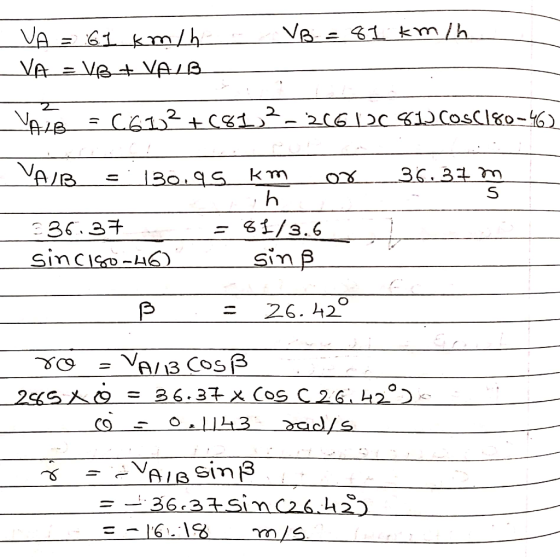
Car A is traveling at the constant speed of 61 km/h as it rounds the circular...
Question is asking for the: r double dot, theta double dot and also, r double dot =1.98 m/s^2 and theta double dot 0.014...
 Question is asking for the: r double dot, theta double
dot
and also, r double dot =1.98 m/s^2 and theta double
dot 0.0144 rad/s^2 are
incorrect.
Thank you!!
Car A is traveling at the constant speed of 47 km/h as it rounds the circular curve of 205-m radius and at the instant represented is at the position e traveling at the constant speed of 60 km/h and passes the center of the circle at this same instant. Car A is...
Question is asking for the: r double dot, theta double
dot
and also, r double dot =1.98 m/s^2 and theta double
dot 0.0144 rad/s^2 are
incorrect.
Thank you!!
Car A is traveling at the constant speed of 47 km/h as it rounds the circular curve of 205-m radius and at the instant represented is at the position e traveling at the constant speed of 60 km/h and passes the center of the circle at this same instant. Car A is...
An unmarked police car traveling a constant 80.0 km/h is passed by a speeder traveling 140...
An unmarked police car traveling a constant 80.0 km/h is passed by a speeder traveling 140 km/h . Precisely 2.50 s after the speeder passes, the police officer steps on the accelerator; if the police car's acceleration is 2.40 m/s2 , how much time passes before the police car overtakes the speeder after the speeder passes (assumed moving at constant speed)?
An unmarked police car traveling a constant 85 km/h is passed by a speeder traveling 136...
An unmarked police car traveling a constant 85 km/h is passed by a speeder traveling 136 km/h . Precisely 1.00 s after the speeder passes, the police officer steps on the accelerator; if the police car's acceleration is 2.30 m/s2 , how much time passes after the police car is passed by a speeder and before the police car overtakes the speeder (assumed moving at constant speed)?
An unmarked police car traveling a constant 95 km/h is passed by a speeder traveling 130...
An unmarked police car traveling a constant 95 km/h is passed by a speeder traveling 130 km/h. Precisely 1.00 s after the speeder passes, the police officer steps on the accelerator; if the police car's acceleration is 2.50 m/s^2, how much time passes after the police car is passed by a speeder and before the police car overtakes the speeder (assumed moving at constant speed)?
Chapter 2, Problem 2/149 Car A rounds a curve of 139-m radius at a constant speed...
 Chapter 2, Problem 2/149 Car A rounds a curve of 139-m radius at a constant speed of 51 km/h. At the instant represented, car B is moving at 86 km/h but is slowing down at the rate of 3.9 m/s2. Determine the velocity and acceleration of car A as observed from car B. + B 139 m Answer: VA/B = + ) m/s : a A/B = + j) m/s2 Click if you would like to Show Work for this...
A car is traveling at a steady 87 km/h in a 50 km/h zone
A car is traveling at a steady 87 km/h in a 50 km/h zone. A police motorcycle takes off at the instant the car passes it, accelerating at a steady 7.4 m/s2.1. How much time elapses before the motorcycle is moving as fast as the car?2. How far is the motorcycle from the car when it reaches this speed?
An unmarked police car traveling a constant 95 km/h is passed by a speeder traveling 140...
An unmarked police car traveling a constant 95 km/h is passed by a speeder traveling 140 km/h. Precisely 1.00 s after the speeder passes, the police officer steps on the accelerator; if the police car's acceleration is 2.60 m/s2 , how much time passes after the police car is passed by a speeder and before the police car overtakes the speeder (assumed moving at constant speed)? Express your answer with the appropriate units.
An unmarked police car traveling a constant 95 km/hkm/h is passed by a speeder traveling 137...
An unmarked police car traveling a constant 95 km/hkm/h is passed by a speeder traveling 137 km/hkm/h . Precisely 1.00 ss after the speeder passes, the police officer steps on the accelerator; if the police car's acceleration is 2.30 m/s2m/s2 , how much time passes after the police car is passed by a speeder and before the police car overtakes the speeder (assumed moving at constant speed)?
An unmarked police car, traveling a constant 90.0 km/h, is passed by a speeder traveling 166.0...
An unmarked police car, traveling a constant 90.0 km/h, is passed by a speeder traveling 166.0 km/h. Precisely 3.40 seconds after the speeder passes, the policeman steps on the accelerator. If the police car's acceleration is 2.1 m/s2, how much time elapses after the police car is passed until it overtakes the speeder (assumed moving at constant speed)?
A car is traveling at a steady 90km/h in a 50 km/h zone. A police motorcycle...
A car is traveling at a steady 90km/h in a 50 km/h zone. A police motorcycle takes off at the instant the car passes it, accelerating at a steady 8.0 m/s^2. A. How much time elapses before the motorcycle is moving as fast as the car? B. How far is the motorcycle from the car when it reaches this speed?
 Question is asking for the: r double dot, theta double
dot
and also, r double dot =1.98 m/s^2 and theta double
dot 0.0144 rad/s^2 are
incorrect.
Thank you!!
Car A is traveling at the constant speed of 47 km/h as it rounds the circular curve of 205-m radius and at the instant represented is at the position e traveling at the constant speed of 60 km/h and passes the center of the circle at this same instant. Car A is...
Question is asking for the: r double dot, theta double
dot
and also, r double dot =1.98 m/s^2 and theta double
dot 0.0144 rad/s^2 are
incorrect.
Thank you!!
Car A is traveling at the constant speed of 47 km/h as it rounds the circular curve of 205-m radius and at the instant represented is at the position e traveling at the constant speed of 60 km/h and passes the center of the circle at this same instant. Car A is...
 Chapter 2, Problem 2/149 Car A rounds a curve of 139-m radius at a constant speed of 51 km/h. At the instant represented, car B is moving at 86 km/h but is slowing down at the rate of 3.9 m/s2. Determine the velocity and acceleration of car A as observed from car B. + B 139 m Answer: VA/B = + ) m/s : a A/B = + j) m/s2 Click if you would like to Show Work for this...
Most questions answered within 3 hours.
-
Where is the error in this code sequence?
String s1 = "Hello";
String s2 = "ello";...
asked 11 months ago -
Financial data for Joel de Paris, Inc., for last year
follow:
Joel de Paris, Inc.
Balance...
asked 11 months ago -
Consider this reaction:
Al2(SO4)3 (aq)+ BaCl3
(aq) Al2Cl6 (aq)- +
3BaSO4(s) . What is the...
asked 11 months ago -
Suppose that Savneet is considering increasing her
recent random sample from 20 car rentals to 40...
asked 11 months ago -
Trucks arrive at an unloading terminal at an average rate of 120
per hour.
Trucks arrive...
asked 11 months ago -
Why are methanol and ethanol completely soluble in water while
octanol is not very little soluble....
asked 11 months ago -
A facilities manager at a university reads in a research report
that the mean amount of...
asked 11 months ago -
When the CuSO4 is rehydrated by adding water to the anhydrous
compound, is this an endothermic...
asked 11 months ago -
A ray of sunlight is passing from diamond into crown glass; the
angle of incidence is...
asked 11 months ago -
A block of mass 0.249 kg is placed on top of a light, vertical
spring of...
asked 11 months ago -
how do the kidneys compensate in the presences of acidosis
a) trigger hyperventilate
b) reserve acid...
asked 11 months ago -
Question 501 pts
The rental rate of capital to the firm increases. Which of the
following...
asked 11 months ago