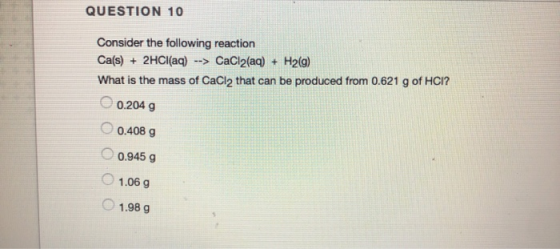
QUESTION 10
Consider the following reaction
Ca(s) + 2HCl(aq) --> CaCl2(aq) + H2(g)
What is the mass of CaCl2 that can be produced from 0.621 g of HCI?
0.204 g
0.408 g
0.945 g
1.06 g
1.98 g
Homework Answers
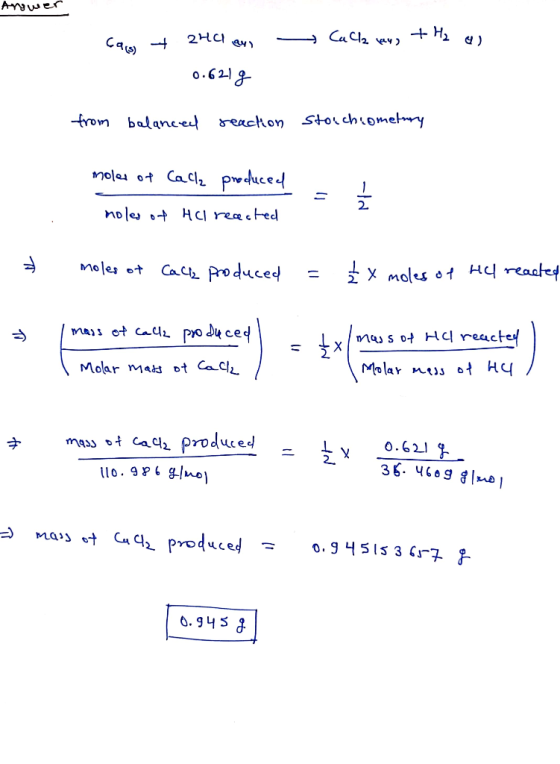
Add Answer to:
QUESTION 10 Consider the following reaction Ca(s) + 2HCl(aq) --> CaCl2(aq) + H2(g) What is the...
QUESTION 13 Given the following reaction Ca(s) + 2HCl(aq) - CaCl2(aq) + H2(g) 11.00 g of...
 QUESTION 13 Given the following reaction Ca(s) + 2HCl(aq) - CaCl2(aq) + H2(g) 11.00 g of Ca reacts with 0.850 g HCl and 1.21 g CaCl2 are produced, what is the theoretical yield, the percent yield and the limiting reactant? 2.77 .43.7%, Ca limiting 2.77 9, 93.8%, HCI limiting 1.29 g, 43.7%, Ca limiting 1.29 g, 93.8% HCI limiting 2.779, 46.6%, Ca limiting 1.29 9. 46.6%, HCI limiting
QUESTION 12 Consider the following reaction Ca(s) + 2HCl(aq) --> CaCl2(aq) + H2(g) If the theoretical...
 QUESTION 12 Consider the following reaction Ca(s) + 2HCl(aq) --> CaCl2(aq) + H2(g) If the theoretical yield of CaCl2 is 0.736 g and the actual yield is 0.644 g, what is the percent yield? 87.5% 47.4% 96.5% 79% 114%
Consider the following reaction Ca(s) + 2HCl(aq) --> CaCl2(aq) + H2(g) If the theoretical yield of...
Consider the following reaction Ca(s) + 2HCl(aq) --> CaCl2(aq) + H2(g) If the theoretical yield of CaCl2 is 0.736 g and the actual yield is 0.720 g, what is the percent yield? A.)53.0% b.)32.6% c.)95.5% d.)97.8% e.)102%
Given the following reaction Ca(s) + 2HCl(aq) → CaCl2(aq) + H2(g) If 0.500 g of Ca...
Given the following reaction Ca(s) + 2HCl(aq) → CaCl2(aq) + H2(g) If 0.500 g of Ca reacts with 0.850 g HCl and 1.21 g CaCl2 are produced, what is the theoretical yield, the percent yield and the limiting reactant? 1.38 g, 87.7%, Ca limiting 1.38 g, 93.8%, HCl limiting 1.29 g, 87.7%, Ca limiting 1.29 g, 93.8% HCl limiting 1.38 g, 92.8%, Ca limiting 1.29 g, 92.8%, HCl limiting
QUESTION 9 Consider the following reaction Ca(s)2HCI(aq) ->CaCl2(aq) H2(g) How many moles of HCI are needed...
 QUESTION 9 Consider the following reaction Ca(s)2HCI(aq) ->CaCl2(aq) H2(g) How many moles of HCI are needed to form 3 moles of CaCl2? 0 1 mole 1.5 moles 3 moles 6 moles 8 moles
QUESTION 1 Consider the following chemical reaction: Mg(s) + 2HCl(aq) – MgCl2(aq) + H2(g) Which of...
 QUESTION 1 Consider the following chemical reaction: Mg(s) + 2HCl(aq) – MgCl2(aq) + H2(g) Which of the following changes will decrease the rate of this reaction? Adding more solid Mg. Adding a catalyst. Decreasing the pressure of H2. Decreasing the temperature. Increasing the concentration of HCI.
QUESTION 1 Consider the following chemical reaction: Mg(s) + 2HCl(aq) → MgCl2(aq) + H2(g) Which of...
 QUESTION 1 Consider the following chemical reaction: Mg(s) + 2HCl(aq) → MgCl2(aq) + H2(g) Which of the following changes will decrease the rate of this reaction? Adding more solid Mg. Adding a catalyst. Decreasing the pressure of H2. Decreasing the temperature. Increasing the concentration of HCI.
QUESTION 1 Consider the following chemical reaction: Mg(s) + 2HCl(aq) → MgCl2(aq) + H2(g) Which of...
 QUESTION 1 Consider the following chemical reaction: Mg(s) + 2HCl(aq) → MgCl2(aq) + H2(g) Which of the following changes will increase the rate of this reaction? Decreasing the concentration of HCI. O Adding more MgCl2. O Increasing the pressure of H2. Decreasing the temperature. Adding a catalyst. N QUESTION 2
consider the following reaction: Zn(s)+2HCl(aq)->ZnCl2(aq)+H2(g). if 14.2 g of Zn reacts with 14.2 g of HCl,...
consider the following reaction: Zn(s)+2HCl(aq)->ZnCl2(aq)+H2(g). if 14.2 g of Zn reacts with 14.2 g of HCl, how many grams of ZnCl2 can be produced?
1. Consider the following equation: Ca(OH)2(s) + 2HCl(aq) + CaCl2(aq) + 2 H20(1).Solve the following questions...
 1. Consider the following equation: Ca(OH)2(s) + 2HCl(aq) + CaCl2(aq) + 2 H20(1).Solve the following questions based on the above questions, a. What type of chemical reaction is taking place? b. How many liters of 0.100 M HCI would be required to react completely with 5.00 grams of calcium hydroxide? (5 pts) Show the work. c. If I combined 15.0 grams of calcium hydroxide with 75,0 mL of 0.500 M HCI, how many grams of calcium chloride would be formed?...
 QUESTION 13 Given the following reaction Ca(s) + 2HCl(aq) - CaCl2(aq) + H2(g) 11.00 g of Ca reacts with 0.850 g HCl and 1.21 g CaCl2 are produced, what is the theoretical yield, the percent yield and the limiting reactant? 2.77 .43.7%, Ca limiting 2.77 9, 93.8%, HCI limiting 1.29 g, 43.7%, Ca limiting 1.29 g, 93.8% HCI limiting 2.779, 46.6%, Ca limiting 1.29 9. 46.6%, HCI limiting
 QUESTION 12 Consider the following reaction Ca(s) + 2HCl(aq) --> CaCl2(aq) + H2(g) If the theoretical yield of CaCl2 is 0.736 g and the actual yield is 0.644 g, what is the percent yield? 87.5% 47.4% 96.5% 79% 114%
 QUESTION 9 Consider the following reaction Ca(s)2HCI(aq) ->CaCl2(aq) H2(g) How many moles of HCI are needed to form 3 moles of CaCl2? 0 1 mole 1.5 moles 3 moles 6 moles 8 moles
 QUESTION 1 Consider the following chemical reaction: Mg(s) + 2HCl(aq) – MgCl2(aq) + H2(g) Which of the following changes will decrease the rate of this reaction? Adding more solid Mg. Adding a catalyst. Decreasing the pressure of H2. Decreasing the temperature. Increasing the concentration of HCI.
 QUESTION 1 Consider the following chemical reaction: Mg(s) + 2HCl(aq) → MgCl2(aq) + H2(g) Which of the following changes will decrease the rate of this reaction? Adding more solid Mg. Adding a catalyst. Decreasing the pressure of H2. Decreasing the temperature. Increasing the concentration of HCI.
 QUESTION 1 Consider the following chemical reaction: Mg(s) + 2HCl(aq) → MgCl2(aq) + H2(g) Which of the following changes will increase the rate of this reaction? Decreasing the concentration of HCI. O Adding more MgCl2. O Increasing the pressure of H2. Decreasing the temperature. Adding a catalyst. N QUESTION 2
 1. Consider the following equation: Ca(OH)2(s) + 2HCl(aq) + CaCl2(aq) + 2 H20(1).Solve the following questions based on the above questions, a. What type of chemical reaction is taking place? b. How many liters of 0.100 M HCI would be required to react completely with 5.00 grams of calcium hydroxide? (5 pts) Show the work. c. If I combined 15.0 grams of calcium hydroxide with 75,0 mL of 0.500 M HCI, how many grams of calcium chloride would be formed?...
Most questions answered within 3 hours.
-
Where is the error in this code sequence?
String s1 = "Hello";
String s2 = "ello";...
asked 10 months ago -
Financial data for Joel de Paris, Inc., for last year
follow:
Joel de Paris, Inc.
Balance...
asked 10 months ago -
Consider this reaction:
Al2(SO4)3 (aq)+ BaCl3
(aq) Al2Cl6 (aq)- +
3BaSO4(s) . What is the...
asked 10 months ago -
Suppose that Savneet is considering increasing her
recent random sample from 20 car rentals to 40...
asked 10 months ago -
Trucks arrive at an unloading terminal at an average rate of 120
per hour.
Trucks arrive...
asked 10 months ago -
Why are methanol and ethanol completely soluble in water while
octanol is not very little soluble....
asked 10 months ago -
A facilities manager at a university reads in a research report
that the mean amount of...
asked 10 months ago -
When the CuSO4 is rehydrated by adding water to the anhydrous
compound, is this an endothermic...
asked 10 months ago -
A ray of sunlight is passing from diamond into crown glass; the
angle of incidence is...
asked 10 months ago -
A block of mass 0.249 kg is placed on top of a light, vertical
spring of...
asked 10 months ago -
how do the kidneys compensate in the presences of acidosis
a) trigger hyperventilate
b) reserve acid...
asked 10 months ago -
Question 501 pts
The rental rate of capital to the firm increases. Which of the
following...
asked 10 months ago