
Homework Answers
Add Answer to:
Question 3 Consider a closed economy described by the following equations: Y-C+1+G Y -5,000 G- 1,000...
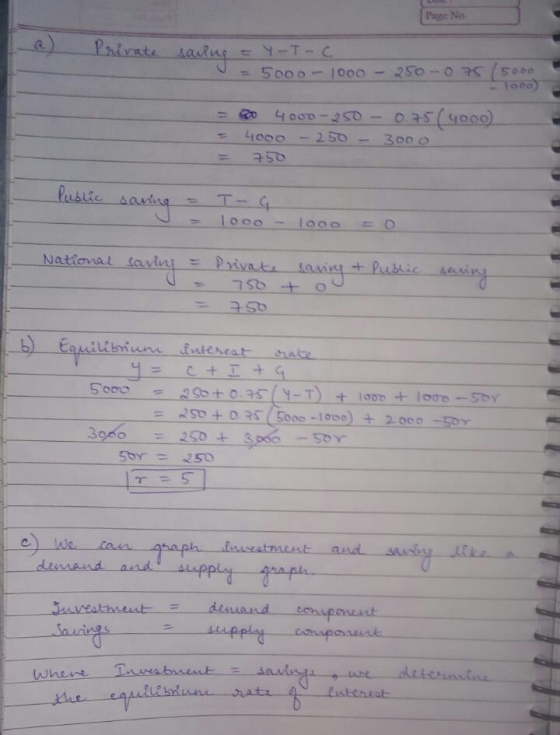
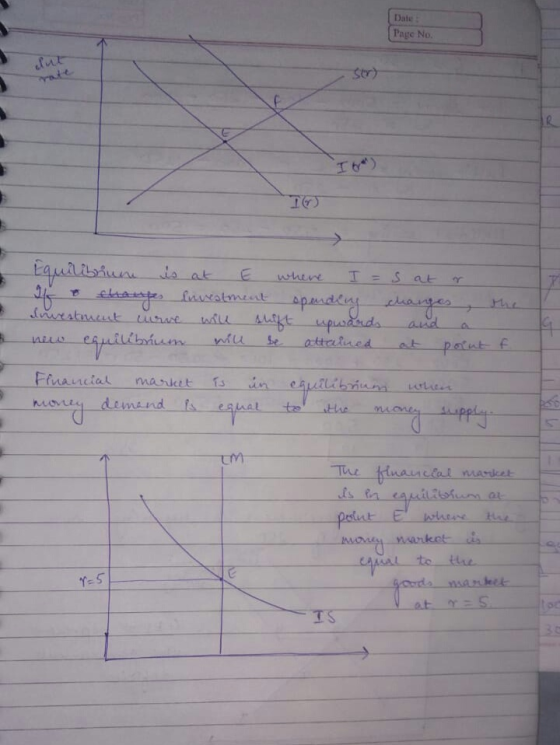
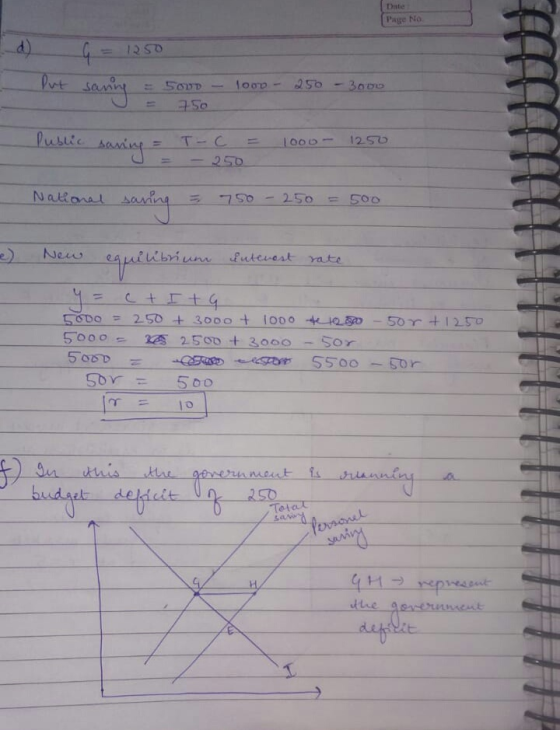
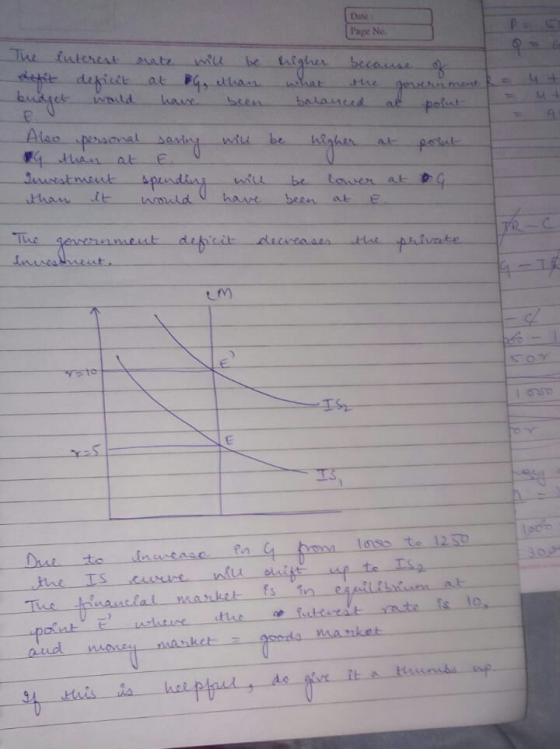
Question 3 Consider a closed economy described by the following equations: Y=C+I+G Y-5,000 G 1,000 T=...
 Question 3 Consider a closed economy described by the following equations: Y=C+I+G Y-5,000 G 1,000 T= 1,000 C 250+0.75 (Y -T) 1,000-50 a. (3 points) In this economy, compute private saving, public saving, and national saving. b. (2 points) Find the equilibrium interest rate. c. (2 points) Draw a graph containing the saving and investment curves for this economy Show the financial market equilibrium. d. (2 points) Now suppose the G rises to 1,250. Compute private saving, public saving, and...
Consider an economy described as follows: Y = C + I + G Y = 8,000...
Consider an economy described as follows: Y = C + I + G Y = 8,000 G = 2,500 T = 2,000 C = 1,000 + 2/3(Y - T) I = 1,200 – 100r a. In this economy, compute private saving, public saving, and national saving. b. Find the equilibrium interest rate. c. Now suppose that G is reduced by 500. Compute private saving, public saving, and national saving. d. Find the new equilibrium interest rate.
Y=C+I+G.Y=8,000.G=2,500.T=2,000.C=1,000+2/3 (Y-T).I=1,200-100 r. = C+I+G = 8,000. G = 2,500. T = 2,000. C = 1,000+2/3...
 Y=C+I+G.Y=8,000.G=2,500.T=2,000.C=1,000+2/3 (Y-T).I=1,200-100 r. = C+I+G = 8,000. G = 2,500. T = 2,000. C = 1,000+2/3 (Y – T'). I = 1,200 - 100 r. a. In this economy, compute private saving, public saving, and national saving. b. Find the equilibrium interest rate. C. Now suppose that G is reduced by 500. Compute private saving, public saving, and national saving. d. Find the new equilibrium interest rate.
How to solve this problem especially on the b and d this kind of graph question...
 How to solve this problem especially on the b and d this kind
of graph question
eclass.srv.ualberta.ca Question 2 (15 marks) Consider the following macroeconomic model that describes an Economy: - 1/2 Y =C+I+G Y = 5000 G = T = 1000 C = 250 +0.75(Y-T) 1 = 1000 - 50r a) Calculate the amount of private saving, public saving and the national saving in this economy. b) Calculate the equilibrium interest rate (r). c) Draw a graph containing the...
How to solve this problem especially on the b and d this kind
of graph question
eclass.srv.ualberta.ca Question 2 (15 marks) Consider the following macroeconomic model that describes an Economy: - 1/2 Y =C+I+G Y = 5000 G = T = 1000 C = 250 +0.75(Y-T) 1 = 1000 - 50r a) Calculate the amount of private saving, public saving and the national saving in this economy. b) Calculate the equilibrium interest rate (r). c) Draw a graph containing the...
Consider an economy in the short-run described by the following equations: AD = C + I...
Consider an economy in the short-run described by the following equations: AD = C + I + G G = 500 TA = 700, TR = 200 C = 400 + 0.6(Y – TA + TR) I = 600 What is the equilibrium condition that allows us to solve for Y. Find Y. Compute private saving, public saving and total/national saving at this level of Y. What is the value of the marginal propensity to consume? What is the value of...
1. Given the following data, answer all questions Y 5000 G-1000 T 1000 C-250+0.75 (Y-T 1000-50...
 1. Given the following data, answer all questions Y 5000 G-1000 T 1000 C-250+0.75 (Y-T 1000-50 a. Calculate: Consumption Private Saving Public Saving- National Saving Investment- b. Calculate the equilibrium interest rate:r c. Assume G increases to 1,250. Calculate: Consumption Private Saving- Public Saving National Saving- d. Calculate the new equilibrium interest rate: Now open the economy to NX: NX 500-500 E Investment- e. Calculate: Consumption Private Saving = Public Saving- National Saving Investment- The trade balance- Equilibrium exchange rate-...
C. Consider an economy described by the following equations: Y = C+I+G+NX K = 2,500 40,000...
 C. Consider an economy described by the following equations: Y = C+I+G+NX K = 2,500 40,000 = K0.5 0.5 = 2000 T = 2000 C = 600+.8 (Y-T) I = 2000 - 40r NX = 1000 - 400€ - 0.002Y T = r = 10 1. [4 points) What is the long-run level of output? 2. [7 points) What is the equilibrium value of the real exchange rate? 3. [9 points) What are the equilibrium values of national saving, investment...
3. Goods market equilibrium An economy is described by: C = 160 + 0.6YD I =...
3. Goods market equilibrium An economy is described by: C = 160 + 0.6YD I = 150 G = 150 T = 100 NX = 0 a. Find equilibrium Y (real GDP). b. Find disposable income, YD c. Consumer spending. Now let G = 200. d. Find the new value of Y. e. Find the new value of disposable income. f. Compute private saving, public saving and national saving. g. Does national saving = I in this case. Show why...
21. G increase with algebra. Consider an economy described by the following model. Y = K1/3L2/3...
 21. G increase with algebra. Consider an economy described by the following model. Y = K1/3L2/3 K = 1000; L = 1000 G = 100 T = 100 C = 250 + 0.5(Y-T) 1 = 600 – 100r Calculate the equilibrium real interest rate, national saving, public saving, private saving, consumption, output, and investment. (Hint: you probably don't want to solve for them it in that order.) i.rs ii. national saving = iii. public saving = iv. private saving =...
Consider an economy in long run equilibrium described by the following equations: Y = C + I + G +...
Consider an economy in long run equilibrium described by the following equations: Y = C + I + G + NX Y = 5000 G = 1000 T = 1000 C = 250 + 0.75*( Y - T ) I = 1000 - 50*r NCO = 500 - 50*r Where r is the real interest rate (in % terms). Suppose G rises to 1250 without any change in T. Solve again for the equilibrium real interest rate and the rest...
 Question 3 Consider a closed economy described by the following equations: Y=C+I+G Y-5,000 G 1,000 T= 1,000 C 250+0.75 (Y -T) 1,000-50 a. (3 points) In this economy, compute private saving, public saving, and national saving. b. (2 points) Find the equilibrium interest rate. c. (2 points) Draw a graph containing the saving and investment curves for this economy Show the financial market equilibrium. d. (2 points) Now suppose the G rises to 1,250. Compute private saving, public saving, and...
 Y=C+I+G.Y=8,000.G=2,500.T=2,000.C=1,000+2/3 (Y-T).I=1,200-100 r. = C+I+G = 8,000. G = 2,500. T = 2,000. C = 1,000+2/3 (Y – T'). I = 1,200 - 100 r. a. In this economy, compute private saving, public saving, and national saving. b. Find the equilibrium interest rate. C. Now suppose that G is reduced by 500. Compute private saving, public saving, and national saving. d. Find the new equilibrium interest rate.
 How to solve this problem especially on the b and d this kind
of graph question
eclass.srv.ualberta.ca Question 2 (15 marks) Consider the following macroeconomic model that describes an Economy: - 1/2 Y =C+I+G Y = 5000 G = T = 1000 C = 250 +0.75(Y-T) 1 = 1000 - 50r a) Calculate the amount of private saving, public saving and the national saving in this economy. b) Calculate the equilibrium interest rate (r). c) Draw a graph containing the...
How to solve this problem especially on the b and d this kind
of graph question
eclass.srv.ualberta.ca Question 2 (15 marks) Consider the following macroeconomic model that describes an Economy: - 1/2 Y =C+I+G Y = 5000 G = T = 1000 C = 250 +0.75(Y-T) 1 = 1000 - 50r a) Calculate the amount of private saving, public saving and the national saving in this economy. b) Calculate the equilibrium interest rate (r). c) Draw a graph containing the...
 1. Given the following data, answer all questions Y 5000 G-1000 T 1000 C-250+0.75 (Y-T 1000-50 a. Calculate: Consumption Private Saving Public Saving- National Saving Investment- b. Calculate the equilibrium interest rate:r c. Assume G increases to 1,250. Calculate: Consumption Private Saving- Public Saving National Saving- d. Calculate the new equilibrium interest rate: Now open the economy to NX: NX 500-500 E Investment- e. Calculate: Consumption Private Saving = Public Saving- National Saving Investment- The trade balance- Equilibrium exchange rate-...
 C. Consider an economy described by the following equations: Y = C+I+G+NX K = 2,500 40,000 = K0.5 0.5 = 2000 T = 2000 C = 600+.8 (Y-T) I = 2000 - 40r NX = 1000 - 400€ - 0.002Y T = r = 10 1. [4 points) What is the long-run level of output? 2. [7 points) What is the equilibrium value of the real exchange rate? 3. [9 points) What are the equilibrium values of national saving, investment...
 21. G increase with algebra. Consider an economy described by the following model. Y = K1/3L2/3 K = 1000; L = 1000 G = 100 T = 100 C = 250 + 0.5(Y-T) 1 = 600 – 100r Calculate the equilibrium real interest rate, national saving, public saving, private saving, consumption, output, and investment. (Hint: you probably don't want to solve for them it in that order.) i.rs ii. national saving = iii. public saving = iv. private saving =...
Most questions answered within 3 hours.
-
Where is the error in this code sequence?
String s1 = "Hello";
String s2 = "ello";...
asked 10 months ago -
Financial data for Joel de Paris, Inc., for last year
follow:
Joel de Paris, Inc.
Balance...
asked 10 months ago -
Consider this reaction:
Al2(SO4)3 (aq)+ BaCl3
(aq) Al2Cl6 (aq)- +
3BaSO4(s) . What is the...
asked 10 months ago -
Suppose that Savneet is considering increasing her
recent random sample from 20 car rentals to 40...
asked 10 months ago -
Trucks arrive at an unloading terminal at an average rate of 120
per hour.
Trucks arrive...
asked 10 months ago -
Why are methanol and ethanol completely soluble in water while
octanol is not very little soluble....
asked 10 months ago -
A facilities manager at a university reads in a research report
that the mean amount of...
asked 10 months ago -
When the CuSO4 is rehydrated by adding water to the anhydrous
compound, is this an endothermic...
asked 10 months ago -
A ray of sunlight is passing from diamond into crown glass; the
angle of incidence is...
asked 10 months ago -
A block of mass 0.249 kg is placed on top of a light, vertical
spring of...
asked 10 months ago -
how do the kidneys compensate in the presences of acidosis
a) trigger hyperventilate
b) reserve acid...
asked 10 months ago -
Question 501 pts
The rental rate of capital to the firm increases. Which of the
following...
asked 10 months ago