
Homework Answers
Add Answer to:
Please explain Data: C(graphite) + O2(g) => CO2(g) AH = -393.5 kJ H2(g) + 1/2O2(g) =>...
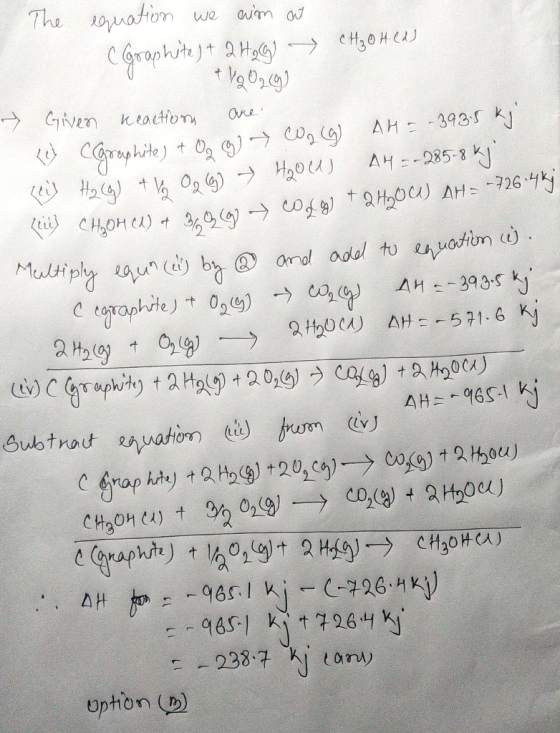
Calculate the enthalpy change for the reaction C (graphite) + 2 H2 (g) + ½ O2...
Calculate the enthalpy change for the reaction C (graphite) + 2 H2 (g) + ½ O2 (g) → CH3OH (ℓ) Using the following information: C (graphite) + O2 (g) → CO2 (g) ΔHf° = –393.5 kJ H2 (g) + ½ O2 (g) → H2O (ℓ) ΔHf° = –285.8 kJ CH3OH (ℓ) + 3/2 O2 (g) → CO2 (g) + 2 H2O (ℓ) ΔHrxn° = –726.4 kJ a. –238.7 kJ b. 1691.5 kJ c. –1691.5 kJ d. 47.1 kJ e. –47.1...
From the following data, C(graphite) + O2(g) → CO2(g) AHrxn = -393.5 kJ/mol H2(g) + O2(g)...
 From the following data, C(graphite) + O2(g) → CO2(g) AHrxn = -393.5 kJ/mol H2(g) + O2(g) → H200) AH"rxn = -285.8 kJ/mol 2C2H6(g) + 702(g) -> 4CO2(g) + 6H2O(l) Arxn=-3119.6 kJ/mol Calculate the enthalpy change for the reaction: 2 C(graphite) + 3H2(g) + C2H668)
From the following heats of combustion, CH3OH(l) + 3/2O2(g) → CO2(g) + 2H2O(l) ΔHorxn = –726.4...
From the following heats of combustion, CH3OH(l) + 3/2O2(g) → CO2(g) + 2H2O(l) ΔHorxn = –726.4 kJ/mol C(graphite) + O2(g) → CO2(g) ΔHorxn = –393.5 kJ/mol H2(g) + ½O2(g) → H2O(l) ΔHorxn = –285.8 kJ/mol Calculate the enthalpy of formation of methanol (CH3OH) from its elements. C(graphite) + 2H2(g) + ½O2(g) → CH3OH(l) Methanol (CH3OH) is an organic solvent and is also used as a fuel in some automobile engines. From...
Given the following equations and AH' values: C(s) + O2(g) + CO2(g) AH = -393.5 kJ...
 Given the following equations and AH' values: C(s) + O2(g) + CO2(g) AH = -393.5 kJ H2(g) + 1/2O2(g) - H20 (1) AH = -285.8 kJ 2C2H2 (8) + 5O2(g) + 4CO2(g) + 2H20 (1) AH'= -2598 kJ Determine the heat of reaction (in kJ) at 298 K for the reaction: 2C(s) + H2(8) C2H2 (8) 0-136.8 0-219.8 0-109.9 O-167.1 +226.2
PROBLEM-SOLVING CLASS ACTIVITY 11 Use Hess's Law to calculate the enthalpy of formation of CH2OH: C(graphite)...
 PROBLEM-SOLVING CLASS ACTIVITY 11 Use Hess's Law to calculate the enthalpy of formation of CH2OH: C(graphite) + 2 H2(g) + 1026) → CH2OH(1) Given the following data: CH2OH() • 02(9) + CO2(g) + 2H2O(1) AH°: -726.4 kJ/mol C(graphite). O2(g) → CO2(9) AH' = -393.5 kJ/mol H2(g) + 40269) → H2O(1) AH = -285.8 kJ/mol
C(s) + O2(g) + CO2(g) AH° = -393.5 kJ (5 pts) Given the following enthalpy values...
 C(s) + O2(g) + CO2(g) AH° = -393.5 kJ (5 pts) Given the following enthalpy values for reactions at 25°C, what is AH at 25°C for the following reaction: C3H3(g) + 502(g) + 4H2O(g) + 3CO2(g) AH = -2043 kJ 3C(s) + 4 H2(g) → C3H8 (g) 2H2(g) + O2(g) + 2H2O(g) AH° = -483.6 kJ
Enter your answer in the provided box From the following data, C(graphite) + O2(0)+ CO2(g) An°...
 Enter your answer in the provided box From the following data, C(graphite) + O2(0)+ CO2(g) An° . =-393.5 kJ/mol rxn Hy(@) +0,6) H200 AH =-285.8 kJ/mol rxn 2C2H6(8) + 1026) →40026) + 6H20(1) AH =-3119.6 kJ/mol rxn calculate the enthalpy change for the reaction below: 2 C(graphite) + 3H2(g) → CH()
AH = -727 kJ Given that CH3OH (1) + 3/2 O2 (g) → CO2 (g) +...
 AH = -727 kJ Given that CH3OH (1) + 3/2 O2 (g) → CO2 (g) + 2 H2O(1) CO(g) + 1/2O2 (g) → CO2 (9) CH3OH(1) → CH3OH(g) AH = -284 kJ AH = 38 kJ H20 (1)→ H20 (9) AH = 44 kJ what is AH, in kJ, for the reaction CH3OH (g) + O2(g) →CO (g) + 2 H2O (9)
loab beboo 2CO2 + H2O. 7. Calculate AH for C2H2 +5/202 Given C(s) +O2(g) CO2(g) AH...
 loab beboo 2CO2 + H2O. 7. Calculate AH for C2H2 +5/202 Given C(s) +O2(g) CO2(g) AH = -393.5 kJ H2+½ O2 H2O AH= -285.8 kJ 2C+H2 C2H2 AH = 226.8 kJ 008700000 08.0 Lon Qoe cOeEo.O60
please help 4. You are given the following information. C (graphite) + O2 (g) - CO2...
 please help
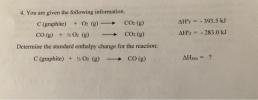
4. You are given the following information. C (graphite) + O2 (g) - CO2 (g) CO(g) + 02 (9) - CO2 (g) Determine the standard enthalpy change for the reaction: C (graphite) + 02 (g) - CO(g) AH = - 393.5 kJ AH° = -283.0 kJ AHrxn = ?
please help
4. You are given the following information. C (graphite) + O2 (g) - CO2 (g) CO(g) + 02 (9) - CO2 (g) Determine the standard enthalpy change for the reaction: C (graphite) + 02 (g) - CO(g) AH = - 393.5 kJ AH° = -283.0 kJ AHrxn = ?
 From the following data, C(graphite) + O2(g) → CO2(g) AHrxn = -393.5 kJ/mol H2(g) + O2(g) → H200) AH"rxn = -285.8 kJ/mol 2C2H6(g) + 702(g) -> 4CO2(g) + 6H2O(l) Arxn=-3119.6 kJ/mol Calculate the enthalpy change for the reaction: 2 C(graphite) + 3H2(g) + C2H668)
 Given the following equations and AH' values: C(s) + O2(g) + CO2(g) AH = -393.5 kJ H2(g) + 1/2O2(g) - H20 (1) AH = -285.8 kJ 2C2H2 (8) + 5O2(g) + 4CO2(g) + 2H20 (1) AH'= -2598 kJ Determine the heat of reaction (in kJ) at 298 K for the reaction: 2C(s) + H2(8) C2H2 (8) 0-136.8 0-219.8 0-109.9 O-167.1 +226.2
 PROBLEM-SOLVING CLASS ACTIVITY 11 Use Hess's Law to calculate the enthalpy of formation of CH2OH: C(graphite) + 2 H2(g) + 1026) → CH2OH(1) Given the following data: CH2OH() • 02(9) + CO2(g) + 2H2O(1) AH°: -726.4 kJ/mol C(graphite). O2(g) → CO2(9) AH' = -393.5 kJ/mol H2(g) + 40269) → H2O(1) AH = -285.8 kJ/mol
 C(s) + O2(g) + CO2(g) AH° = -393.5 kJ (5 pts) Given the following enthalpy values for reactions at 25°C, what is AH at 25°C for the following reaction: C3H3(g) + 502(g) + 4H2O(g) + 3CO2(g) AH = -2043 kJ 3C(s) + 4 H2(g) → C3H8 (g) 2H2(g) + O2(g) + 2H2O(g) AH° = -483.6 kJ
 Enter your answer in the provided box From the following data, C(graphite) + O2(0)+ CO2(g) An° . =-393.5 kJ/mol rxn Hy(@) +0,6) H200 AH =-285.8 kJ/mol rxn 2C2H6(8) + 1026) →40026) + 6H20(1) AH =-3119.6 kJ/mol rxn calculate the enthalpy change for the reaction below: 2 C(graphite) + 3H2(g) → CH()
 AH = -727 kJ Given that CH3OH (1) + 3/2 O2 (g) → CO2 (g) + 2 H2O(1) CO(g) + 1/2O2 (g) → CO2 (9) CH3OH(1) → CH3OH(g) AH = -284 kJ AH = 38 kJ H20 (1)→ H20 (9) AH = 44 kJ what is AH, in kJ, for the reaction CH3OH (g) + O2(g) →CO (g) + 2 H2O (9)
 loab beboo 2CO2 + H2O. 7. Calculate AH for C2H2 +5/202 Given C(s) +O2(g) CO2(g) AH = -393.5 kJ H2+½ O2 H2O AH= -285.8 kJ 2C+H2 C2H2 AH = 226.8 kJ 008700000 08.0 Lon Qoe cOeEo.O60
 please help
4. You are given the following information. C (graphite) + O2 (g) - CO2 (g) CO(g) + 02 (9) - CO2 (g) Determine the standard enthalpy change for the reaction: C (graphite) + 02 (g) - CO(g) AH = - 393.5 kJ AH° = -283.0 kJ AHrxn = ?
please help
4. You are given the following information. C (graphite) + O2 (g) - CO2 (g) CO(g) + 02 (9) - CO2 (g) Determine the standard enthalpy change for the reaction: C (graphite) + 02 (g) - CO(g) AH = - 393.5 kJ AH° = -283.0 kJ AHrxn = ?
Most questions answered within 3 hours.
-
Where is the error in this code sequence?
String s1 = "Hello";
String s2 = "ello";...
asked 10 months ago -
Financial data for Joel de Paris, Inc., for last year
follow:
Joel de Paris, Inc.
Balance...
asked 10 months ago -
Consider this reaction:
Al2(SO4)3 (aq)+ BaCl3
(aq) Al2Cl6 (aq)- +
3BaSO4(s) . What is the...
asked 10 months ago -
Suppose that Savneet is considering increasing her
recent random sample from 20 car rentals to 40...
asked 10 months ago -
Trucks arrive at an unloading terminal at an average rate of 120
per hour.
Trucks arrive...
asked 10 months ago -
Why are methanol and ethanol completely soluble in water while
octanol is not very little soluble....
asked 10 months ago -
A facilities manager at a university reads in a research report
that the mean amount of...
asked 10 months ago -
When the CuSO4 is rehydrated by adding water to the anhydrous
compound, is this an endothermic...
asked 10 months ago -
A ray of sunlight is passing from diamond into crown glass; the
angle of incidence is...
asked 10 months ago -
A block of mass 0.249 kg is placed on top of a light, vertical
spring of...
asked 10 months ago -
how do the kidneys compensate in the presences of acidosis
a) trigger hyperventilate
b) reserve acid...
asked 10 months ago -
Question 501 pts
The rental rate of capital to the firm increases. Which of the
following...
asked 10 months ago