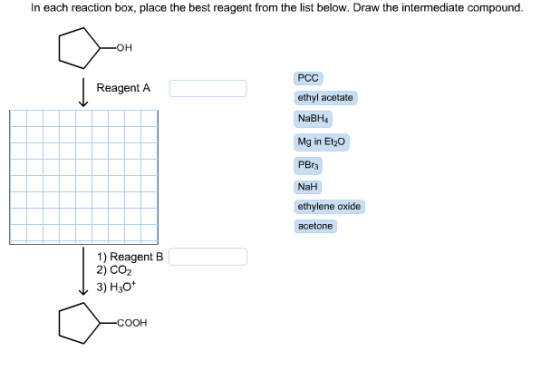
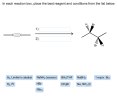
In each reaction box, place the best reagent from the list below. Draw the intermediate compound.
In each reaction box, place the best reagent from the list below. Draw the intermediate compound.
Homework Answers
A reaction sequence and the final product is given. The reagents along with the intermediate products need to be given. A chemical reaction involves the reaction between two or more substances. The reaction process is helped by the reagents that help in bringing about the transformation of the reactant into product.
Each of the given reagent has a specific role and help in achieving the final product.
PCC is pyridinium chlorochromate and is used in the oxidation of alcohols to form either ketones or aldehydes.
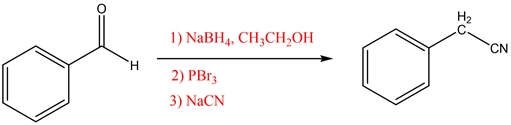
Sodium borohydride is a mild reducing agent that converts the carbonyl compounds to alcohols.
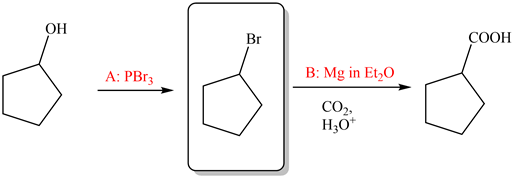
is used in the substitution of alcohols to haloalkanes.
NaH is a strong base that converts alcohols into alkoxide ions by liberation of hydrogen gas.
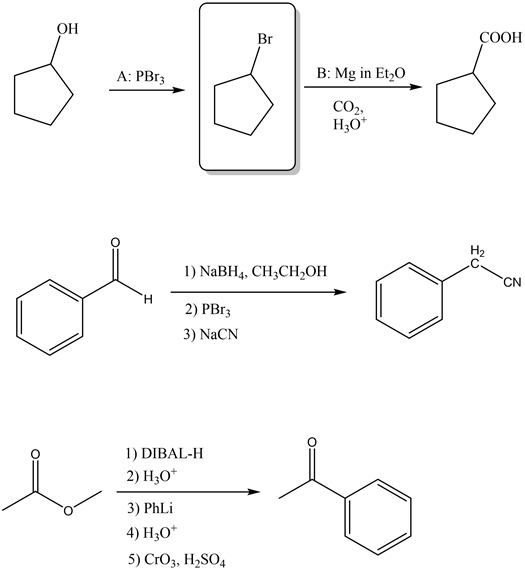
Mg in dry ether is used to convert a haloalkane to Grignard reagent.
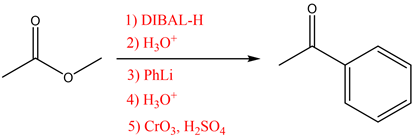
DIBAL-H is a mild reducing agent that converts esters to ketones/aldehydes. It can also reduce aldehydes and ketones to alcohols.
is used for oxidation of alcohols. It is a strong oxidizing agent and oxidizes primary alcohols to carboxylic acid and secondary alcohols to ketones.
The first reaction sequence is as follows:
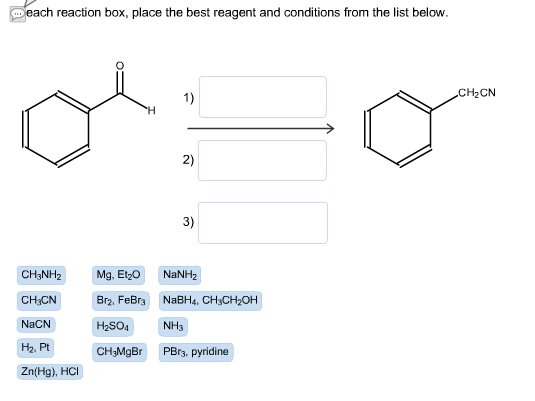
The second reaction sequence is as follows:
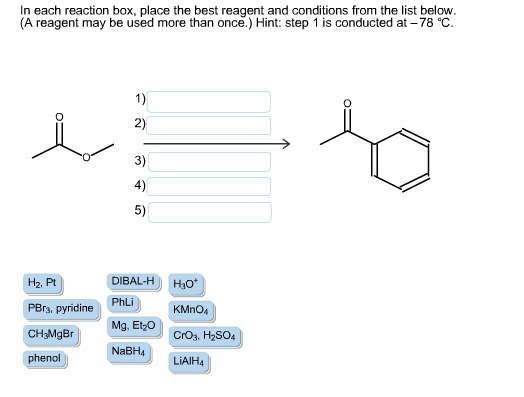
The third reaction sequence is as follows:
Add Answer to:
In each reaction box, place the best reagent from the list
below. Draw the intermediate compound.
In each reaction box, place the best reagent and conditions from the list below. In each reaction box, place the best...
 In each reaction box, place the best reagent and conditions from
the list below.
In each reaction box, place the best reagent and conditions from the list below. In each reaction box, place the best reagent and conditions from the list below.
In each reaction box, place the best reagent and conditions from
the list below.
In each reaction box, place the best reagent and conditions from the list below. In each reaction box, place the best reagent and conditions from the list below.
In each reaction box, place the best reagent and conditions from the list below. In each...
 In each reaction box, place the best reagent and conditions from
the list below.
In each reaction box, place the best reagent and conditions from the list below. In each reaction box, place the best reagent and conditions from the list below.
In each reaction box, place the best reagent and conditions from
the list below.
In each reaction box, place the best reagent and conditions from the list below. In each reaction box, place the best reagent and conditions from the list below.
In each reaction box, place the best reagent and conditions from the list below. In each...
 In each reaction box, place the best reagent and conditions from
the list below.
In each reaction box, place the best reagent and conditions from the list below. In each reaction box, place the best reagent and conditions from the list below.
In each reaction box, place the best reagent and conditions from
the list below.
In each reaction box, place the best reagent and conditions from the list below. In each reaction box, place the best reagent and conditions from the list below.
In each reaction box, place the best reagent and conditions from the list below. Draw the...
 In each reaction box, place the best reagent and conditions from
the list below.
Draw the organic products of the following reation.
In each reaction box, place the best reagent and conditions from
the list below.
Draw the organic products of the following reation.
In each reaction box, place the best reagent and conditions from the list below. In each reaction box, place the bes...
 In each reaction box, place the
best reagent and conditions from the list below.
In each reaction box, place the best reagent and conditions from the list below. Only one of the reagents can react with the very unreactive cyclopentane. A radical intermediate is involved. PCC stands for pyridinium chlorochromate. It oxidizes a primary alcohol to an aldehyde or a secondary alcohol to a ketone.
In each reaction box, place the
best reagent and conditions from the list below.
In each reaction box, place the best reagent and conditions from the list below. Only one of the reagents can react with the very unreactive cyclopentane. A radical intermediate is involved. PCC stands for pyridinium chlorochromate. It oxidizes a primary alcohol to an aldehyde or a secondary alcohol to a ketone.
In each reaction box, place the best reagent and conditions from the list below. In each...
 In each reaction box, place the best reagent and conditions from the list below. In each reaction box, place the best reagent and conditions from the list below. In each reaction box, place the best reagent and conditions from the list below. Your reagent for the first step is incorrect. This reaction involved a double elimination of HBr to form an alkyne. Which reagent is a strong base capable of carrying out this reaction ?
In each reaction box, place the best reagent and conditions from the list below. In each reaction box, place the b...
 In each reaction box, place the best reagent and conditions from
the list below.
In each reaction box, place the best reagent and conditions from the list below.
In each reaction box, place the best reagent and conditions from
the list below.
In each reaction box, place the best reagent and conditions from the list below.
In each reaction box, place the best reagent and conditions from the list below. In each reaction box, place the bes...
 In each reaction box, place the best reagent and conditions from
the list below.
In each reaction box, place the best reagent and conditions from the list below.
In each reaction box, place the best reagent and conditions from
the list below.
In each reaction box, place the best reagent and conditions from the list below.
In each reaction box, place the best reagent and conditions from the list below. In each reaction box, place the b...
 In each reaction box, place the best reagent and conditions from
the list below.
In each reaction box, place the best reagent and conditions from the list below.
In each reaction box, place the best reagent and conditions from
the list below.
In each reaction box, place the best reagent and conditions from the list below.
In each reaction box, place the best reagent and conditions from the list below. (bromine) In each reaction box, place...
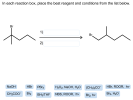 In each reaction box, place the best reagent and conditions from
the list below. (bromine)
In each reaction box, place the best reagent and conditions from the list below.
In each reaction box, place the best reagent and conditions from
the list below. (bromine)
In each reaction box, place the best reagent and conditions from the list below.
 In each reaction box, place the best reagent and conditions from
the list below.
In each reaction box, place the best reagent and conditions from the list below. In each reaction box, place the best reagent and conditions from the list below.
In each reaction box, place the best reagent and conditions from
the list below.
In each reaction box, place the best reagent and conditions from the list below. In each reaction box, place the best reagent and conditions from the list below.
 In each reaction box, place the best reagent and conditions from
the list below.
In each reaction box, place the best reagent and conditions from the list below. In each reaction box, place the best reagent and conditions from the list below.
In each reaction box, place the best reagent and conditions from
the list below.
In each reaction box, place the best reagent and conditions from the list below. In each reaction box, place the best reagent and conditions from the list below.
 In each reaction box, place the best reagent and conditions from
the list below.
In each reaction box, place the best reagent and conditions from the list below. In each reaction box, place the best reagent and conditions from the list below.
In each reaction box, place the best reagent and conditions from
the list below.
In each reaction box, place the best reagent and conditions from the list below. In each reaction box, place the best reagent and conditions from the list below.
 In each reaction box, place the best reagent and conditions from
the list below.
Draw the organic products of the following reation.
In each reaction box, place the best reagent and conditions from
the list below.
Draw the organic products of the following reation.
 In each reaction box, place the
best reagent and conditions from the list below.
In each reaction box, place the best reagent and conditions from the list below. Only one of the reagents can react with the very unreactive cyclopentane. A radical intermediate is involved. PCC stands for pyridinium chlorochromate. It oxidizes a primary alcohol to an aldehyde or a secondary alcohol to a ketone.
In each reaction box, place the
best reagent and conditions from the list below.
In each reaction box, place the best reagent and conditions from the list below. Only one of the reagents can react with the very unreactive cyclopentane. A radical intermediate is involved. PCC stands for pyridinium chlorochromate. It oxidizes a primary alcohol to an aldehyde or a secondary alcohol to a ketone.
 In each reaction box, place the best reagent and conditions from the list below. In each reaction box, place the best reagent and conditions from the list below. In each reaction box, place the best reagent and conditions from the list below. Your reagent for the first step is incorrect. This reaction involved a double elimination of HBr to form an alkyne. Which reagent is a strong base capable of carrying out this reaction ?
 In each reaction box, place the best reagent and conditions from
the list below.
In each reaction box, place the best reagent and conditions from the list below.
In each reaction box, place the best reagent and conditions from
the list below.
In each reaction box, place the best reagent and conditions from the list below.
 In each reaction box, place the best reagent and conditions from
the list below.
In each reaction box, place the best reagent and conditions from the list below.
In each reaction box, place the best reagent and conditions from
the list below.
In each reaction box, place the best reagent and conditions from the list below.
 In each reaction box, place the best reagent and conditions from
the list below.
In each reaction box, place the best reagent and conditions from the list below.
In each reaction box, place the best reagent and conditions from
the list below.
In each reaction box, place the best reagent and conditions from the list below.
 In each reaction box, place the best reagent and conditions from
the list below. (bromine)
In each reaction box, place the best reagent and conditions from the list below.
In each reaction box, place the best reagent and conditions from
the list below. (bromine)
In each reaction box, place the best reagent and conditions from the list below.
Most questions answered within 3 hours.
-
Where is the error in this code sequence?
String s1 = "Hello";
String s2 = "ello";...
asked 10 months ago -
Financial data for Joel de Paris, Inc., for last year
follow:
Joel de Paris, Inc.
Balance...
asked 10 months ago -
Consider this reaction:
Al2(SO4)3 (aq)+ BaCl3
(aq) Al2Cl6 (aq)- +
3BaSO4(s) . What is the...
asked 10 months ago -
Suppose that Savneet is considering increasing her
recent random sample from 20 car rentals to 40...
asked 10 months ago -
Trucks arrive at an unloading terminal at an average rate of 120
per hour.
Trucks arrive...
asked 10 months ago -
Why are methanol and ethanol completely soluble in water while
octanol is not very little soluble....
asked 10 months ago -
A facilities manager at a university reads in a research report
that the mean amount of...
asked 10 months ago -
When the CuSO4 is rehydrated by adding water to the anhydrous
compound, is this an endothermic...
asked 10 months ago -
A ray of sunlight is passing from diamond into crown glass; the
angle of incidence is...
asked 10 months ago -
A block of mass 0.249 kg is placed on top of a light, vertical
spring of...
asked 10 months ago -
how do the kidneys compensate in the presences of acidosis
a) trigger hyperventilate
b) reserve acid...
asked 10 months ago -
Question 501 pts
The rental rate of capital to the firm increases. Which of the
following...
asked 10 months ago