

Homework Answers
Soaps are potassium or sodium salts of long chain carboxylic acid with the carbon chain varying between C12 to C18 Some common used fatty acids are stearic acid will be written as C17H35COONa. (Assumption - Sodium salt of stearic acid is prepared in lab)
Treating soap with MgCl2 will lead to the formation of its corresponding Magnesium salt. The formula is as follows.
2C17H35COONa + MgCl2
[C17H35COO]2Mg + 2NaCl
Detergents are superior than soaps because
Detergents are sodium salt of long chain hydrocarbons like alkyl sulphates or alkyl benzene sulphonates and can dissolve in hard water containing Mg2+, Ca2+ ions. They are effective in hard, soft and normal water. However, soap has a tendency to precipitate in hard water containing the above ions.
Add Answer to:
PROP2027: Preparation and Properties of a Soap - Bettelheim/Landsberg. 9e POST-LABORATORY QUESTIONS 1. Write the chemical...
Answer the following questions for the preparation of soap laboratory Sodium Methylsulfonate is a poor detergent...
 Answer the following questions for the preparation of
soap laboratory
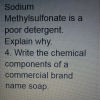
Sodium Methylsulfonate is a poor detergent Explain why. 4. Write the chemical components of a commercial brand name soap.
Answer the following questions for the preparation of
soap laboratory
Sodium Methylsulfonate is a poor detergent Explain why. 4. Write the chemical components of a commercial brand name soap.
#3-4 Post-Laboratory Questions (Use the spaces provided for the answers and additional paper if necessary) 1....
 #3-4
Post-Laboratory Questions (Use the spaces provided for the answers and additional paper if necessary) 1. A strip of tin (Sn) is placed in an AgNO, solution. ction reaction should ocur (1) Predict whether or not a spontaneous Explain your reasoning oxidation-reduction reaction should occur in this system (2) Write a chemical equation to describe the net reaction, if it is spontaneous. (3) Indicate the experimental observations you would expect for this procedure. 2. The half-cell reactions that occur in...
#3-4
Post-Laboratory Questions (Use the spaces provided for the answers and additional paper if necessary) 1. A strip of tin (Sn) is placed in an AgNO, solution. ction reaction should ocur (1) Predict whether or not a spontaneous Explain your reasoning oxidation-reduction reaction should occur in this system (2) Write a chemical equation to describe the net reaction, if it is spontaneous. (3) Indicate the experimental observations you would expect for this procedure. 2. The half-cell reactions that occur in...
Laboratory Questions Activity 1: Synthesis Reaction Describe all of the signs that indicated a chemical reaction...
Laboratory Questions Activity 1: Synthesis Reaction Describe all of the signs that indicated a chemical reaction occurred. Describe the temperature change that occurred during this reaction. Is heat required or produced during the reaction? Describe any other changes that were observed in the steel wool. What reaction might create such a change? Write a balanced equation for the reaction of the steel wool with oxygen. Be sure to include heat energy in the reaction.
Post Laboratory Questions 1. Write the equation for the decomposition of sulfurous acid. Usingl 2. Using...
 Post Laboratory Questions 1. Write the equation for the decomposition of sulfurous acid. Usingl 2. Using the three criteria for double displacement reactions, and the solubility table. predict whether a double displacement reaction will occur for each of the following. If the reaction will occur, balance the reaction write conventional, total ionic and net ionic equations. Box the net ionic equation. Be sure to include the proper phase labels. If no reaction will occur. write "no reaction". All reactants are...
write a balanced equation including phases, and identifying the chemical formula of the precipitate. Part 1...
 write a balanced equation including phases, and identifying
the chemical formula of the precipitate.
Part 1 - Preparation of CaCO3(s) The following is a procedure that was theoretically performed by a student. Read through the procedure and answer the questions below. 1. A 10.0 mL graduated cylinder to measure 10.0 mL of a 1.00 M CaCl2 solution into an initially empty 50.0 mL beaker. 2. A 50.0 ml graduated cylinder was then used to measure out 25.0 mL of 0.500...
write a balanced equation including phases, and identifying
the chemical formula of the precipitate.
Part 1 - Preparation of CaCO3(s) The following is a procedure that was theoretically performed by a student. Read through the procedure and answer the questions below. 1. A 10.0 mL graduated cylinder to measure 10.0 mL of a 1.00 M CaCl2 solution into an initially empty 50.0 mL beaker. 2. A 50.0 ml graduated cylinder was then used to measure out 25.0 mL of 0.500...
5. Why are simple stains able to "stick” to bacteria? Explain the chemical properties of the...
 5. Why are simple stains able to "stick” to bacteria? Explain the chemical properties of the stain and bacteria surface. 3-Preparation of Bacterial Smears and Simple Stains Introduction Microbial cultures are handled using aseptic technique. Aseptie technique is a set of procedures used to minimize contamination of materials by microorganisms from the environment, and to minimize the spread of cultures around the laboratory. In this experiment, you will be using an inoculating loop to transfer bacteria from a culture tube...
write balanced molevular and ionic equations for each reaction that produced percipitation. Post Laboratory Questions 1....
 write balanced molevular and ionic equations for each reaction that
produced percipitation.
Post Laboratory Questions 1. Write balanced molecular and ionic equations for each reaction that produced precipitation Compound Molecular Equation Net lonic Equation Ba NO3)2 Na₂504 BalNO3)2 Nach Ba(NO3)2 + rayCD3 | AgNO3 NaBr AgNO3 Ag Noz t NaBr Age Br + 2 Na NO3 AgNO3 + Na +2Br Agt Br + 2 Ag Br + 20 AgNO3 + NaOH - AgoH + Nanoz Agt +N05 + Mat toti...
write balanced molevular and ionic equations for each reaction that
produced percipitation.
Post Laboratory Questions 1. Write balanced molecular and ionic equations for each reaction that produced precipitation Compound Molecular Equation Net lonic Equation Ba NO3)2 Na₂504 BalNO3)2 Nach Ba(NO3)2 + rayCD3 | AgNO3 NaBr AgNO3 Ag Noz t NaBr Age Br + 2 Na NO3 AgNO3 + Na +2Br Agt Br + 2 Ag Br + 20 AgNO3 + NaOH - AgoH + Nanoz Agt +N05 + Mat toti...
Experiment 6 PRE-LABORATORY PROBLEMS NAME 1. Write a purpose statement and a summary of the procedure...
 Experiment 6 PRE-LABORATORY PROBLEMS NAME 1. Write a purpose statement and a summary of the procedure to include special technique equipment, chemicals, and chemical reactions to be performed, an understanding of any calculations that are important to understanding the procedure. 2. Calculate the molar mass of copper (II) Sulfate pentahydrate, Cuso,5H.O. 3. Calculate the mass percent of water present in Copper(II) sulfate pentahydrate. 4. Define the term hydrate and anhydrous. S. A 2.000 gram sample of hydrated barium carbonate was...
Reactions and Neutralization in the Copper Cycle A Cycle of Chemical Reactions of Copper PRE-LABORATORY ASSIGNMENT...
 Reactions and Neutralization in the Copper Cycle
A Cycle of Chemical Reactions of Copper PRE-LABORATORY ASSIGNMENT Finish the pre-laboratory assignments before the laboratory experiment. Read the manual of this experiment and complete the following questions. 1. a. Identify oxidation-reduction reactions in the copper cycle experiment. For each oxidation-reduction reaction, write half reactions to show what is oxidized and what is reduced. Identify acid-base reactions and precipitation reactions in the copper cycle experi- ment. Write equations for the corresponding reactions. b....
Reactions and Neutralization in the Copper Cycle
A Cycle of Chemical Reactions of Copper PRE-LABORATORY ASSIGNMENT Finish the pre-laboratory assignments before the laboratory experiment. Read the manual of this experiment and complete the following questions. 1. a. Identify oxidation-reduction reactions in the copper cycle experiment. For each oxidation-reduction reaction, write half reactions to show what is oxidized and what is reduced. Identify acid-base reactions and precipitation reactions in the copper cycle experi- ment. Write equations for the corresponding reactions. b....
CHE115 Tear this page out of your laboratory manual Name: our laboratory manual and submit it...
 CHE115 Tear this page out of your laboratory manual Name: our laboratory manual and submit it to your TA with your answers Zinc reacts with lodine in the fixed mass ratio of 1 gram of zinc to ne, how many grams of iodine are required to completely react with B. Post-Lab Assessment Questions: (32 pts) 1. (4 pts) Given that zinc reacts with i 3.88 grams of iodine, how many grams of 4.2 grams of zinc? You must show your...
 Answer the following questions for the preparation of
soap laboratory
Sodium Methylsulfonate is a poor detergent Explain why. 4. Write the chemical components of a commercial brand name soap.
Answer the following questions for the preparation of
soap laboratory
Sodium Methylsulfonate is a poor detergent Explain why. 4. Write the chemical components of a commercial brand name soap.
 #3-4
Post-Laboratory Questions (Use the spaces provided for the answers and additional paper if necessary) 1. A strip of tin (Sn) is placed in an AgNO, solution. ction reaction should ocur (1) Predict whether or not a spontaneous Explain your reasoning oxidation-reduction reaction should occur in this system (2) Write a chemical equation to describe the net reaction, if it is spontaneous. (3) Indicate the experimental observations you would expect for this procedure. 2. The half-cell reactions that occur in...
#3-4
Post-Laboratory Questions (Use the spaces provided for the answers and additional paper if necessary) 1. A strip of tin (Sn) is placed in an AgNO, solution. ction reaction should ocur (1) Predict whether or not a spontaneous Explain your reasoning oxidation-reduction reaction should occur in this system (2) Write a chemical equation to describe the net reaction, if it is spontaneous. (3) Indicate the experimental observations you would expect for this procedure. 2. The half-cell reactions that occur in...
 Post Laboratory Questions 1. Write the equation for the decomposition of sulfurous acid. Usingl 2. Using the three criteria for double displacement reactions, and the solubility table. predict whether a double displacement reaction will occur for each of the following. If the reaction will occur, balance the reaction write conventional, total ionic and net ionic equations. Box the net ionic equation. Be sure to include the proper phase labels. If no reaction will occur. write "no reaction". All reactants are...
 write a balanced equation including phases, and identifying
the chemical formula of the precipitate.
Part 1 - Preparation of CaCO3(s) The following is a procedure that was theoretically performed by a student. Read through the procedure and answer the questions below. 1. A 10.0 mL graduated cylinder to measure 10.0 mL of a 1.00 M CaCl2 solution into an initially empty 50.0 mL beaker. 2. A 50.0 ml graduated cylinder was then used to measure out 25.0 mL of 0.500...
write a balanced equation including phases, and identifying
the chemical formula of the precipitate.
Part 1 - Preparation of CaCO3(s) The following is a procedure that was theoretically performed by a student. Read through the procedure and answer the questions below. 1. A 10.0 mL graduated cylinder to measure 10.0 mL of a 1.00 M CaCl2 solution into an initially empty 50.0 mL beaker. 2. A 50.0 ml graduated cylinder was then used to measure out 25.0 mL of 0.500...
 5. Why are simple stains able to "stick” to bacteria? Explain the chemical properties of the stain and bacteria surface. 3-Preparation of Bacterial Smears and Simple Stains Introduction Microbial cultures are handled using aseptic technique. Aseptie technique is a set of procedures used to minimize contamination of materials by microorganisms from the environment, and to minimize the spread of cultures around the laboratory. In this experiment, you will be using an inoculating loop to transfer bacteria from a culture tube...
 write balanced molevular and ionic equations for each reaction that
produced percipitation.
Post Laboratory Questions 1. Write balanced molecular and ionic equations for each reaction that produced precipitation Compound Molecular Equation Net lonic Equation Ba NO3)2 Na₂504 BalNO3)2 Nach Ba(NO3)2 + rayCD3 | AgNO3 NaBr AgNO3 Ag Noz t NaBr Age Br + 2 Na NO3 AgNO3 + Na +2Br Agt Br + 2 Ag Br + 20 AgNO3 + NaOH - AgoH + Nanoz Agt +N05 + Mat toti...
write balanced molevular and ionic equations for each reaction that
produced percipitation.
Post Laboratory Questions 1. Write balanced molecular and ionic equations for each reaction that produced precipitation Compound Molecular Equation Net lonic Equation Ba NO3)2 Na₂504 BalNO3)2 Nach Ba(NO3)2 + rayCD3 | AgNO3 NaBr AgNO3 Ag Noz t NaBr Age Br + 2 Na NO3 AgNO3 + Na +2Br Agt Br + 2 Ag Br + 20 AgNO3 + NaOH - AgoH + Nanoz Agt +N05 + Mat toti...
 Experiment 6 PRE-LABORATORY PROBLEMS NAME 1. Write a purpose statement and a summary of the procedure to include special technique equipment, chemicals, and chemical reactions to be performed, an understanding of any calculations that are important to understanding the procedure. 2. Calculate the molar mass of copper (II) Sulfate pentahydrate, Cuso,5H.O. 3. Calculate the mass percent of water present in Copper(II) sulfate pentahydrate. 4. Define the term hydrate and anhydrous. S. A 2.000 gram sample of hydrated barium carbonate was...
 Reactions and Neutralization in the Copper Cycle
A Cycle of Chemical Reactions of Copper PRE-LABORATORY ASSIGNMENT Finish the pre-laboratory assignments before the laboratory experiment. Read the manual of this experiment and complete the following questions. 1. a. Identify oxidation-reduction reactions in the copper cycle experiment. For each oxidation-reduction reaction, write half reactions to show what is oxidized and what is reduced. Identify acid-base reactions and precipitation reactions in the copper cycle experi- ment. Write equations for the corresponding reactions. b....
Reactions and Neutralization in the Copper Cycle
A Cycle of Chemical Reactions of Copper PRE-LABORATORY ASSIGNMENT Finish the pre-laboratory assignments before the laboratory experiment. Read the manual of this experiment and complete the following questions. 1. a. Identify oxidation-reduction reactions in the copper cycle experiment. For each oxidation-reduction reaction, write half reactions to show what is oxidized and what is reduced. Identify acid-base reactions and precipitation reactions in the copper cycle experi- ment. Write equations for the corresponding reactions. b....
 CHE115 Tear this page out of your laboratory manual Name: our laboratory manual and submit it to your TA with your answers Zinc reacts with lodine in the fixed mass ratio of 1 gram of zinc to ne, how many grams of iodine are required to completely react with B. Post-Lab Assessment Questions: (32 pts) 1. (4 pts) Given that zinc reacts with i 3.88 grams of iodine, how many grams of 4.2 grams of zinc? You must show your...
Most questions answered within 3 hours.
-
Where is the error in this code sequence?
String s1 = "Hello";
String s2 = "ello";...
asked 11 months ago -
Financial data for Joel de Paris, Inc., for last year
follow:
Joel de Paris, Inc.
Balance...
asked 11 months ago -
Consider this reaction:
Al2(SO4)3 (aq)+ BaCl3
(aq) Al2Cl6 (aq)- +
3BaSO4(s) . What is the...
asked 11 months ago -
Suppose that Savneet is considering increasing her
recent random sample from 20 car rentals to 40...
asked 11 months ago -
Trucks arrive at an unloading terminal at an average rate of 120
per hour.
Trucks arrive...
asked 11 months ago -
Why are methanol and ethanol completely soluble in water while
octanol is not very little soluble....
asked 11 months ago -
A facilities manager at a university reads in a research report
that the mean amount of...
asked 11 months ago -
When the CuSO4 is rehydrated by adding water to the anhydrous
compound, is this an endothermic...
asked 11 months ago -
A ray of sunlight is passing from diamond into crown glass; the
angle of incidence is...
asked 11 months ago -
A block of mass 0.249 kg is placed on top of a light, vertical
spring of...
asked 11 months ago -
how do the kidneys compensate in the presences of acidosis
a) trigger hyperventilate
b) reserve acid...
asked 11 months ago -
Question 501 pts
The rental rate of capital to the firm increases. Which of the
following...
asked 11 months ago