
Homework Answers
First of all we need to understand the meaning of opportunity cost. Opportunity cost of any good refers to the value of other good that is forgone in order to produce that good.
In this case ,for worker A, Opportunity cost of producing 5 bracelets is 4 rings. For worker B, opportunity cost of producing 6 bracelets is 3 rings. For worker C, Opportunity cost of producing 7 bracelets is 5 rings and so on.
If all the workers are dedicated towards making bracelets, the company will produce 29 bracelets in total and 0 rings.If all the workers are dedicated towards making rings, the company will produce 0 bracelets and 19 rings in total. Thus we get the two extremes of our production possibilities frontier (PPF) : (29,0) and (0,19). Here x axis represents the no. of bracelets produced and y axis represents no. of rings produced.
If worker A and B are dedicated towards making bracelets and rest are dedicated towards making rings, we get the combination (11,12). If worker A,B and C are dedicated towards making bracelets and rest are dedicated towards making rings then the combination we get is (18,7). If worker A,B,C and D are dedicated towards making bracelets and rest are dedicated towards making rings, we get the combination (22,4). If Only worker A is dedicated towards making bracelets and rest are dedicated towards making rings, we get the combination (5,15).
Therefore the six combinations are (29,0), (0,19), (11,12), (18,7), (22,4) and (5,15).
Add Answer to:
Please explain it briefly A company employs five workers to produce bracelets and rings. The following...
Ginny is a skilled toy maker who is able to produce both trains and balls. She has 8 hours a day to produce toys.
 5. Opportunity cost and production possibilities Ginny is a skilled toy maker who is able to produce both trains and balls. She has 8 hours a day to produce toys. The following table shows the daily output resulting from various possible combinations of her time. On the following graph, use the blue points (circle symbol) to plot Ginny's initial production possibilities frontier (PPF).
Kevin is a skilled toy maker who is able to produce both boats and kites. He has 8 hours a day to produce toys.
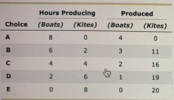 5. Opportunity cost and production possibilities Kevin is a skilled toy maker who is able to produce both boats and kites. He has 8 hours a day to produce toys. The following table shows the daily output resulting from various possible combinations of his time. On the following graph, use the blue points (circle symbol) to plot Kevin's initial production possibilities frontier (PPF).
Please explain it briefly, im having trouble to understand the question. Thank you. Harrison plans to...
 Please explain it briefly, im having trouble to understand the
question. Thank you.
Harrison plans to spend a total of six hours to study for his exams in Economics and Geography. The following table shows his expected mark on each exam based on the number of hours spent studying each course. For example, if he spends all six hours studying Geography, he expects to get 84 marks in his Geography exam. Hours Spent Studying Geography 0 Hours Spent Studying Economics...
Please explain it briefly, im having trouble to understand the
question. Thank you.
Harrison plans to spend a total of six hours to study for his exams in Economics and Geography. The following table shows his expected mark on each exam based on the number of hours spent studying each course. For example, if he spends all six hours studying Geography, he expects to get 84 marks in his Geography exam. Hours Spent Studying Geography 0 Hours Spent Studying Economics...
1. Each country has 10 workers who can produce either microchips or brooms. A worker in...
 1. Each country has 10 workers who can produce either microchips or brooms. A worker in U.S can produce 9 microchips a day or 1 broom a day. A worker in Mexico can produce 1 microchip or 9 brooms a day. 1. a) Draw the production possibilities frontier (PPF) of microchips and brooms for U.S. 1. b) Draw the production possibilities frontier (PPF) of microchips and brooms for Mexico 1. c) Explain how trade can benefit both the U.S and...
please help with worksheet NAME SECTION PRINT LAST NAME, FIRST NAME Use the graph below to answer questions 6 throug...
 please help with worksheet
NAME SECTION PRINT LAST NAME, FIRST NAME Use the graph below to answer questions 6 through 9 Can Openers 14,000 12,000 10,000 8,000 6,000 PHE: 4,000 PHF 2,000 2 3 4 1 8 Drill Presses events would best explain a shift from PPF, to PPF2? Which of the following 6. An increase in rate of unemployment An increase in the size of the labor force A reduction in rate of unemployment A reduction in the size...
please help with worksheet
NAME SECTION PRINT LAST NAME, FIRST NAME Use the graph below to answer questions 6 through 9 Can Openers 14,000 12,000 10,000 8,000 6,000 PHE: 4,000 PHF 2,000 2 3 4 1 8 Drill Presses events would best explain a shift from PPF, to PPF2? Which of the following 6. An increase in rate of unemployment An increase in the size of the labor force A reduction in rate of unemployment A reduction in the size...
1. Give the three reasons that explain why the division of labor increases an economy’s level...
1. Give the three reasons that explain why the division of labor increases an economy’s level of production. 2. What are three reasons to study economics? 3. Suppose you have a team of two workers: one is a baker and one is a chef. Explain why the kitchen can produce more meals in a given period of time if each worker specializes in what they do best than if each worker tries to do everything from appetizer to dessert. 4....
1. Give the three reasons that explain why the division of labor increases an economy’s level...
1. Give the three reasons that explain why the division of labor increases an economy’s level of production. 2. What are three reasons to study economics? 3. Suppose you have a team of two workers: one is a baker and one is a chef. Explain why the kitchen can produce more meals in a given period of time if each worker specializes in what they do best than if each worker tries to do everything from appetizer to dessert. 4....
10. workers: Larry, Moe, and Curly. Each works 10 hours a day and can produce two...
 10. workers: Larry, Moe, and Curly. Each works 10 hours a day and can produce two services: mowing lawns and washing Using the blue points (circle symbol), graph the production possibiities frontler (PPF) for this economy on the folowing graph. Then use the black the purpie point (diamond symbol) to identify point D on the graph. mows lawns. (D) Using the blue points (circle symbol), graph the production possiblities frontier (PPF) for this economy on the folowing graph. Then use...
Juanita is a skilled toy maker who is able to produce both cars and drums. She has 8 hours a day to produce toys. The following table shows the daily output resulting from various possible combinations of her time.
 Juanita is a skilled toy maker who is able to produce both cars
and drums. She has 8 hours a day to produce toys. The following
table shows the daily output resulting from various possible
combinations of her time. 5. Opportunity cost and production possibilities Juanita is a skilled toy maker who is able to produce both cars and drums. She has 8 hours a day to produce toys. The following table shows the daily output resulting from various possible combinations of...
Juanita is a skilled toy maker who is able to produce both cars
and drums. She has 8 hours a day to produce toys. The following
table shows the daily output resulting from various possible
combinations of her time. 5. Opportunity cost and production possibilities Juanita is a skilled toy maker who is able to produce both cars and drums. She has 8 hours a day to produce toys. The following table shows the daily output resulting from various possible combinations of...
8. Problems and Applications Q2 American and Japanese workers can each produce 4 cars a year....
 8. Problems and Applications Q2 American and Japanese workers can each produce 4 cars a year. An American worker can produce 10 tons of grain a year, whereas a Japanese worker can produce 5 tons of grain a year. To keep things simple, assume that e ach country has 100 million workers. Complete the following table with the number of workers needed to make one car or 1 ton of grain in the United States and Japan. Workers Needed to...
 Please explain it briefly, im having trouble to understand the
question. Thank you.
Harrison plans to spend a total of six hours to study for his exams in Economics and Geography. The following table shows his expected mark on each exam based on the number of hours spent studying each course. For example, if he spends all six hours studying Geography, he expects to get 84 marks in his Geography exam. Hours Spent Studying Geography 0 Hours Spent Studying Economics...
Please explain it briefly, im having trouble to understand the
question. Thank you.
Harrison plans to spend a total of six hours to study for his exams in Economics and Geography. The following table shows his expected mark on each exam based on the number of hours spent studying each course. For example, if he spends all six hours studying Geography, he expects to get 84 marks in his Geography exam. Hours Spent Studying Geography 0 Hours Spent Studying Economics...
 1. Each country has 10 workers who can produce either microchips or brooms. A worker in U.S can produce 9 microchips a day or 1 broom a day. A worker in Mexico can produce 1 microchip or 9 brooms a day. 1. a) Draw the production possibilities frontier (PPF) of microchips and brooms for U.S. 1. b) Draw the production possibilities frontier (PPF) of microchips and brooms for Mexico 1. c) Explain how trade can benefit both the U.S and...
 please help with worksheet
NAME SECTION PRINT LAST NAME, FIRST NAME Use the graph below to answer questions 6 through 9 Can Openers 14,000 12,000 10,000 8,000 6,000 PHE: 4,000 PHF 2,000 2 3 4 1 8 Drill Presses events would best explain a shift from PPF, to PPF2? Which of the following 6. An increase in rate of unemployment An increase in the size of the labor force A reduction in rate of unemployment A reduction in the size...
please help with worksheet
NAME SECTION PRINT LAST NAME, FIRST NAME Use the graph below to answer questions 6 through 9 Can Openers 14,000 12,000 10,000 8,000 6,000 PHE: 4,000 PHF 2,000 2 3 4 1 8 Drill Presses events would best explain a shift from PPF, to PPF2? Which of the following 6. An increase in rate of unemployment An increase in the size of the labor force A reduction in rate of unemployment A reduction in the size...
 10. workers: Larry, Moe, and Curly. Each works 10 hours a day and can produce two services: mowing lawns and washing Using the blue points (circle symbol), graph the production possibiities frontler (PPF) for this economy on the folowing graph. Then use the black the purpie point (diamond symbol) to identify point D on the graph. mows lawns. (D) Using the blue points (circle symbol), graph the production possiblities frontier (PPF) for this economy on the folowing graph. Then use...
 8. Problems and Applications Q2 American and Japanese workers can each produce 4 cars a year. An American worker can produce 10 tons of grain a year, whereas a Japanese worker can produce 5 tons of grain a year. To keep things simple, assume that e ach country has 100 million workers. Complete the following table with the number of workers needed to make one car or 1 ton of grain in the United States and Japan. Workers Needed to...
Most questions answered within 3 hours.
-
Where is the error in this code sequence?
String s1 = "Hello";
String s2 = "ello";...
asked 10 months ago -
Financial data for Joel de Paris, Inc., for last year
follow:
Joel de Paris, Inc.
Balance...
asked 10 months ago -
Consider this reaction:
Al2(SO4)3 (aq)+ BaCl3
(aq) Al2Cl6 (aq)- +
3BaSO4(s) . What is the...
asked 10 months ago -
Suppose that Savneet is considering increasing her
recent random sample from 20 car rentals to 40...
asked 10 months ago -
Trucks arrive at an unloading terminal at an average rate of 120
per hour.
Trucks arrive...
asked 10 months ago -
Why are methanol and ethanol completely soluble in water while
octanol is not very little soluble....
asked 10 months ago -
A facilities manager at a university reads in a research report
that the mean amount of...
asked 10 months ago -
When the CuSO4 is rehydrated by adding water to the anhydrous
compound, is this an endothermic...
asked 10 months ago -
A ray of sunlight is passing from diamond into crown glass; the
angle of incidence is...
asked 10 months ago -
A block of mass 0.249 kg is placed on top of a light, vertical
spring of...
asked 10 months ago -
how do the kidneys compensate in the presences of acidosis
a) trigger hyperventilate
b) reserve acid...
asked 10 months ago -
Question 501 pts
The rental rate of capital to the firm increases. Which of the
following...
asked 10 months ago