
Homework Answers
Add Answer to:
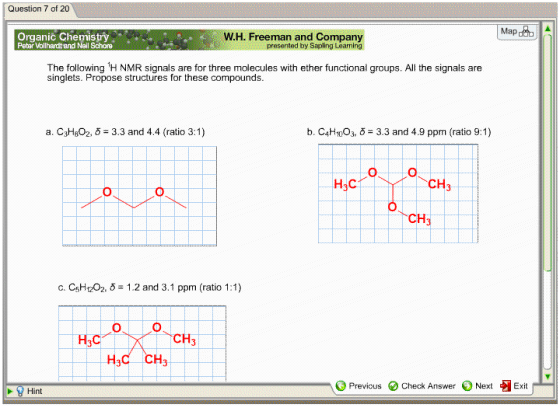
The following^1H NMR signals are for three molecules with ether functional groups. All the signals are...
The 1H-NMR spectrum of 1-bromopropane shows three signals and the 1H-NMR spectrum of 2-bromopropane shows two...
The 1H-NMR spectrum of 1-bromopropane shows three signals and the 1H-NMR spectrum of 2-bromopropane shows two signals. Draw these two molecules and determine the relative integrals of each signal.
Using line structures, propose individual molecules with the formula C4H8O that contain the following functional groups?...
Using line structures, propose individual molecules with the formula C4H8O that contain the following functional groups? a) a ketone b) an aldehyde with a branched alkene c) an aldehyde with an unbranched alkane d) a cycloalkane e) a cyclic ether that is NOT an epoxide f) an epoxide g) a acyclic ether h) an alkene and an alcohol
Identify functional groups of the above molecules using the table given. Identify the functional groups in the following...
 Identify functional groups of
the above molecules using the table given.
Identify the functional groups in the following molecules. (Use names from the table below. List each class of functional group only once. If there are fewer than 3 functional groups, lcave an appropriate number of answer boxes empty.) OH а) NH2 phenylalanine Cн-он b) NHCH Structures of Some Common Functional Groups Name Structure Name Structure X Alkene Nitro Alkyne C C Thiol Aldehyde Arene Halide Ketone (XF, CI, Br,...
Identify functional groups of
the above molecules using the table given.
Identify the functional groups in the following molecules. (Use names from the table below. List each class of functional group only once. If there are fewer than 3 functional groups, lcave an appropriate number of answer boxes empty.) OH а) NH2 phenylalanine Cн-он b) NHCH Structures of Some Common Functional Groups Name Structure Name Structure X Alkene Nitro Alkyne C C Thiol Aldehyde Arene Halide Ketone (XF, CI, Br,...
3. Indicate how many different 1H-NMR signals are expected for the following molecules and describe their...
 3. Indicate how many different 1H-NMR signals are expected for the following molecules and describe their multiplicity (splitting) BrCHCHBr CICH,CHI CI
The molecular formulas IR and 1H NMR spectra of different organic compounds are shown below. the 1 H NMR all run that...
 The molecular formulas IR and 1H NMR spectra of different
organic compounds are shown below. the 1 H NMR all run that 300 MHz
in CDCl3. identify the compound by interpreting both the spectrum.
All piece must be assigned for the appropriate functional groups
(IR) and protons (NMR) to earn full credit.
The
molecular formulas IR and 1H NMR spectra of different organic
compounds are shown below. the 1 H NMR all run that 300 MHz in
CDCl3. identify the...
The molecular formulas IR and 1H NMR spectra of different
organic compounds are shown below. the 1 H NMR all run that 300 MHz
in CDCl3. identify the compound by interpreting both the spectrum.
All piece must be assigned for the appropriate functional groups
(IR) and protons (NMR) to earn full credit.
The
molecular formulas IR and 1H NMR spectra of different organic
compounds are shown below. the 1 H NMR all run that 300 MHz in
CDCl3. identify the...
Identify all major functional groups in the IR spectra Identify all peaks in 1H- and isC-NMR...
 Identify all major functional groups in the IR spectra Identify all peaks in 1H- and isC-NMR spectra. Identify the molecular mass of the unknown from the mass spectrum Determine the pattern of fragmentation from the mass spectrum Generate a molecular formula Determine the Index of Hydrogen Deficiency Determine the structure of the unknown compound.
Please explain all steps. Include degrees of unsaturation, functional groups, and signals used to determine structure. For the compounds listed below: 1. (18 points) Label each set of chemically equi...
 Please explain all steps. Include degrees of
unsaturation, functional groups, and signals used to determine
structure.
For the compounds listed below: 1. (18 points) Label each set of chemically equivalent protons, using a for the set that will be have the lowest frequency (most upfield) in the 1H NMR spectrum, b for the next a. lowest, and so on. of each set of the equivalent protons. expected for each compound. b. Indicate the splitting pattern (singlet, doublet, triplet...) for expected...
Please explain all steps. Include degrees of
unsaturation, functional groups, and signals used to determine
structure.
For the compounds listed below: 1. (18 points) Label each set of chemically equivalent protons, using a for the set that will be have the lowest frequency (most upfield) in the 1H NMR spectrum, b for the next a. lowest, and so on. of each set of the equivalent protons. expected for each compound. b. Indicate the splitting pattern (singlet, doublet, triplet...) for expected...
Part A - Determination of number of H-NMR signals It is important to be able to recognize the significant spectroscopic differences among isomers and other compounds with a similar molecular structur...
 Part A - Determination of number of H-NMR signals It is important to be able to recognize the significant spectroscopic differences among isomers and other compounds with a similar molecular structure Generally, analyzing the molecular structures and spectroscopic data to answer a few questions will help you identify how to distinguish among molecules with similar structures. The following questions are useful when using 1H-NMR to accomplish the goal: 1. How many spectroscopic signals are expected? 2. What are the expected...
1) Predict the number of signals expected in the proton spin decoupled 13C NMR spectrum of...
 1) Predict the number of signals expected in the proton spin decoupled 13C NMR spectrum of the compound shown below 2) Which of the molecules below has the largest number of chemically distinct protons? a. Methyl propyl ether b, 2-butanone c. Diethyl ether 3) What would you expect the integration ratio to be for the protons, in order of chemical shift from TMS, in the molecule below? a. 4:3 b. 6:4 c. 3:3:2:2 d. 3:2 4) Select the functional group...
7. Label all functional groups present within the following molecules. If a higher priority functional group...
 7. Label all functional groups present within the following molecules. If a higher priority functional group is comprised of two or more other functional groups, label the higher priority group only. (2 pts each) он penicillin G 8. Which of the following compounds is/are optically active? Circle your answer. (2 pts each) meso-tartaric acid L-cysteine 1,4-butanediol (R)-2-iodohexane 9. Rank the following in order of increasing acidity. (5 pts) СH3NH2 снзон HBr СHЗCH2CH2CH2СH3 HF
 Identify functional groups of
the above molecules using the table given.
Identify the functional groups in the following molecules. (Use names from the table below. List each class of functional group only once. If there are fewer than 3 functional groups, lcave an appropriate number of answer boxes empty.) OH а) NH2 phenylalanine Cн-он b) NHCH Structures of Some Common Functional Groups Name Structure Name Structure X Alkene Nitro Alkyne C C Thiol Aldehyde Arene Halide Ketone (XF, CI, Br,...
Identify functional groups of
the above molecules using the table given.
Identify the functional groups in the following molecules. (Use names from the table below. List each class of functional group only once. If there are fewer than 3 functional groups, lcave an appropriate number of answer boxes empty.) OH а) NH2 phenylalanine Cн-он b) NHCH Structures of Some Common Functional Groups Name Structure Name Structure X Alkene Nitro Alkyne C C Thiol Aldehyde Arene Halide Ketone (XF, CI, Br,...
 3. Indicate how many different 1H-NMR signals are expected for the following molecules and describe their multiplicity (splitting) BrCHCHBr CICH,CHI CI
 The molecular formulas IR and 1H NMR spectra of different
organic compounds are shown below. the 1 H NMR all run that 300 MHz
in CDCl3. identify the compound by interpreting both the spectrum.
All piece must be assigned for the appropriate functional groups
(IR) and protons (NMR) to earn full credit.
The
molecular formulas IR and 1H NMR spectra of different organic
compounds are shown below. the 1 H NMR all run that 300 MHz in
CDCl3. identify the...
The molecular formulas IR and 1H NMR spectra of different
organic compounds are shown below. the 1 H NMR all run that 300 MHz
in CDCl3. identify the compound by interpreting both the spectrum.
All piece must be assigned for the appropriate functional groups
(IR) and protons (NMR) to earn full credit.
The
molecular formulas IR and 1H NMR spectra of different organic
compounds are shown below. the 1 H NMR all run that 300 MHz in
CDCl3. identify the...
 Identify all major functional groups in the IR spectra Identify all peaks in 1H- and isC-NMR spectra. Identify the molecular mass of the unknown from the mass spectrum Determine the pattern of fragmentation from the mass spectrum Generate a molecular formula Determine the Index of Hydrogen Deficiency Determine the structure of the unknown compound.
 Please explain all steps. Include degrees of
unsaturation, functional groups, and signals used to determine
structure.
For the compounds listed below: 1. (18 points) Label each set of chemically equivalent protons, using a for the set that will be have the lowest frequency (most upfield) in the 1H NMR spectrum, b for the next a. lowest, and so on. of each set of the equivalent protons. expected for each compound. b. Indicate the splitting pattern (singlet, doublet, triplet...) for expected...
Please explain all steps. Include degrees of
unsaturation, functional groups, and signals used to determine
structure.
For the compounds listed below: 1. (18 points) Label each set of chemically equivalent protons, using a for the set that will be have the lowest frequency (most upfield) in the 1H NMR spectrum, b for the next a. lowest, and so on. of each set of the equivalent protons. expected for each compound. b. Indicate the splitting pattern (singlet, doublet, triplet...) for expected...
 Part A - Determination of number of H-NMR signals It is important to be able to recognize the significant spectroscopic differences among isomers and other compounds with a similar molecular structure Generally, analyzing the molecular structures and spectroscopic data to answer a few questions will help you identify how to distinguish among molecules with similar structures. The following questions are useful when using 1H-NMR to accomplish the goal: 1. How many spectroscopic signals are expected? 2. What are the expected...
 1) Predict the number of signals expected in the proton spin decoupled 13C NMR spectrum of the compound shown below 2) Which of the molecules below has the largest number of chemically distinct protons? a. Methyl propyl ether b, 2-butanone c. Diethyl ether 3) What would you expect the integration ratio to be for the protons, in order of chemical shift from TMS, in the molecule below? a. 4:3 b. 6:4 c. 3:3:2:2 d. 3:2 4) Select the functional group...
 7. Label all functional groups present within the following molecules. If a higher priority functional group is comprised of two or more other functional groups, label the higher priority group only. (2 pts each) он penicillin G 8. Which of the following compounds is/are optically active? Circle your answer. (2 pts each) meso-tartaric acid L-cysteine 1,4-butanediol (R)-2-iodohexane 9. Rank the following in order of increasing acidity. (5 pts) СH3NH2 снзон HBr СHЗCH2CH2CH2СH3 HF
Most questions answered within 3 hours.
-
Where is the error in this code sequence?
String s1 = "Hello";
String s2 = "ello";...
asked 11 months ago -
Financial data for Joel de Paris, Inc., for last year
follow:
Joel de Paris, Inc.
Balance...
asked 11 months ago -
Consider this reaction:
Al2(SO4)3 (aq)+ BaCl3
(aq) Al2Cl6 (aq)- +
3BaSO4(s) . What is the...
asked 11 months ago -
Suppose that Savneet is considering increasing her
recent random sample from 20 car rentals to 40...
asked 11 months ago -
Trucks arrive at an unloading terminal at an average rate of 120
per hour.
Trucks arrive...
asked 11 months ago -
Why are methanol and ethanol completely soluble in water while
octanol is not very little soluble....
asked 11 months ago -
A facilities manager at a university reads in a research report
that the mean amount of...
asked 11 months ago -
When the CuSO4 is rehydrated by adding water to the anhydrous
compound, is this an endothermic...
asked 11 months ago -
A ray of sunlight is passing from diamond into crown glass; the
angle of incidence is...
asked 11 months ago -
A block of mass 0.249 kg is placed on top of a light, vertical
spring of...
asked 11 months ago -
how do the kidneys compensate in the presences of acidosis
a) trigger hyperventilate
b) reserve acid...
asked 11 months ago -
Question 501 pts
The rental rate of capital to the firm increases. Which of the
following...
asked 11 months ago