
Homework Answers
A compound is given in which the number of equivalent protons needs to be identified along with the number of signals given by the compound in . Equivalent protons are present in chemically same environment, thus, identify the protons which are having similar chemical environment.
Similarly, the number of signals obtained in NMR is also depend on the different type of protons present in the compound.
NMR stands for nuclear magnetic resonance which is a useful spectroscopic technique for determining the type of protons and the number of protons in the compounds.
A set of protons which are present in same chemical environment, that is, present between the same group of atoms are said to be chemically equivalent protons. All chemically equivalent proton generates 1 signal or 1 peak in .
A set of protons which are present in different chemical environment, that is, present between the different group of atoms are said to be chemically non-equivalent protons. All chemically non-equivalent proton generates distinct signal in .
Draw the given structure of the compound and identify the number of carbons that are present in different environment. Thus, identify the protons that are equivalent as shown below:
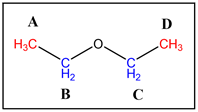
The protons that are shown with the same color are equivalent to each other.
Identify the distinct protons and then calculate the number of signals in of the given compound as follows:
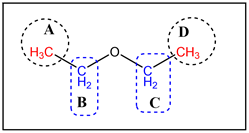
As the two distinct sets of protons are present, therefore, the number of signals obtained will be 2.
Ans:Hence, the group of protons that are equivalent are shown as follows:
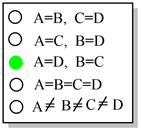
Hence, the number of signals obtained in is shown below:

Add Answer to:
Diethyl ether has the following structure Which groups of protons are equivalent to each other? How...
Diethyl ether has the following structure: H₂a CH3 LO CH2 CH2 a) Which groups of protons are equivalent to each other?...
 Diethyl ether has the following structure: H₂a CH3 LO CH2 CH2 a) Which groups of protons are equivalent to each other? A=B, C=D A=C, B=D A=D, B=C A=B=C=D O A#B#C#D b) How many signals (individual resonances, not counting splitting) are expected in the 'H NMR spectrum? 1 000000
Please explain all steps. Include degrees of unsaturation, functional groups, and signals used to determine structure. For the compounds listed below: 1. (18 points) Label each set of chemically equi...
 Please explain all steps. Include degrees of
unsaturation, functional groups, and signals used to determine
structure.
For the compounds listed below: 1. (18 points) Label each set of chemically equivalent protons, using a for the set that will be have the lowest frequency (most upfield) in the 1H NMR spectrum, b for the next a. lowest, and so on. of each set of the equivalent protons. expected for each compound. b. Indicate the splitting pattern (singlet, doublet, triplet...) for expected...
Please explain all steps. Include degrees of
unsaturation, functional groups, and signals used to determine
structure.
For the compounds listed below: 1. (18 points) Label each set of chemically equivalent protons, using a for the set that will be have the lowest frequency (most upfield) in the 1H NMR spectrum, b for the next a. lowest, and so on. of each set of the equivalent protons. expected for each compound. b. Indicate the splitting pattern (singlet, doublet, triplet...) for expected...
Indicate how many 1H NMR signals (individual resonances, not counting splitting) are expected for the compound...
 Indicate how many 1H NMR signals (individual resonances, not
counting splitting) are expected for the compound below.
Indicate how many 1H NMR signals (individual resonances, not
counting splitting) are expected for the compound below.
Indicate how many 'H NMR signals (individual resonances, not counting splitting) are expected for the compound....
 Indicate how many 'H NMR signals (individual resonances, not counting splitting) are expected for the compound. Br—CH20 -CH3 Br How many 'H NMR signals are expected? signals
Indicate how many^1 H NMR signals (individual resonances, not counting splitting) are expected for the compound...
 Indicate how many^1 H NMR signals (individual resonances, not counting splitting) are expected for the compound below.
Indicate how many 'H NMR signals (individual resonances, not counting splitting) are expected for the compound below. B...
 Indicate how many 'H NMR signals (individual resonances, not counting splitting) are expected for the compound below. Br-CH20-CH3 Number H signals
How many 1H-NMR signals would be in the spectrum for the following compound? Diastereotopic hydrogens would...
 How many 1H-NMR signals would be in the spectrum for the
following compound? Diastereotopic hydrogens would produce
different signals.
What is the splitting pattern for Ha in the following
structure?
Which of the following methyl group will have the furthest
upfield chemical shift?
How many 'H-NMR signals would be in the spectrum for the following compound? Diastereotopic hydrogens would produce different signals. (R)-2-iodo-pentane a. 5 b. 6 c. 7 d. 4 What is the splitting pattern for Ha in the...
How many 1H-NMR signals would be in the spectrum for the
following compound? Diastereotopic hydrogens would produce
different signals.
What is the splitting pattern for Ha in the following
structure?
Which of the following methyl group will have the furthest
upfield chemical shift?
How many 'H-NMR signals would be in the spectrum for the following compound? Diastereotopic hydrogens would produce different signals. (R)-2-iodo-pentane a. 5 b. 6 c. 7 d. 4 What is the splitting pattern for Ha in the...
1) Below is molecule 1. Provide the relationship between the indicated protons below, either diastereotopic or...
 1) Below is molecule 1. Provide the relationship between the indicated protons below, either diastereotopic or identical and then answer the remaining questions about the molecule. Molecule 1 has been drawn with all of the hydrogens and with none of them drawn out. a) What is the relationship b) What is the relationship between HA and HD? between Hg and HC? H. HE ΉA F HD molecule 1 c) How many signals would expect in the H NMR of molecule...
or the homotopic protons labeled Ha in the structure below, predict the following characteristics of their...
 or the homotopic protons labeled Ha in the structure below,
predict the following characteristics of their signal in the 1H NMR
spectrum: the approximate chemical shift, the splitting pattern,
and the integration value.
or the homotopic protons labeled Ha in the structure below,
predict the following characteristics of their signal in the 1H NMR
spectrum: the approximate chemical shift, the splitting pattern,
and the integration value.
e. How many sets of non-equivalent protons are present in Benzoic Acid? f. Label all protons...
e. How many sets of non-equivalent protons are present in Benzoic Acid? f. Label all protons in your structure (Benzoic Acid) and indicate what would be the multiplicity of each set of non-equivalent protons in your compound (singlet, doublet, ect.)? g. How many peaks would you predict would appear in the Carbon-13 NMR spectrum? Please label all carbons in your structure (Benzoic Acid) h. Which carbon atom in your compound would you predict would be the farthest downfield in your...
 Diethyl ether has the following structure: H₂a CH3 LO CH2 CH2 a) Which groups of protons are equivalent to each other? A=B, C=D A=C, B=D A=D, B=C A=B=C=D O A#B#C#D b) How many signals (individual resonances, not counting splitting) are expected in the 'H NMR spectrum? 1 000000
 Please explain all steps. Include degrees of
unsaturation, functional groups, and signals used to determine
structure.
For the compounds listed below: 1. (18 points) Label each set of chemically equivalent protons, using a for the set that will be have the lowest frequency (most upfield) in the 1H NMR spectrum, b for the next a. lowest, and so on. of each set of the equivalent protons. expected for each compound. b. Indicate the splitting pattern (singlet, doublet, triplet...) for expected...
Please explain all steps. Include degrees of
unsaturation, functional groups, and signals used to determine
structure.
For the compounds listed below: 1. (18 points) Label each set of chemically equivalent protons, using a for the set that will be have the lowest frequency (most upfield) in the 1H NMR spectrum, b for the next a. lowest, and so on. of each set of the equivalent protons. expected for each compound. b. Indicate the splitting pattern (singlet, doublet, triplet...) for expected...
 Indicate how many 1H NMR signals (individual resonances, not
counting splitting) are expected for the compound below.
Indicate how many 1H NMR signals (individual resonances, not
counting splitting) are expected for the compound below.
 Indicate how many 'H NMR signals (individual resonances, not counting splitting) are expected for the compound. Br—CH20 -CH3 Br How many 'H NMR signals are expected? signals
 Indicate how many^1 H NMR signals (individual resonances, not counting splitting) are expected for the compound below.
 Indicate how many 'H NMR signals (individual resonances, not counting splitting) are expected for the compound below. Br-CH20-CH3 Number H signals
 How many 1H-NMR signals would be in the spectrum for the
following compound? Diastereotopic hydrogens would produce
different signals.
What is the splitting pattern for Ha in the following
structure?
Which of the following methyl group will have the furthest
upfield chemical shift?
How many 'H-NMR signals would be in the spectrum for the following compound? Diastereotopic hydrogens would produce different signals. (R)-2-iodo-pentane a. 5 b. 6 c. 7 d. 4 What is the splitting pattern for Ha in the...
How many 1H-NMR signals would be in the spectrum for the
following compound? Diastereotopic hydrogens would produce
different signals.
What is the splitting pattern for Ha in the following
structure?
Which of the following methyl group will have the furthest
upfield chemical shift?
How many 'H-NMR signals would be in the spectrum for the following compound? Diastereotopic hydrogens would produce different signals. (R)-2-iodo-pentane a. 5 b. 6 c. 7 d. 4 What is the splitting pattern for Ha in the...
 1) Below is molecule 1. Provide the relationship between the indicated protons below, either diastereotopic or identical and then answer the remaining questions about the molecule. Molecule 1 has been drawn with all of the hydrogens and with none of them drawn out. a) What is the relationship b) What is the relationship between HA and HD? between Hg and HC? H. HE ΉA F HD molecule 1 c) How many signals would expect in the H NMR of molecule...
 or the homotopic protons labeled Ha in the structure below,
predict the following characteristics of their signal in the 1H NMR
spectrum: the approximate chemical shift, the splitting pattern,
and the integration value.
or the homotopic protons labeled Ha in the structure below,
predict the following characteristics of their signal in the 1H NMR
spectrum: the approximate chemical shift, the splitting pattern,
and the integration value.
Most questions answered within 3 hours.
-
Where is the error in this code sequence?
String s1 = "Hello";
String s2 = "ello";...
asked 10 months ago -
Financial data for Joel de Paris, Inc., for last year
follow:
Joel de Paris, Inc.
Balance...
asked 10 months ago -
Consider this reaction:
Al2(SO4)3 (aq)+ BaCl3
(aq) Al2Cl6 (aq)- +
3BaSO4(s) . What is the...
asked 10 months ago -
Suppose that Savneet is considering increasing her
recent random sample from 20 car rentals to 40...
asked 10 months ago -
Trucks arrive at an unloading terminal at an average rate of 120
per hour.
Trucks arrive...
asked 10 months ago -
Why are methanol and ethanol completely soluble in water while
octanol is not very little soluble....
asked 10 months ago -
A facilities manager at a university reads in a research report
that the mean amount of...
asked 10 months ago -
When the CuSO4 is rehydrated by adding water to the anhydrous
compound, is this an endothermic...
asked 10 months ago -
A ray of sunlight is passing from diamond into crown glass; the
angle of incidence is...
asked 10 months ago -
A block of mass 0.249 kg is placed on top of a light, vertical
spring of...
asked 10 months ago -
how do the kidneys compensate in the presences of acidosis
a) trigger hyperventilate
b) reserve acid...
asked 10 months ago -
Question 501 pts
The rental rate of capital to the firm increases. Which of the
following...
asked 10 months ago