An object is moving around the unit circle with parametric equations x(t)=cos(t), y(t)=sin(t), so it's location...
An object is moving around the unit circle with parametric equations x(t)=cos(t), y(t)=sin(t), so it's location at time t is P(t)=(cos(t),sin(t)) . Assume 0 < t < π/2. At a given time t, the tangent line to the unit circle at the position P(t) will determine a right triangle in the first quadrant. (Connect the origin with the y-intercept and x-intercept of the tangent line.)
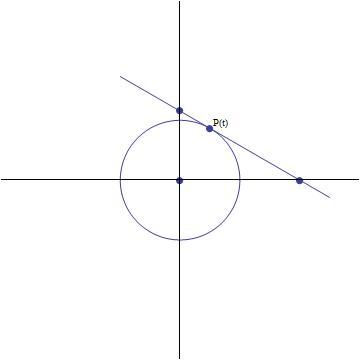
(a) The area of the right triangle is
a(t)= .
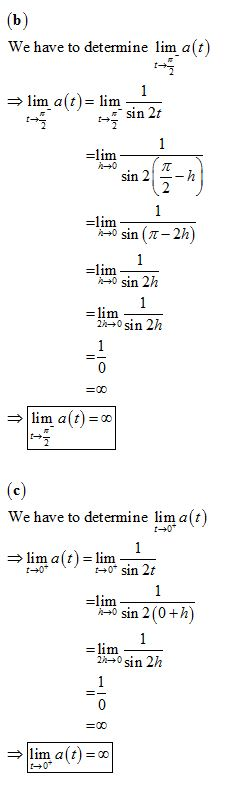
(b)
lim t → pi/2−a(t)=
(c)
lim t → 0+a(t)=
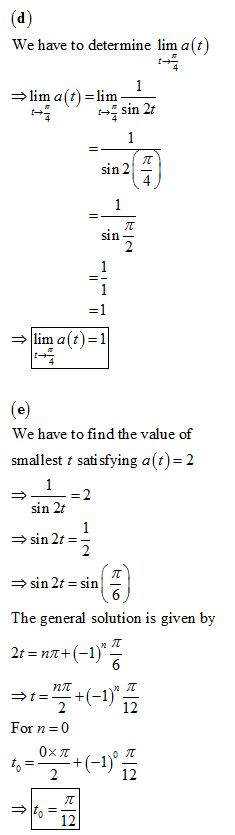
(d)
lim t → pi/4 a(t)=
(e) With our restriction on t, the smallest t so
that a(t)=2 is
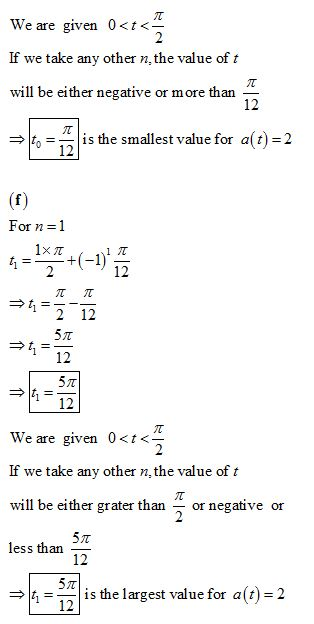
(f) With our restriction on t, the largest t so
that a(t)=2 is
(g) The average rate of change of the area of the triangle on the
time interval [π/6,π/4] is .
(g) The average rate of change of the area of the triangle on the
time interval [π/4,π/3] is .
(h) Create a table of values to study the average rate of change of
the area of the triangle on the time intervals
[π/6,b], as b approaches π/6
from the right. The limiting value is .
(i) Create a table of values to study the average rate of change of
the area of the triangle on the time intervals
[a,π/3], as a approaches π/3
from the left. The limiting value is .
Homework Answers


Add Answer to:
An object is moving around the unit circle with parametric
equations x(t)=cos(t), y(t)=sin(t), so it's location...
An object is moving around the unit circle with parametric equations x(t)=cos(t), y(t)=sin(t), so it's location...
An object is moving around the unit circle with parametric equations x(t)=cos(t), y(t)=sin(t), so it's location at time t is P(t)=(cos(t),sin(t)) . Assume 0 < t < ?/2. At a given time t, the tangent line to the unit circle at the position P(t) will determine a right triangle in the first quadrant. (Connect the origin with the y-intercept and x-intercept of the tangent line.)
I just need help with question F An object is moving around the unit circle with...
 I just need help with question F
An object is moving around the unit circle with parametric equations x(t)=cos(t), y(t)=sin(t), so it's location at time t is P(t)=(cos(t), sin(t)). Assume 0 < t < pi/2. At a given time t, the tangent line to the unit circle at the position P(t) will determine a right triangle in the first quadrant. (Connect the origin with the y-intercept and x-intercept of the tangent line.) The identity sin(2t)=2sin(t)cost(t) might be useful in some...
I just need help with question F
An object is moving around the unit circle with parametric equations x(t)=cos(t), y(t)=sin(t), so it's location at time t is P(t)=(cos(t), sin(t)). Assume 0 < t < pi/2. At a given time t, the tangent line to the unit circle at the position P(t) will determine a right triangle in the first quadrant. (Connect the origin with the y-intercept and x-intercept of the tangent line.) The identity sin(2t)=2sin(t)cost(t) might be useful in some...
An ant is moving around the unit circle in the plane so that its location is...
An ant is moving around the unit circle in the plane so that its location is given by the parametric equations (cos(π t), sin(π t)). Assume the distance units in the plane are "feet" and the time units are "seconds". In particular, the ant is initially at the point A=(1,0). A spider is located at the point S=(3,0) on the x-axis. The spider plans to move along the tangential line pictured at a constant rate. Assume the spider starts moving...
Evaluate Sc (2+2)dy where C is described by parametric equations x(t) = cos(t), y= sin(t), z...
 Evaluate Sc (2+2)dy where C is described by parametric equations x(t) = cos(t), y= sin(t), z = 2,0 <t< Select one: O A. +2 O B. 1+2 O C.-1 OD. -1 ABC is a triangle in R where A =(1,4,5), B =(2,-1,0) and C =(4, 2, -3). Find the area of ABC. Select one: O A. (-30,7, -13) O B. -2 OC. V1118 O D. VILLE
Activity: A Journey Through Calculus from A to Z sin(x-1) :- 1) x< h(x) kr2 -...
 Activity: A Journey Through Calculus from A to Z sin(x-1) :- 1) x< h(x) kr2 - 8x + 6. 13x53 Ver-6 – x2 +5, x>3 Consider f'(x), the derivative of the continuous functionſ defined on the closed interval -6,7] except at x 5. A portion of f' is given in the graph above and consists of a semicircle and two line segments. The function (x) is a piecewise defined function given above where k is a constant The function g(x)...
 I just need help with question F
An object is moving around the unit circle with parametric equations x(t)=cos(t), y(t)=sin(t), so it's location at time t is P(t)=(cos(t), sin(t)). Assume 0 < t < pi/2. At a given time t, the tangent line to the unit circle at the position P(t) will determine a right triangle in the first quadrant. (Connect the origin with the y-intercept and x-intercept of the tangent line.) The identity sin(2t)=2sin(t)cost(t) might be useful in some...
I just need help with question F
An object is moving around the unit circle with parametric equations x(t)=cos(t), y(t)=sin(t), so it's location at time t is P(t)=(cos(t), sin(t)). Assume 0 < t < pi/2. At a given time t, the tangent line to the unit circle at the position P(t) will determine a right triangle in the first quadrant. (Connect the origin with the y-intercept and x-intercept of the tangent line.) The identity sin(2t)=2sin(t)cost(t) might be useful in some...
 Evaluate Sc (2+2)dy where C is described by parametric equations x(t) = cos(t), y= sin(t), z = 2,0 <t< Select one: O A. +2 O B. 1+2 O C.-1 OD. -1 ABC is a triangle in R where A =(1,4,5), B =(2,-1,0) and C =(4, 2, -3). Find the area of ABC. Select one: O A. (-30,7, -13) O B. -2 OC. V1118 O D. VILLE
 Activity: A Journey Through Calculus from A to Z sin(x-1) :- 1) x< h(x) kr2 - 8x + 6. 13x53 Ver-6 – x2 +5, x>3 Consider f'(x), the derivative of the continuous functionſ defined on the closed interval -6,7] except at x 5. A portion of f' is given in the graph above and consists of a semicircle and two line segments. The function (x) is a piecewise defined function given above where k is a constant The function g(x)...
Most questions answered within 3 hours.
-
Where is the error in this code sequence?
String s1 = "Hello";
String s2 = "ello";...
asked 11 months ago -
Financial data for Joel de Paris, Inc., for last year
follow:
Joel de Paris, Inc.
Balance...
asked 11 months ago -
Consider this reaction:
Al2(SO4)3 (aq)+ BaCl3
(aq) Al2Cl6 (aq)- +
3BaSO4(s) . What is the...
asked 11 months ago -
Suppose that Savneet is considering increasing her
recent random sample from 20 car rentals to 40...
asked 11 months ago -
Trucks arrive at an unloading terminal at an average rate of 120
per hour.
Trucks arrive...
asked 11 months ago -
Why are methanol and ethanol completely soluble in water while
octanol is not very little soluble....
asked 11 months ago -
A facilities manager at a university reads in a research report
that the mean amount of...
asked 11 months ago -
When the CuSO4 is rehydrated by adding water to the anhydrous
compound, is this an endothermic...
asked 11 months ago -
A ray of sunlight is passing from diamond into crown glass; the
angle of incidence is...
asked 11 months ago -
A block of mass 0.249 kg is placed on top of a light, vertical
spring of...
asked 11 months ago -
how do the kidneys compensate in the presences of acidosis
a) trigger hyperventilate
b) reserve acid...
asked 11 months ago -
Question 501 pts
The rental rate of capital to the firm increases. Which of the
following...
asked 11 months ago