Homework Answers
Add Answer to:
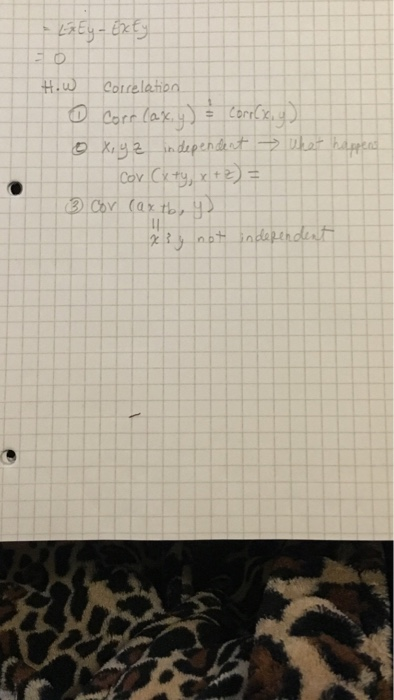
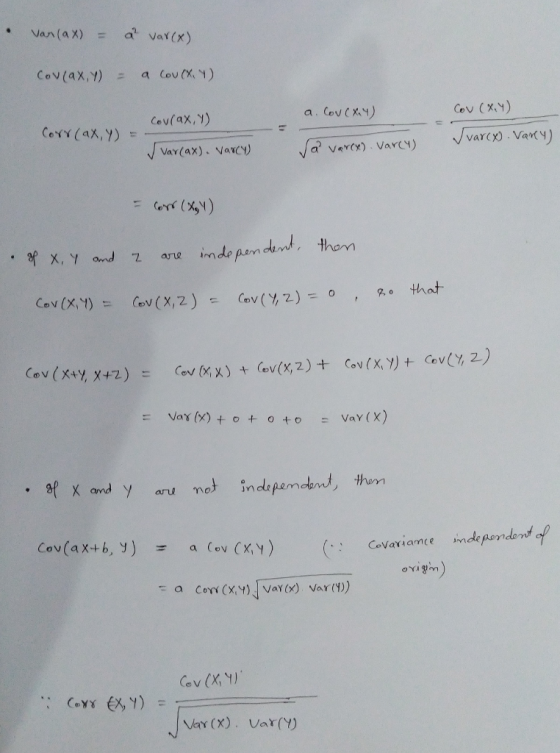
Prove the following statements • corr(ax,y) = corr(x,y) • show that if x,y and z are...
Show that if Y = ax + b (a = 0), then Corr(X, Y = +1...
 Show that if Y = ax + b (a = 0), then Corr(X, Y = +1 or -1. We know Cov(X, Y) = Covl X, a X ) +o) - (1 ])uxo. X). Then Cov(X, Y) oxor Jux Corr(x, y) = which is 1 when a > 0 and –1 when a < 0 0x (lal ox) lal Under what condition will = +1? The value p = +1 when a > 0
X and z are independent. Var(x)=1 ; Var(z) = sigma ^2. E(z)= 0 and y= ax+b+z...
 X
and z are independent. Var(x)=1 ; Var(z) = sigma ^2. E(z)= 0 and y=
ax+b+z
I) cov(x,y)= ?
ii) corr(x,y)=?
dependent Varvane 2.
X
and z are independent. Var(x)=1 ; Var(z) = sigma ^2. E(z)= 0 and y=
ax+b+z
I) cov(x,y)= ?
ii) corr(x,y)=?
dependent Varvane 2.
(5) Show Corr(aX + b, cY + d) = Corr(X, Y). Hint: Use results for the covariance and variance.] (5) Show Corr(aX + b, cY + d) = Corr(X, Y). Hint: Use results for the covariance and variance.]
 (5) Show Corr(aX + b, cY + d) = Corr(X, Y). Hint: Use results for the covariance and variance.]
(5) Show Corr(aX + b, cY + d) = Corr(X, Y). Hint: Use results for the covariance and variance.]
(5) Show Corr(aX + b, cY + d) = Corr(X, Y). Hint: Use results for the covariance and variance.]
1. Show that Corr(aX + b, cY + d) = Corr(X, Y) using the definition of...
 1. Show that Corr(aX + b, cY + d) = Corr(X, Y) using the definition of correlation in page 249, and finding each component first. Correlatiorn DEFINITION The correlation coefficient of X and Y, denoted by Corr(X, Y), or ρχ.r, or just ρ, is defined by Ox-GY
(5) Show Corr(aX + b, cY + d) = Corr(X, Y). Hint: Use results for the...
 (5) Show Corr(aX + b, cY + d) = Corr(X, Y). Hint: Use results for the covariance and variance.]
Ex. 36 Show that if Y= aX+ b (a≠0), then Corr(X, Y) = +1 or -1. Under what conditions will p = +1?
Ex. 36Show that if Y= aX+ b (a≠0), then Corr(X, Y) = +1 or -1. Under what conditions will p = +1?
Assume a, b ∈ Z. Prove that if ax + by = 1 for some x,...
Assume a, b ∈ Z. Prove that if ax + by = 1 for some x, y ∈ Z, then gcd(a, b) = 1.
4. Assume X ~ Uniform(0, 1) and let Y = 2X+1 and Z = X2 +...
 4. Assume X ~ Uniform(0, 1) and let Y = 2X+1 and Z = X2 + 1. (a) Find Cov(X,Y), Var(X+Y), Var(X - Y) and Corr(X,Y). (b) Find Cov(X, Z), Var(X + Z), Var(X – Z) and Corr(X, Z).
How to prove that: Cov(aX, aY) = a^2Cov(X,Y)
How to prove that: Cov(aX, aY) = a^2Cov(X,Y)
Problem 2 Suppose two continuous random variables (X, Y) ~ f(x,y). (1) Prove E(X +Y) =...
 Problem 2 Suppose two continuous random variables (X, Y) ~ f(x,y). (1) Prove E(X +Y) = E(X)+ E(Y). (2) Prove Var(X + Y) = Var(X) + Var(Y)2Cov(X, Y). (3) Prove Cov(X, Y) E(XY)- E(X)E(Y). (4) Prove that if X and Y are independent, i.e., f(x, y) Cov(X, Y) 0. Is the reverse true? (5) Prove Cov (aX b,cY + d) = acCov(X, Y). (6) Prove Cov(X, X) = Var(X) fx (x)fy(y) for any (x,y), then =
 Show that if Y = ax + b (a = 0), then Corr(X, Y = +1 or -1. We know Cov(X, Y) = Covl X, a X ) +o) - (1 ])uxo. X). Then Cov(X, Y) oxor Jux Corr(x, y) = which is 1 when a > 0 and –1 when a < 0 0x (lal ox) lal Under what condition will = +1? The value p = +1 when a > 0
 X
and z are independent. Var(x)=1 ; Var(z) = sigma ^2. E(z)= 0 and y=
ax+b+z
I) cov(x,y)= ?
ii) corr(x,y)=?
dependent Varvane 2.
X
and z are independent. Var(x)=1 ; Var(z) = sigma ^2. E(z)= 0 and y=
ax+b+z
I) cov(x,y)= ?
ii) corr(x,y)=?
dependent Varvane 2.
 (5) Show Corr(aX + b, cY + d) = Corr(X, Y). Hint: Use results for the covariance and variance.]
(5) Show Corr(aX + b, cY + d) = Corr(X, Y). Hint: Use results for the covariance and variance.]
(5) Show Corr(aX + b, cY + d) = Corr(X, Y). Hint: Use results for the covariance and variance.]
 1. Show that Corr(aX + b, cY + d) = Corr(X, Y) using the definition of correlation in page 249, and finding each component first. Correlatiorn DEFINITION The correlation coefficient of X and Y, denoted by Corr(X, Y), or ρχ.r, or just ρ, is defined by Ox-GY
 (5) Show Corr(aX + b, cY + d) = Corr(X, Y). Hint: Use results for the covariance and variance.]
 4. Assume X ~ Uniform(0, 1) and let Y = 2X+1 and Z = X2 + 1. (a) Find Cov(X,Y), Var(X+Y), Var(X - Y) and Corr(X,Y). (b) Find Cov(X, Z), Var(X + Z), Var(X – Z) and Corr(X, Z).
 Problem 2 Suppose two continuous random variables (X, Y) ~ f(x,y). (1) Prove E(X +Y) = E(X)+ E(Y). (2) Prove Var(X + Y) = Var(X) + Var(Y)2Cov(X, Y). (3) Prove Cov(X, Y) E(XY)- E(X)E(Y). (4) Prove that if X and Y are independent, i.e., f(x, y) Cov(X, Y) 0. Is the reverse true? (5) Prove Cov (aX b,cY + d) = acCov(X, Y). (6) Prove Cov(X, X) = Var(X) fx (x)fy(y) for any (x,y), then =
Most questions answered within 3 hours.
-
Where is the error in this code sequence?
String s1 = "Hello";
String s2 = "ello";...
asked 11 months ago -
Financial data for Joel de Paris, Inc., for last year
follow:
Joel de Paris, Inc.
Balance...
asked 11 months ago -
Consider this reaction:
Al2(SO4)3 (aq)+ BaCl3
(aq) Al2Cl6 (aq)- +
3BaSO4(s) . What is the...
asked 11 months ago -
Suppose that Savneet is considering increasing her
recent random sample from 20 car rentals to 40...
asked 11 months ago -
Trucks arrive at an unloading terminal at an average rate of 120
per hour.
Trucks arrive...
asked 11 months ago -
Why are methanol and ethanol completely soluble in water while
octanol is not very little soluble....
asked 11 months ago -
A facilities manager at a university reads in a research report
that the mean amount of...
asked 11 months ago -
When the CuSO4 is rehydrated by adding water to the anhydrous
compound, is this an endothermic...
asked 11 months ago -
A ray of sunlight is passing from diamond into crown glass; the
angle of incidence is...
asked 11 months ago -
A block of mass 0.249 kg is placed on top of a light, vertical
spring of...
asked 11 months ago -
how do the kidneys compensate in the presences of acidosis
a) trigger hyperventilate
b) reserve acid...
asked 11 months ago -
Question 501 pts
The rental rate of capital to the firm increases. Which of the
following...
asked 11 months ago