 Please answer
Homework Answers
Answer:
The following would have occurred over 1933:
C. Decrease in Agg D
because the decrease in aggregate demand in 1933 would have reduced the real GDP and the price level in 1933. As the decrease in aggregate demand means less consumption expenditure which will lead to decrease in the production and other economic activities which will adversely affect the GDP and price level
Add Answer to:
Please answer DQuestion 13 2.6 pts In 1932, we had real GDP of 788.2, and in...
Please answer DQuestion 15 2.6 pts Suppose that from one year to the next real GDP...
 Please answer
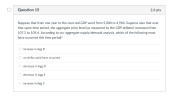
DQuestion 15 2.6 pts Suppose that from one year to the next real GDP went from 5,000 to 4,960. Suppose also that over that same time period, the aggregate price level (as measured by the GDP deflator) increased from 107.2 to 109.4. According to our aggregate supply/demand analysis, which of the following must have occurred this time period? increase in Agg D no shifts could have occurred decrease in Agg D decrease in Agg S increase in Agg...
Please answer
DQuestion 15 2.6 pts Suppose that from one year to the next real GDP went from 5,000 to 4,960. Suppose also that over that same time period, the aggregate price level (as measured by the GDP deflator) increased from 107.2 to 109.4. According to our aggregate supply/demand analysis, which of the following must have occurred this time period? increase in Agg D no shifts could have occurred decrease in Agg D decrease in Agg S increase in Agg...
Suppose the current level of real GDP for an economy is below its potential level of...
Suppose the current level of real GDP for an economy is below its potential level of RGDP. Starting with this situation, and in the absence of any government action, what should next happen in the AD-AS model? Group of answer choices A. A decrease in the Long-Run Aggregate Supply B. An increase in Aggregate Demand C. A decrease in Aggregate Demand D. An increase in the Short-Run Aggregate Supply E. An increase in the Long-Run Aggregate Supply F. A decrease...
Actual GDP (S Billions) Actual GDP growth rate Real GDP (S Billions) Real GDP growth rate(...
 Actual GDP (S Billions) Actual GDP growth rate Real GDP (S Billions) Real GDP growth rate( GDP Price Deflator Rate of inflation Az? 800 100 842 D-? 3% B-7 820 0.714 E#7 01.980 6. The dollar amount of cell A is a) $700 b) $800 c) $850 d) $900 7. The dollar amount of cell B is a) $780 b) $808 c) $827 d) $842 8. The GDP price deflator in cell C (first decimal; no rounding) is a) 100.8...
Question 43 5 pts If the Money Supply (M) is $10 billion, real GDP (Q) is...
Question 43 5 pts If the Money Supply (M) is $10 billion, real GDP (Q) is $20 billion, and the Price Level (P) is 2.0, then the velocity of money (V) is: 2. 40. 20. 4. --------------------------- Question 44 5 pts Which of the following does NOT explain the downward slope of the aggregate demand curve? The real balance (wealth) effect The multiplier effect The international trade effect The interest rate effect Question 45 5 pts An increase in household...
16. to the wealth effect, an increase in the price level causes ease in real wealth and more purchases b. An incr C. A decrease d. rease in real wealth and fewer purchases se in real wealth and f...
 16. to the wealth effect, an increase in the price level causes ease in real wealth and more purchases b. An incr C. A decrease d. rease in real wealth and fewer purchases se in real wealth and fewer purchases A decrease in r price level increase tends to reduce net exports, thereby reducing the amount of real goods a. The b. The international banner effect C. rvices purchased in the U.S. Economists refer to this phenomenon as international wealth...
Q 12 , 13, 14 * Deliberate changes in government expenditures and taxes to influence GDP...
Q 12 , 13, 14 * Deliberate changes in government expenditures and taxes to influence GDP A. are enacted by the Council of Economic Advisers. B. are examples of automatic fiscal policy because the politicians automatically respond. C. operate without time lags. D. are forms of discretionary fiscal policy. ----------------------------------------- The term "stagflation" refers to the situation when A. real GDP and the price level both rise because of an increase in aggregate demand. B. prices become stagnant and do...
QUESTION 10 0.36 points Save Answer LRAS Aggregate price level P, AD, Real GDP In response to the high unemployment rate and low level of real GDP at point El in the diagram above, the Federal Op...
 QUESTION 10 0.36 points Save Answer LRAS Aggregate price level P, AD, Real GDP In response to the high unemployment rate and low level of real GDP at point El in the diagram above, the Federal Open Market Committee (the decision-making body of the Federal Reserve) decides to engineer a decrease in interest rates. If no other disturbances occurred, and the Fed calibrated its policy perfectly so that full employment equilibrium was restored, what price level would prevail at the...
What is most likely to happen to the price level and real GDP if the Fed...
What is most likely to happen to the price level and real GDP if the Fed raises the Required Reserves Ratio from 10% to 15%. Select one: a. Price level and real GDP will both increase b. Price level and real GDP will both decrease c. Price level will increase, but real GDP will decrease d. Price level will decrease, but real GDP will increase e. Monetary policies have no effect on the economy
Product 13) 13) The gap that exists when equilibrium real Gross Domestic (GDP) is greater than...
 Product 13) 13) The gap that exists when equilibrium real Gross Domestic (GDP) is greater than full employment real Gross Domestic Product (GDP) is called a(n) A) demand gap. C) recessionary gap B) employment gap D) inflationary gap 14) 14) Economic growth will NOT result in inflation if aggregate demand shifts A) outward to the right at the same speed as aggregate supply B) outward to the right as aggregate supply shifts inward to the left. C) inward to the...
14. Consider starting from full-employment equilibrium in our Aggregate Demand and Supply model (with flexible wages...
 14. Consider starting from full-employment equilibrium in our Aggregate Demand and Supply model (with flexible wages and worker misperception of price level changes in the short run), at Po, Qn on the output market graph below. Then we get a decrease in Aggregate Demand from Agg D, to Agg D1. P LR Agg S SR Agg S. Agg D 0 Agg D1 Q Q1 N We can say that O In the long run, P and Q will return to...
 Please answer
DQuestion 15 2.6 pts Suppose that from one year to the next real GDP went from 5,000 to 4,960. Suppose also that over that same time period, the aggregate price level (as measured by the GDP deflator) increased from 107.2 to 109.4. According to our aggregate supply/demand analysis, which of the following must have occurred this time period? increase in Agg D no shifts could have occurred decrease in Agg D decrease in Agg S increase in Agg...
Please answer
DQuestion 15 2.6 pts Suppose that from one year to the next real GDP went from 5,000 to 4,960. Suppose also that over that same time period, the aggregate price level (as measured by the GDP deflator) increased from 107.2 to 109.4. According to our aggregate supply/demand analysis, which of the following must have occurred this time period? increase in Agg D no shifts could have occurred decrease in Agg D decrease in Agg S increase in Agg...
 Actual GDP (S Billions) Actual GDP growth rate Real GDP (S Billions) Real GDP growth rate( GDP Price Deflator Rate of inflation Az? 800 100 842 D-? 3% B-7 820 0.714 E#7 01.980 6. The dollar amount of cell A is a) $700 b) $800 c) $850 d) $900 7. The dollar amount of cell B is a) $780 b) $808 c) $827 d) $842 8. The GDP price deflator in cell C (first decimal; no rounding) is a) 100.8...
 16. to the wealth effect, an increase in the price level causes ease in real wealth and more purchases b. An incr C. A decrease d. rease in real wealth and fewer purchases se in real wealth and fewer purchases A decrease in r price level increase tends to reduce net exports, thereby reducing the amount of real goods a. The b. The international banner effect C. rvices purchased in the U.S. Economists refer to this phenomenon as international wealth...
 QUESTION 10 0.36 points Save Answer LRAS Aggregate price level P, AD, Real GDP In response to the high unemployment rate and low level of real GDP at point El in the diagram above, the Federal Open Market Committee (the decision-making body of the Federal Reserve) decides to engineer a decrease in interest rates. If no other disturbances occurred, and the Fed calibrated its policy perfectly so that full employment equilibrium was restored, what price level would prevail at the...
 Product 13) 13) The gap that exists when equilibrium real Gross Domestic (GDP) is greater than full employment real Gross Domestic Product (GDP) is called a(n) A) demand gap. C) recessionary gap B) employment gap D) inflationary gap 14) 14) Economic growth will NOT result in inflation if aggregate demand shifts A) outward to the right at the same speed as aggregate supply B) outward to the right as aggregate supply shifts inward to the left. C) inward to the...
 14. Consider starting from full-employment equilibrium in our Aggregate Demand and Supply model (with flexible wages and worker misperception of price level changes in the short run), at Po, Qn on the output market graph below. Then we get a decrease in Aggregate Demand from Agg D, to Agg D1. P LR Agg S SR Agg S. Agg D 0 Agg D1 Q Q1 N We can say that O In the long run, P and Q will return to...
Most questions answered within 3 hours.
-
Where is the error in this code sequence?
String s1 = "Hello";
String s2 = "ello";...
asked 10 months ago -
Financial data for Joel de Paris, Inc., for last year
follow:
Joel de Paris, Inc.
Balance...
asked 10 months ago -
Consider this reaction:
Al2(SO4)3 (aq)+ BaCl3
(aq) Al2Cl6 (aq)- +
3BaSO4(s) . What is the...
asked 10 months ago -
Suppose that Savneet is considering increasing her
recent random sample from 20 car rentals to 40...
asked 10 months ago -
Trucks arrive at an unloading terminal at an average rate of 120
per hour.
Trucks arrive...
asked 10 months ago -
Why are methanol and ethanol completely soluble in water while
octanol is not very little soluble....
asked 10 months ago -
A facilities manager at a university reads in a research report
that the mean amount of...
asked 10 months ago -
When the CuSO4 is rehydrated by adding water to the anhydrous
compound, is this an endothermic...
asked 10 months ago -
A ray of sunlight is passing from diamond into crown glass; the
angle of incidence is...
asked 10 months ago -
A block of mass 0.249 kg is placed on top of a light, vertical
spring of...
asked 10 months ago -
how do the kidneys compensate in the presences of acidosis
a) trigger hyperventilate
b) reserve acid...
asked 10 months ago -
Question 501 pts
The rental rate of capital to the firm increases. Which of the
following...
asked 10 months ago