
Homework Answers
Add Answer to:
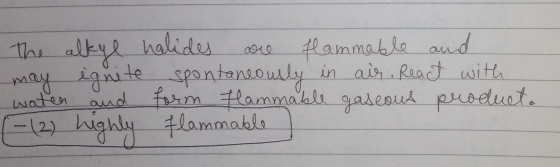
The alkyl halides in this lab must be handled with care because they are: Lacrymators and...
Tellurium compounds, which are toxic and have a hideous stench, must be handled with extreme care....
Tellurium compounds, which are toxic and have a hideous stench, must be handled with extreme care. Match the following molecular geometries with the correct tellurium-flourine molecular (or ionic) formula: A TeF8 B TeF3- C TeF5- D TeF4 E TeF8+ F TeF5+ G TeF2 H TeF6 I None of the above seesaw bent trigonal bipyramid octahedron T-shape square pyramid
E1 eliminations of alkyl halides are rarely useful for synthetic purposes because they give mixtu...
E1 eliminations of alkyl halides are rarely useful for synthetic purposes because they give mixtures of substitution and elimination products. Explain why the sulfuric acid-catalyzed dehydration of cyclohexanol gives a good yield of cyclohexene even though the reaction goes by an E1 mechanism. (Hint: What are the nucleophiles in the reaction mixture? What products are formed if these nucleophiles attack the carbocation? What further reactions can these substitution products undergo?)
I know they're numbered seperately as 3 questions, but because they build on eachother, I didn't...
 I know they're numbered seperately as 3 questions, but because
they build on eachother, I didn't know how else to seperate
it.
Pre-Lab Questions 1. List the alkyl halides 1-chlorobutane, 2-chlorobutane, 2- chloro-2methylpropane, in order or reactivity from most reactive to least reactive for: a. an Snl reaction. b. an S2 reaction. 2. Draw the mechanism for: a. an Sp1 reaction. b. an Sy2 reaction. 3. Using your mechanisms in question 2, fully explain your rankings in question 1.
I know they're numbered seperately as 3 questions, but because
they build on eachother, I didn't know how else to seperate
it.
Pre-Lab Questions 1. List the alkyl halides 1-chlorobutane, 2-chlorobutane, 2- chloro-2methylpropane, in order or reactivity from most reactive to least reactive for: a. an Snl reaction. b. an S2 reaction. 2. Draw the mechanism for: a. an Sp1 reaction. b. an Sy2 reaction. 3. Using your mechanisms in question 2, fully explain your rankings in question 1.
Proposed Synthesis Show the structure of your target molecule as well as synthetic schemes illustrating the two st...
 Proposed Synthesis Show the structure of your target molecule as well as synthetic schemes illustrating the two steps required for preparing it from "allowed" starting materials. For each synthetic step indicate the source of the experimental procedure you will follow-sources can either be literature references or simply the course pack itself. (See the example below for the format to be followed) ~Example Target Molecule: NO2 Cl Step 1: OH Reference: Tetrahedron, 1990, 46, 2975 HNO3 Step 2 o H2SO4 NO2...
CHEM 2123/Pre-Lab Study Questions /Exp. #6 Reactivities of Alkyl Halides in Nucleophilic Subs. Reactions Amonda salas...
 CHEM 2123/Pre-Lab Study Questions /Exp. #6 Reactivities of Alkyl Halides in Nucleophilic Subs. Reactions Amonda salas Name 1. Classify the following substrates as 1°, 2, 3, aryl, allylic, or benzy lic: CH OCH CHB сна 2. Identify the substrate, nucleophile/base, and the leaving group in the following reactions and indicate the type of reaction (i.e. SN1, SN2, EI, E2) taking place: Br Nal Accionc H.с н.с Нас, CH,OH HEAT сH,он CH-Br Н-о CH CHs CH,CH-ONa HEAT Нс CH3 3. Rank...
13 SN1: Synthesis of tert-Butyl Chloride Alkyl halides can be prepared from their corresponding alcohols via...
 13 SN1: Synthesis of tert-Butyl Chloride Alkyl halides can be prepared from their corresponding alcohols via an acid catalyzed substitution reaction. The mechanism of these acid catalyzed substitution reactions are labeled as SNI (substitution, nucleophilic, unimolecular) and S 2 (substitution, nucleophilic, bimolecular). Tertiary alcohols follow the Syl route, primary alcohols follow the Sy2 route, and secondary alcohols can follow either path. Under acidic conditions, the mechanism (Figure 1) of the Syl reaction involves rapid protonation of the alcohol, followed by...
Alkyl halides may undergo elimination reactions with BrØnstead-Lowry bases in which the halide and an adjacent...
Alkyl halides may undergo elimination reactions with BrØnstead-Lowry bases in which the halide and an adjacent proton are lost to form a new π bond. Because of the loss of a proton and a halide anion the reactions are termed ‘dehydrohalogenation’. The two most common associated mechanisms are designated as either unimolecular (E1) or bimolecular (E2) elimination reactions based on reaction rate studies. E1 reactions proceed via a two-step mechanism that involves the cleavage of the leaving group (here the...
Alkyl halides may undergo elimination reactions with BrØnstead-Lowry bases in which the halide and an adjacent...
Alkyl halides may undergo elimination reactions with BrØnstead-Lowry bases in which the halide and an adjacent proton are lost to form a new π bond. Because of the loss of a proton and a halide anion the reactions are termed ‘dehydrohalogenation’. The two most common associated mechanisms are designated as either unimolecular (E1) or bimolecular (E2) elimination reactions based on reaction rate studies. E1 reactions proceed via a two-step mechanism that involves the cleavage of the leaving group (here the...
pleas help 5,6,7,8,9,10 III IV 5. The product of free-radical halogenation reactions is an alkyl halide....
 pleas help 5,6,7,8,9,10
III IV 5. The product of free-radical halogenation reactions is an alkyl halide. The major amount of this halide forms during the second step of propagation. However, you should be aware that one possible termination step also forms alkyl halides. Why does the majority of the alkyl halide product come from the propagation step and not the termination step? A. At any given time during the reaction, the concentration of both the alkyl radical and the halide...
pleas help 5,6,7,8,9,10
III IV 5. The product of free-radical halogenation reactions is an alkyl halide. The major amount of this halide forms during the second step of propagation. However, you should be aware that one possible termination step also forms alkyl halides. Why does the majority of the alkyl halide product come from the propagation step and not the termination step? A. At any given time during the reaction, the concentration of both the alkyl radical and the halide...
13 SN1: Synthesis of tert-Butyl Chloride Alkyl halides can be prepared from their corresponding alcohols via...
 13 SN1: Synthesis of tert-Butyl Chloride Alkyl halides can be prepared from their corresponding alcohols via an acid catalyzed substitution reaction. The mechanism of these acid catalyzed substitution reactions are labeled as Syl (substitution, nucleophilic, unimolecular) and S2 (substitution, nucleophilic, bimolecular). Tertiary alcohols follow the Snl route, primary alcohols follow the S2 route, and secondary alcohols can follow either path. Under acidic conditions, the mechanism (Figure 1) of the Sul reaction involves rapid protonation of the alcohol, followed by the...
 I know they're numbered seperately as 3 questions, but because
they build on eachother, I didn't know how else to seperate
it.
Pre-Lab Questions 1. List the alkyl halides 1-chlorobutane, 2-chlorobutane, 2- chloro-2methylpropane, in order or reactivity from most reactive to least reactive for: a. an Snl reaction. b. an S2 reaction. 2. Draw the mechanism for: a. an Sp1 reaction. b. an Sy2 reaction. 3. Using your mechanisms in question 2, fully explain your rankings in question 1.
I know they're numbered seperately as 3 questions, but because
they build on eachother, I didn't know how else to seperate
it.
Pre-Lab Questions 1. List the alkyl halides 1-chlorobutane, 2-chlorobutane, 2- chloro-2methylpropane, in order or reactivity from most reactive to least reactive for: a. an Snl reaction. b. an S2 reaction. 2. Draw the mechanism for: a. an Sp1 reaction. b. an Sy2 reaction. 3. Using your mechanisms in question 2, fully explain your rankings in question 1.
 Proposed Synthesis Show the structure of your target molecule as well as synthetic schemes illustrating the two steps required for preparing it from "allowed" starting materials. For each synthetic step indicate the source of the experimental procedure you will follow-sources can either be literature references or simply the course pack itself. (See the example below for the format to be followed) ~Example Target Molecule: NO2 Cl Step 1: OH Reference: Tetrahedron, 1990, 46, 2975 HNO3 Step 2 o H2SO4 NO2...
 CHEM 2123/Pre-Lab Study Questions /Exp. #6 Reactivities of Alkyl Halides in Nucleophilic Subs. Reactions Amonda salas Name 1. Classify the following substrates as 1°, 2, 3, aryl, allylic, or benzy lic: CH OCH CHB сна 2. Identify the substrate, nucleophile/base, and the leaving group in the following reactions and indicate the type of reaction (i.e. SN1, SN2, EI, E2) taking place: Br Nal Accionc H.с н.с Нас, CH,OH HEAT сH,он CH-Br Н-о CH CHs CH,CH-ONa HEAT Нс CH3 3. Rank...
 13 SN1: Synthesis of tert-Butyl Chloride Alkyl halides can be prepared from their corresponding alcohols via an acid catalyzed substitution reaction. The mechanism of these acid catalyzed substitution reactions are labeled as SNI (substitution, nucleophilic, unimolecular) and S 2 (substitution, nucleophilic, bimolecular). Tertiary alcohols follow the Syl route, primary alcohols follow the Sy2 route, and secondary alcohols can follow either path. Under acidic conditions, the mechanism (Figure 1) of the Syl reaction involves rapid protonation of the alcohol, followed by...
 pleas help 5,6,7,8,9,10
III IV 5. The product of free-radical halogenation reactions is an alkyl halide. The major amount of this halide forms during the second step of propagation. However, you should be aware that one possible termination step also forms alkyl halides. Why does the majority of the alkyl halide product come from the propagation step and not the termination step? A. At any given time during the reaction, the concentration of both the alkyl radical and the halide...
pleas help 5,6,7,8,9,10
III IV 5. The product of free-radical halogenation reactions is an alkyl halide. The major amount of this halide forms during the second step of propagation. However, you should be aware that one possible termination step also forms alkyl halides. Why does the majority of the alkyl halide product come from the propagation step and not the termination step? A. At any given time during the reaction, the concentration of both the alkyl radical and the halide...
 13 SN1: Synthesis of tert-Butyl Chloride Alkyl halides can be prepared from their corresponding alcohols via an acid catalyzed substitution reaction. The mechanism of these acid catalyzed substitution reactions are labeled as Syl (substitution, nucleophilic, unimolecular) and S2 (substitution, nucleophilic, bimolecular). Tertiary alcohols follow the Snl route, primary alcohols follow the S2 route, and secondary alcohols can follow either path. Under acidic conditions, the mechanism (Figure 1) of the Sul reaction involves rapid protonation of the alcohol, followed by the...
Most questions answered within 3 hours.
-
Where is the error in this code sequence?
String s1 = "Hello";
String s2 = "ello";...
asked 10 months ago -
Financial data for Joel de Paris, Inc., for last year
follow:
Joel de Paris, Inc.
Balance...
asked 10 months ago -
Consider this reaction:
Al2(SO4)3 (aq)+ BaCl3
(aq) Al2Cl6 (aq)- +
3BaSO4(s) . What is the...
asked 10 months ago -
Suppose that Savneet is considering increasing her
recent random sample from 20 car rentals to 40...
asked 10 months ago -
Trucks arrive at an unloading terminal at an average rate of 120
per hour.
Trucks arrive...
asked 10 months ago -
Why are methanol and ethanol completely soluble in water while
octanol is not very little soluble....
asked 10 months ago -
A facilities manager at a university reads in a research report
that the mean amount of...
asked 10 months ago -
When the CuSO4 is rehydrated by adding water to the anhydrous
compound, is this an endothermic...
asked 10 months ago -
A ray of sunlight is passing from diamond into crown glass; the
angle of incidence is...
asked 10 months ago -
A block of mass 0.249 kg is placed on top of a light, vertical
spring of...
asked 10 months ago -
how do the kidneys compensate in the presences of acidosis
a) trigger hyperventilate
b) reserve acid...
asked 10 months ago -
Question 501 pts
The rental rate of capital to the firm increases. Which of the
following...
asked 10 months ago