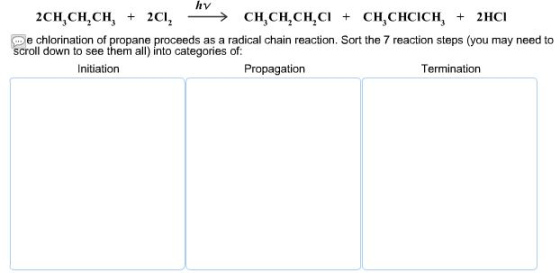
The chlorination of propane proceeds as a radical chain reaction. Sort the 7 reaction steps
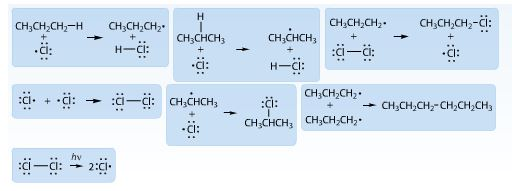
The chlorination of propane proceeds as a radical chain reaction. Sort the 7 reaction steps (you may need to scroll down to see them all) into categories of:
Homework Answers
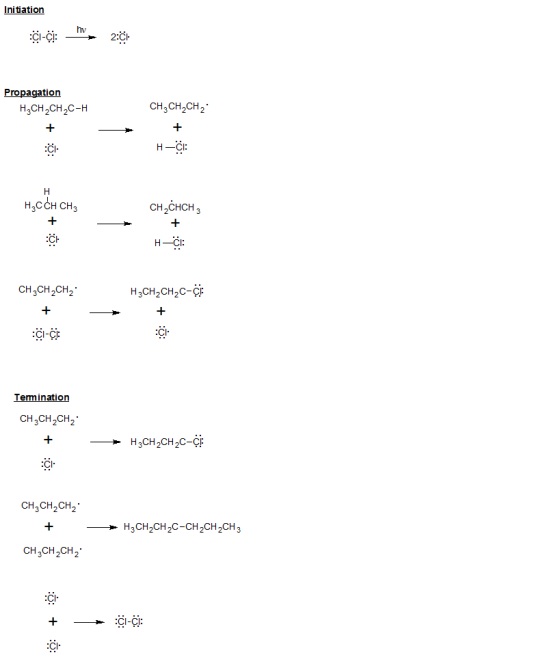
Given below are the reactons corresponding to the initiation, propagation and termination in free radical chlorination of propane.
The reaction begins with an initiation step, which is the separation of the halogen (X2) into two radicals (atoms with a single unpaired electron) by the addition of uv light. This is called the initiation step because it initiates the reaction. The next step is propagation wherein, the first step is hydrogen abstraction by a chloride radical. A primary and secondary carbon radicals are formed. The carbon radical then combines with Cl2 to form alkyl halide and regenerating Cl radical. In the termination step two radicals of carbon or two radicals of Cl can combine to terminate the process. Additionally a carbon radical may combine with a Cl free radical to terminate the process.
The detailed reactions are shown below in the figure.
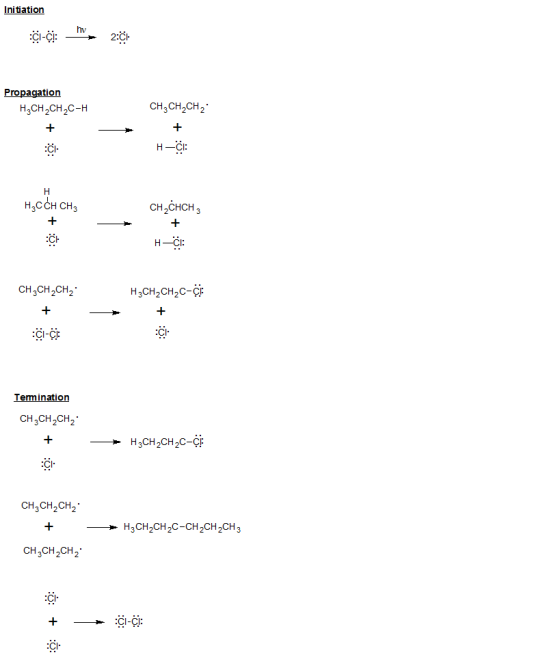
This problem is based on the concept of free radical substitution reactions.
Free radical substitution reaction is a type of reaction which substitutes a halogen atom in place of hydrogen from an alkane with the formation of a radical. This is an example of a photochemical reaction.
Free radical reactions take place in various steps which includes the chain initiation step followed by chain propagation step and then the final chain termination step.
Chain initiation step of chlorination of propane is written as follows:
Chain propagation step of chlorination of propane is written as follows:
Chain termination step of chlorination of propane is written as follows:
Ans:
The seven reactions step for the chlorination of propane is arranged as follows:
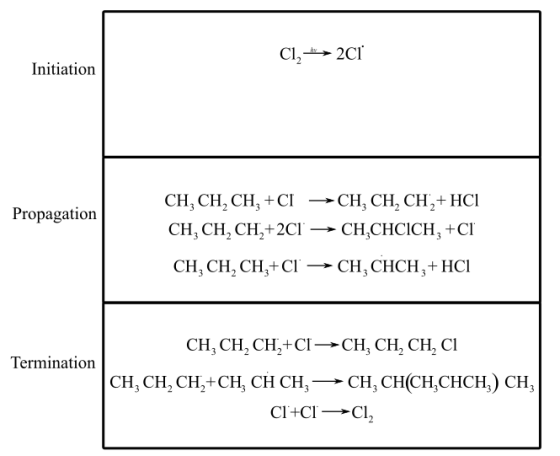
Given below are the reactons corresponding to the initiation, propagation and termination in free radical chlorination of propane.
The reaction begins with an initiation step, which is the separation of the halogen (X2) into two radicals (atoms with a single unpaired electron) by the addition of uv light. This is called the initiation step because it initiates the reaction. The next step is propagation wherein, the first step is hydrogen abstraction by a chloride radical. A primary and secondary carbon radicals are formed. The carbon radical then combines with Cl2 to form alkyl halide and regenerating Cl radical. In the termination step two radicals of carbon or two radicals of Cl can combine to terminate the process. Additionally a carbon radical may combine with a Cl free radical to terminate the process.
The detailed reactions are shown below in the figure.
Add Answer to:
The chlorination of propane proceeds as a radical chain reaction. Sort the 7 reaction steps
Mechanisms Question 1 (22 marks) (a) Consider the radical chain reactions of the alkane shown below with Br, in the...
 Mechanisms Question 1 (22 marks) (a) Consider the radical chain reactions of the alkane shown below with Br, in the presence of light. H3C HH H C-CCHS CH3 Br2 hv 2 Different mono- bromo products 25 °C + (you will need to look up the bond dissociation energy (BDE) for the types of bonds formed and broken in this reactions) (i) Give the structures of the products from the reaction and using standard arrow conventions show the series of mechanistic...
a) Show the mechanism for the free radical chlorination of bromopropane. Clearly show the initiation, propagation,...
 a) Show the mechanism for the free radical chlorination of
bromopropane. Clearly show the initiation, propagation, and
termination steps.
b) Use the BDEs shown on page 1 to calculate the enthalpy change
for this reaction.
c) Unfortunately, the student’s attempt in question 3 failed,
and he only made traces of 2- chloropropane by using this approach.
What was the major product of the reaction, and explain why it was
formed instead. You may find the BDEs on page 1 to...
a) Show the mechanism for the free radical chlorination of
bromopropane. Clearly show the initiation, propagation, and
termination steps.
b) Use the BDEs shown on page 1 to calculate the enthalpy change
for this reaction.
c) Unfortunately, the student’s attempt in question 3 failed,
and he only made traces of 2- chloropropane by using this approach.
What was the major product of the reaction, and explain why it was
formed instead. You may find the BDEs on page 1 to...
[01] Give all three termination steps (using structures) for a radical chain reaction monochlorination (Clh/hv) of...
 [01] Give all three termination steps (using structures) for a radical chain reaction monochlorination (Clh/hv) of cyclopropane to give chlorocyclopropane 1. 2. [01] a. Give the resulting structure from the following electron flow. b. Give the curved arrows on structure at left to indicate the electron flow in going to the resonance structure on the right. Be precise. 3. [O1] Give the structure of the major product for the following reaction as well as the two allylic resonance structures from...
pleas help 5,6,7,8,9,10 III IV 5. The product of free-radical halogenation reactions is an alkyl halide....
 pleas help 5,6,7,8,9,10
III IV 5. The product of free-radical halogenation reactions is an alkyl halide. The major amount of this halide forms during the second step of propagation. However, you should be aware that one possible termination step also forms alkyl halides. Why does the majority of the alkyl halide product come from the propagation step and not the termination step? A. At any given time during the reaction, the concentration of both the alkyl radical and the halide...
pleas help 5,6,7,8,9,10
III IV 5. The product of free-radical halogenation reactions is an alkyl halide. The major amount of this halide forms during the second step of propagation. However, you should be aware that one possible termination step also forms alkyl halides. Why does the majority of the alkyl halide product come from the propagation step and not the termination step? A. At any given time during the reaction, the concentration of both the alkyl radical and the halide...
Need help with both 3 and 4 please 3. The reactions below refer to questions 5-7 and illustrate the reaction steps in t...
 Need help with both 3 and 4 please
3. The reactions below refer to questions 5-7 and illustrate the reaction steps in the anti-Markovnikov addition of HBr to (E)-prop-1-en-1-ylbenzene. Draw curved arrows that account for electron movement in reactions below and classify each reaction according to 6 patterns of radical reactions. reaction pattern Br + Br T + H-Br: - T + :Br. 4. In step a), bromine radical preferentially attaches to carbon C-2 (bromination of C-1 and formation of...
Need help with both 3 and 4 please
3. The reactions below refer to questions 5-7 and illustrate the reaction steps in the anti-Markovnikov addition of HBr to (E)-prop-1-en-1-ylbenzene. Draw curved arrows that account for electron movement in reactions below and classify each reaction according to 6 patterns of radical reactions. reaction pattern Br + Br T + H-Br: - T + :Br. 4. In step a), bromine radical preferentially attaches to carbon C-2 (bromination of C-1 and formation of...
One of the steps in the mechanism of the above reaction is shown below. Draw the...
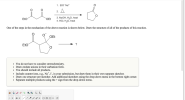 One of the steps in the mechanism of the above reaction is shown below. Draw the structure of all of the products of this reaction. You do not have to consider stereochemistry. Draw enolate anions in their carbanion form. You should include all products. Include counter-ions, e.g., Na^+, I^-, in your submission, but draw them in their own separate sketcher. Draw one structure per sketcher. Add additional sketchers using the drop-down menu in the bottom right corner. Separate multiple products...
Primers are short pieces of DNA that are used in PCR (Polymerase Chain Reaction), the process...
Primers are short pieces of DNA that are used in PCR (Polymerase Chain Reaction), the process which is used in molecular labs to make copies of short stretches of a gene or genome. You have designed primes that have a Molecular Weight (MW) of 6000. It arrives as a dry sample in the quantity of 300 µg. How much water do you need to add to make a primer stock solution of 100 mM primers? HINTS: Remember that mM is...
Exploring Utilities in linux 1. Describe the steps and command that is required to translate all...
Exploring Utilities in linux 1. Describe the steps and command that is required to translate all the characters in a file called May-2014 report from lowercase to uppercase. 2. Describe the steps and command that is required to translate all the blank characters to new line characters (new line character = ‘\n’) in a file called May-2014. 3. Describe the steps and command that are required to change all instances of the work “May” to the word “MAY” in the...
Yobel is a supply chain management company in Peru. They manufacture on-site products for large international...
Yobel is a supply chain management company in Peru. They manufacture on-site products for large international companies such as Revlon, Kodak, Ivory, etc. These companies have specific quality criteria that they expect to be maintained even if the product is not manufactured or sold in the United States. Suppose you're put in charge of quality control for Revlon lipstick. The specified "failure rate" or proportion of flawed lipsticks, as specified by Revlon is 0.05. This sort of relationship is normally...
Each question is worth 15 points Write all reaction steps in the syntheses questions, and mention...
 Each question is worth 15 points Write all reaction steps in the syntheses questions, and mention the major intermediates 1) Synthesize the following alkenes In addition to triphenylphosphine, select the necessary aldehydes/ketones and organic halides. 2) Complete the reaction steps of the following conversions 3) a). Form eyclohexanone by an intra aldol reaction of an open chain aldehyde/ketone. b). Perform 1,2 and 1,4 additions on CH CH-CHCOCH, with MeMgBr b). CHICHO CHCH CH 5) a). Write the mechanism to the...
 Mechanisms Question 1 (22 marks) (a) Consider the radical chain reactions of the alkane shown below with Br, in the presence of light. H3C HH H C-CCHS CH3 Br2 hv 2 Different mono- bromo products 25 °C + (you will need to look up the bond dissociation energy (BDE) for the types of bonds formed and broken in this reactions) (i) Give the structures of the products from the reaction and using standard arrow conventions show the series of mechanistic...
 a) Show the mechanism for the free radical chlorination of
bromopropane. Clearly show the initiation, propagation, and
termination steps.
b) Use the BDEs shown on page 1 to calculate the enthalpy change
for this reaction.
c) Unfortunately, the student’s attempt in question 3 failed,
and he only made traces of 2- chloropropane by using this approach.
What was the major product of the reaction, and explain why it was
formed instead. You may find the BDEs on page 1 to...
a) Show the mechanism for the free radical chlorination of
bromopropane. Clearly show the initiation, propagation, and
termination steps.
b) Use the BDEs shown on page 1 to calculate the enthalpy change
for this reaction.
c) Unfortunately, the student’s attempt in question 3 failed,
and he only made traces of 2- chloropropane by using this approach.
What was the major product of the reaction, and explain why it was
formed instead. You may find the BDEs on page 1 to...
 [01] Give all three termination steps (using structures) for a radical chain reaction monochlorination (Clh/hv) of cyclopropane to give chlorocyclopropane 1. 2. [01] a. Give the resulting structure from the following electron flow. b. Give the curved arrows on structure at left to indicate the electron flow in going to the resonance structure on the right. Be precise. 3. [O1] Give the structure of the major product for the following reaction as well as the two allylic resonance structures from...
 pleas help 5,6,7,8,9,10
III IV 5. The product of free-radical halogenation reactions is an alkyl halide. The major amount of this halide forms during the second step of propagation. However, you should be aware that one possible termination step also forms alkyl halides. Why does the majority of the alkyl halide product come from the propagation step and not the termination step? A. At any given time during the reaction, the concentration of both the alkyl radical and the halide...
pleas help 5,6,7,8,9,10
III IV 5. The product of free-radical halogenation reactions is an alkyl halide. The major amount of this halide forms during the second step of propagation. However, you should be aware that one possible termination step also forms alkyl halides. Why does the majority of the alkyl halide product come from the propagation step and not the termination step? A. At any given time during the reaction, the concentration of both the alkyl radical and the halide...
 Need help with both 3 and 4 please
3. The reactions below refer to questions 5-7 and illustrate the reaction steps in the anti-Markovnikov addition of HBr to (E)-prop-1-en-1-ylbenzene. Draw curved arrows that account for electron movement in reactions below and classify each reaction according to 6 patterns of radical reactions. reaction pattern Br + Br T + H-Br: - T + :Br. 4. In step a), bromine radical preferentially attaches to carbon C-2 (bromination of C-1 and formation of...
Need help with both 3 and 4 please
3. The reactions below refer to questions 5-7 and illustrate the reaction steps in the anti-Markovnikov addition of HBr to (E)-prop-1-en-1-ylbenzene. Draw curved arrows that account for electron movement in reactions below and classify each reaction according to 6 patterns of radical reactions. reaction pattern Br + Br T + H-Br: - T + :Br. 4. In step a), bromine radical preferentially attaches to carbon C-2 (bromination of C-1 and formation of...
 One of the steps in the mechanism of the above reaction is shown below. Draw the structure of all of the products of this reaction. You do not have to consider stereochemistry. Draw enolate anions in their carbanion form. You should include all products. Include counter-ions, e.g., Na^+, I^-, in your submission, but draw them in their own separate sketcher. Draw one structure per sketcher. Add additional sketchers using the drop-down menu in the bottom right corner. Separate multiple products...
 Each question is worth 15 points Write all reaction steps in the syntheses questions, and mention the major intermediates 1) Synthesize the following alkenes In addition to triphenylphosphine, select the necessary aldehydes/ketones and organic halides. 2) Complete the reaction steps of the following conversions 3) a). Form eyclohexanone by an intra aldol reaction of an open chain aldehyde/ketone. b). Perform 1,2 and 1,4 additions on CH CH-CHCOCH, with MeMgBr b). CHICHO CHCH CH 5) a). Write the mechanism to the...
Most questions answered within 3 hours.
-
Where is the error in this code sequence?
String s1 = "Hello";
String s2 = "ello";...
asked 11 months ago -
Financial data for Joel de Paris, Inc., for last year
follow:
Joel de Paris, Inc.
Balance...
asked 11 months ago -
Consider this reaction:
Al2(SO4)3 (aq)+ BaCl3
(aq) Al2Cl6 (aq)- +
3BaSO4(s) . What is the...
asked 11 months ago -
Suppose that Savneet is considering increasing her
recent random sample from 20 car rentals to 40...
asked 11 months ago -
Trucks arrive at an unloading terminal at an average rate of 120
per hour.
Trucks arrive...
asked 11 months ago -
Why are methanol and ethanol completely soluble in water while
octanol is not very little soluble....
asked 11 months ago -
A facilities manager at a university reads in a research report
that the mean amount of...
asked 11 months ago -
When the CuSO4 is rehydrated by adding water to the anhydrous
compound, is this an endothermic...
asked 11 months ago -
A ray of sunlight is passing from diamond into crown glass; the
angle of incidence is...
asked 11 months ago -
A block of mass 0.249 kg is placed on top of a light, vertical
spring of...
asked 11 months ago -
how do the kidneys compensate in the presences of acidosis
a) trigger hyperventilate
b) reserve acid...
asked 11 months ago -
Question 501 pts
The rental rate of capital to the firm increases. Which of the
following...
asked 11 months ago