
Homework Answers
Add Answer to:
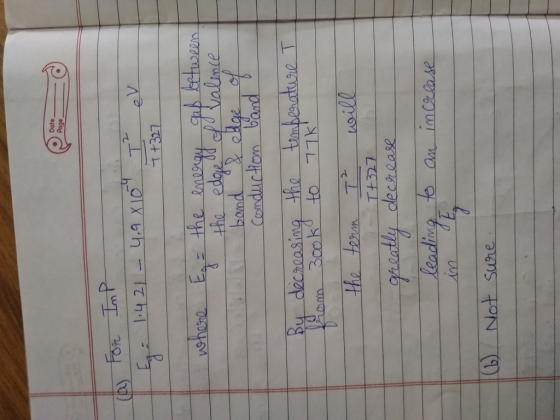
(A) Comment on the energy needed to excite an electron from the valence band edge to...
4. A photon of light can excite an electron from the valence band to the conduction...
 4. A photon of light can excite an electron from the valence band to the conduction band of a semiconductor. This process is called photoconduction. a. PbS has a band gap of 0.37 eV. What wavelength of light would be needed to start the photoconduction in this semiconductor? b. In the light meters of cameras one would need a semiconductor that operates efficiently in visible light, or at-550 nm. Would PbS be a suitable semiconductor for a light meter? Why...
4. A photon of light can excite an electron from the valence band to the conduction...
 4. A photon of light can excite an electron from the valence band to the conduction band of a semiconductor. This process is called photoconduction. a. PbS has a band gap of 0.37 eV. What wavelength of light would be needed to start the photoconduction in this semiconductor? b. In the light meters of cameras one would need a semiconductor that operates efficiently in visible light, or at-550 nm. Would PbS be a suitable semiconductor for a light meter? Why...
[590] The band stru energy. What is the minimal photon energy to directly excite an electron...
 [590] The band stru energy. What is the minimal photon energy to directly excite an electron from the valence band to the conduction band? A. 0.7 eV B. 0.8 eV C. 1.2 eV D. 1.5 eV cture for an imaginary semiconductor is shown in Figure 2, where Er is the Fermi CJ 1.2 eV Ef 0.8ev 1.5 ev Figure 2
Please explain part b in details thx! Question 2 At 300 K, the bandgap of GaP is 2.26 eV and the effective density of states at the conduction and valence band edge are 1.8 x 1019 cm23 and 1.9 x 10¹⁹...
 Please explain part b in details thx!
Question 2 At 300 K, the bandgap of GaP is 2.26 eV and the effective density of states at the conduction and valence band edge are 1.8 x 1019 cm23 and 1.9 x 1019 cm3, respectively. (a) Calculate the intrinsic concentration of GaP at 300K (7 marks) Calculate the GaP effective mass of holes at 300K. (b) (8 marks) (c The GaP sample is now doped with donor concentration of 1021 cm3 with...
Please explain part b in details thx!
Question 2 At 300 K, the bandgap of GaP is 2.26 eV and the effective density of states at the conduction and valence band edge are 1.8 x 1019 cm23 and 1.9 x 1019 cm3, respectively. (a) Calculate the intrinsic concentration of GaP at 300K (7 marks) Calculate the GaP effective mass of holes at 300K. (b) (8 marks) (c The GaP sample is now doped with donor concentration of 1021 cm3 with...
Theory section is below for the equations PRELAB Read the theory section below. Calculate the photon...
 Theory section is below for the equations
PRELAB Read the theory section below. Calculate the photon wavelength in nm corresponding to a photon energy equal to the theoretical band gap energy of S1.121 eV and GaAs, 1.422 eV. These will be used to set the monochromator. THEORY One of the most important characteristics of a semiconductor is its band gap energy Eg Whereas an electron in an isolated atom has discrete energy levels, an electron in a semiconductor crystal has...
Theory section is below for the equations
PRELAB Read the theory section below. Calculate the photon wavelength in nm corresponding to a photon energy equal to the theoretical band gap energy of S1.121 eV and GaAs, 1.422 eV. These will be used to set the monochromator. THEORY One of the most important characteristics of a semiconductor is its band gap energy Eg Whereas an electron in an isolated atom has discrete energy levels, an electron in a semiconductor crystal has...
Please help me 1. In degenerate p-type silicon, a. The Fermi energy is above the valence...
 Please help me
1. In degenerate p-type silicon, a. The Fermi energy is above the valence energy and below the intrinsic Fermi energy b. The Fermi energy is below the valence energy c. The Fermi energy is above the conduction energy d. The Fermi energy is below the conduction energy and above the intrinsic Fermi energy 2. A semiconductor has No 5X 1010 cm3 and N-2X 1018 cm2. It is a. b. C. d. N-type and electrons are the majority...
Please help me
1. In degenerate p-type silicon, a. The Fermi energy is above the valence energy and below the intrinsic Fermi energy b. The Fermi energy is below the valence energy c. The Fermi energy is above the conduction energy d. The Fermi energy is below the conduction energy and above the intrinsic Fermi energy 2. A semiconductor has No 5X 1010 cm3 and N-2X 1018 cm2. It is a. b. C. d. N-type and electrons are the majority...
Crystal types are sometimes classified based on the type of bonding, for example ionic crystals. Name...
 Crystal types are sometimes classified based on the type of bonding, for example ionic crystals. Name two other types of crystal. (b) A crystal is formed from N atoms. Give a brief description of the origin of energy bands in solids. (c) Sketch the band structure of an undoped semiconductor, label the conduction and valence bands, and the relevant energies. Mark the position of the Fermi energy. Make a second sketch and assume the semiconductor has been doped n -...
Consider an electron in a cubic box that measures 1nm on an edge a) Calculate the...
Consider an electron in a cubic box that measures 1nm on an edge a) Calculate the energy difference between the ground and first excited states and compare this energy difference with KbT at 300 K. b) Using the Boltzman factor, Nx=N0 exp (-delta E/KbT), calculate and comment on the relative population of the first excited state at this temperature. c) What minimum wavelength is required to excite the electron into the the first excited state d) How would you answer...
Draw the energy band diagram at equilibrium for the p+ /n/p semiconductor heterostructure (p+ indicates a...
Draw the energy band diagram at equilibrium for the p+ /n/p semiconductor heterostructure (p+ indicates a p-type semiconductor which is heavily doped, i.e., more heavily doped than p). You should indicate Ec (conduction band), Ev (valence band), Ei (intrinsic Fermi level), and Ef (Fermi level) throughout the device structure. show your work (i.e., you should start from the diagram of individual material pieces). State any reason for your drawing.
1.The work function of a material refers to the minimum energy required to remove an electron...
1.The work function of a material refers to the minimum energy required to remove an electron from the material. The work function of tungsten is 4.55 eV. Calculate the maximum wavelength (in nm) for the photoelectric emission of electrons. 2. Calculate the de Broglie wavelength (in nm) for a proton with KE = 10 eV 3. The forbidden energy bandgap of Ge is 0.66 eV. Determine the wavelength (in nm) of an incident photon that can interact with a valence...
 4. A photon of light can excite an electron from the valence band to the conduction band of a semiconductor. This process is called photoconduction. a. PbS has a band gap of 0.37 eV. What wavelength of light would be needed to start the photoconduction in this semiconductor? b. In the light meters of cameras one would need a semiconductor that operates efficiently in visible light, or at-550 nm. Would PbS be a suitable semiconductor for a light meter? Why...
 4. A photon of light can excite an electron from the valence band to the conduction band of a semiconductor. This process is called photoconduction. a. PbS has a band gap of 0.37 eV. What wavelength of light would be needed to start the photoconduction in this semiconductor? b. In the light meters of cameras one would need a semiconductor that operates efficiently in visible light, or at-550 nm. Would PbS be a suitable semiconductor for a light meter? Why...
 [590] The band stru energy. What is the minimal photon energy to directly excite an electron from the valence band to the conduction band? A. 0.7 eV B. 0.8 eV C. 1.2 eV D. 1.5 eV cture for an imaginary semiconductor is shown in Figure 2, where Er is the Fermi CJ 1.2 eV Ef 0.8ev 1.5 ev Figure 2
 Please explain part b in details thx!
Question 2 At 300 K, the bandgap of GaP is 2.26 eV and the effective density of states at the conduction and valence band edge are 1.8 x 1019 cm23 and 1.9 x 1019 cm3, respectively. (a) Calculate the intrinsic concentration of GaP at 300K (7 marks) Calculate the GaP effective mass of holes at 300K. (b) (8 marks) (c The GaP sample is now doped with donor concentration of 1021 cm3 with...
Please explain part b in details thx!
Question 2 At 300 K, the bandgap of GaP is 2.26 eV and the effective density of states at the conduction and valence band edge are 1.8 x 1019 cm23 and 1.9 x 1019 cm3, respectively. (a) Calculate the intrinsic concentration of GaP at 300K (7 marks) Calculate the GaP effective mass of holes at 300K. (b) (8 marks) (c The GaP sample is now doped with donor concentration of 1021 cm3 with...
 Theory section is below for the equations
PRELAB Read the theory section below. Calculate the photon wavelength in nm corresponding to a photon energy equal to the theoretical band gap energy of S1.121 eV and GaAs, 1.422 eV. These will be used to set the monochromator. THEORY One of the most important characteristics of a semiconductor is its band gap energy Eg Whereas an electron in an isolated atom has discrete energy levels, an electron in a semiconductor crystal has...
Theory section is below for the equations
PRELAB Read the theory section below. Calculate the photon wavelength in nm corresponding to a photon energy equal to the theoretical band gap energy of S1.121 eV and GaAs, 1.422 eV. These will be used to set the monochromator. THEORY One of the most important characteristics of a semiconductor is its band gap energy Eg Whereas an electron in an isolated atom has discrete energy levels, an electron in a semiconductor crystal has...
 Please help me
1. In degenerate p-type silicon, a. The Fermi energy is above the valence energy and below the intrinsic Fermi energy b. The Fermi energy is below the valence energy c. The Fermi energy is above the conduction energy d. The Fermi energy is below the conduction energy and above the intrinsic Fermi energy 2. A semiconductor has No 5X 1010 cm3 and N-2X 1018 cm2. It is a. b. C. d. N-type and electrons are the majority...
Please help me
1. In degenerate p-type silicon, a. The Fermi energy is above the valence energy and below the intrinsic Fermi energy b. The Fermi energy is below the valence energy c. The Fermi energy is above the conduction energy d. The Fermi energy is below the conduction energy and above the intrinsic Fermi energy 2. A semiconductor has No 5X 1010 cm3 and N-2X 1018 cm2. It is a. b. C. d. N-type and electrons are the majority...
 Crystal types are sometimes classified based on the type of bonding, for example ionic crystals. Name two other types of crystal. (b) A crystal is formed from N atoms. Give a brief description of the origin of energy bands in solids. (c) Sketch the band structure of an undoped semiconductor, label the conduction and valence bands, and the relevant energies. Mark the position of the Fermi energy. Make a second sketch and assume the semiconductor has been doped n -...
Most questions answered within 3 hours.
-
Where is the error in this code sequence?
String s1 = "Hello";
String s2 = "ello";...
asked 10 months ago -
Financial data for Joel de Paris, Inc., for last year
follow:
Joel de Paris, Inc.
Balance...
asked 10 months ago -
Consider this reaction:
Al2(SO4)3 (aq)+ BaCl3
(aq) Al2Cl6 (aq)- +
3BaSO4(s) . What is the...
asked 10 months ago -
Suppose that Savneet is considering increasing her
recent random sample from 20 car rentals to 40...
asked 10 months ago -
Trucks arrive at an unloading terminal at an average rate of 120
per hour.
Trucks arrive...
asked 10 months ago -
Why are methanol and ethanol completely soluble in water while
octanol is not very little soluble....
asked 10 months ago -
A facilities manager at a university reads in a research report
that the mean amount of...
asked 10 months ago -
When the CuSO4 is rehydrated by adding water to the anhydrous
compound, is this an endothermic...
asked 10 months ago -
A ray of sunlight is passing from diamond into crown glass; the
angle of incidence is...
asked 10 months ago -
A block of mass 0.249 kg is placed on top of a light, vertical
spring of...
asked 10 months ago -
how do the kidneys compensate in the presences of acidosis
a) trigger hyperventilate
b) reserve acid...
asked 10 months ago -
Question 501 pts
The rental rate of capital to the firm increases. Which of the
following...
asked 10 months ago