
Homework Answers
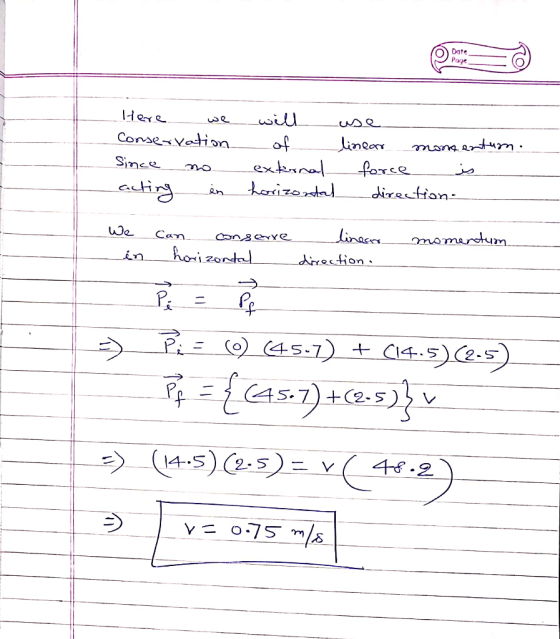
Here we will use conservation of linear momentum.
Add Answer to:
1. Suppose that you have a mass of 45.7 kg and are standing on frictionless roller...
PLEASE ANSWER ALL PARTS, THANK YOU !!!!! You are sitting in a sled, at rest on a pond covered with nice, thick, frictionless ice. Your own mass of is 84.0 kg, and the mass of the sled when empty is 11...
PLEASE ANSWER ALL PARTS, THANK YOU !!!!! You are sitting in a sled, at rest on a pond covered with nice, thick, frictionless ice. Your own mass of is 84.0 kg, and the mass of the sled when empty is 11.0 kg. (a) From shore, someone throws a baseball of mass 0.11 kg to you, and you catch it; the horizontal component of the ball’s velocity is 25.2 m/s. What will be the sled’s (and your) speed with respect to...
If a person with mass 70.0kg, standing still, throws an object with mass 5.0 kg at...
If a person with mass 70.0kg, standing still, throws an object with mass 5.0 kg at 50.0 m/s, what will be the recoil velocity of the person, assuming he is standing on a frictionless surface? A.) -3.6 m/s B.) 0 m/s C.) 3.6 m/s D.) 50.0 m/s
You are sitting in a sled, at rest on a pond covered with nice, thick, frictionless...
You are sitting in a sled, at rest on a pond covered with nice, thick, frictionless ice. Your own mass of is 84 kg, and the mass of the sled when empty is 11.5 kg. (a) From shore, someone throws a baseball of mass 0.11 kg to you, and you catch it; the horizontal component of the ball’s velocity is 32.6 m/s. What will be the sled’s (and your) speed with respect to the surface of the pond after you...
A 20 kg child standing on a frictionless skateboard is holding a 2 kg ball. The...
A 20 kg child standing on a frictionless skateboard is holding a 2 kg ball. The child throws the ball to the right at a speed of 8 m/s. What is the velocity of the child after the ball leaves his hand?
(b) Once again, you're standing on the center of a frozen, frictionless pond. This time, your...
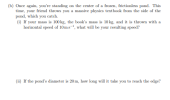 (b) Once again, you're standing on the center of a frozen, frictionless pond. This time, your friend throws you a massive physics textbook from the side of the pond, which you catch. (i) If your mass is 100 kg, the book's mass is 10 kg, and it is thrown with a horizontal speed of 10ms-4, what will be your resulting speed? (ii) If the pond's diameter is 20m, how long will it take you to reach the edge?
You are standing on a large sheet of frictionless ice and are holding a large rock....
You are standing on a large sheet of frictionless ice and are holding a large rock. In order to get off the ice, you throw the rock so it has velocity relative to the earth of 12.4 m/s at an angle of 34.0 ? above the horizontal. If your mass is 74.0 kg and the rock's mass is 14.7 kg , what is your speed after you throw the rock?
9: While standing on roller skates, a 60 kg boy pushes his 35 kg little brother...
 9: While standing on roller skates, a 60 kg boy pushes his 35 kg little brother (also on skates) with a horizontal force The little brother is observed to have an acceleration of 2 m/s2 while the older brother is pushing him. (a) What is the resulting acceleration of the older brother while he is pushing the little brother? (b) If the push from the older brother on the younger brother lasts for .72 seconds, how fast is each brother...
how to do this question? While Standing on frictionless ice, you (mass 65.0 kg) toss a...
 how to do this question?
While Standing on frictionless ice, you (mass 65.0 kg) toss a 4.50 kg rock with initial speed 12.0 m/s. The rock is 15.2 m from you when it lands. Take the x axis on the ice surface in the horizontal direction of the motion of the rock. Ignore the initial height of the toss. Part A At what angle did you toss it? Part B How fast are you moving? |v| =
how to do this question?
While Standing on frictionless ice, you (mass 65.0 kg) toss a 4.50 kg rock with initial speed 12.0 m/s. The rock is 15.2 m from you when it lands. Take the x axis on the ice surface in the horizontal direction of the motion of the rock. Ignore the initial height of the toss. Part A At what angle did you toss it? Part B How fast are you moving? |v| =
In the figure, a frictionless roller coaster car of mass m = 637 kg tops the...
 In the
figure, a frictionless roller coaster car of mass m = 637 kg tops the first
hill with speed v0 = 19.3 m/s at
height h = 37.2 m. How much work
does the gravitational force do on the car from that point
to (a) point A, (b) point B, and (c) point C? If the gravitational
potential energy of the car-Earth system is taken to be zero
at C, what is its value when
the car is at...
In the
figure, a frictionless roller coaster car of mass m = 637 kg tops the first
hill with speed v0 = 19.3 m/s at
height h = 37.2 m. How much work
does the gravitational force do on the car from that point
to (a) point A, (b) point B, and (c) point C? If the gravitational
potential energy of the car-Earth system is taken to be zero
at C, what is its value when
the car is at...
A 40 kg sled on frictionless ice is at rest next to you. You are standing...
A 40 kg sled on frictionless ice is at rest next to you. You are standing on the ground. You push on it with a force of 10 N for 3 seconds. The sled moves away. You remain stationary. a. How much total impulse was applied to the sled? (in N•s) b. What is the final velocity of the sled? c. How much impulse did the sled apply to you? d. What is your final velocity?
 (b) Once again, you're standing on the center of a frozen, frictionless pond. This time, your friend throws you a massive physics textbook from the side of the pond, which you catch. (i) If your mass is 100 kg, the book's mass is 10 kg, and it is thrown with a horizontal speed of 10ms-4, what will be your resulting speed? (ii) If the pond's diameter is 20m, how long will it take you to reach the edge?
 9: While standing on roller skates, a 60 kg boy pushes his 35 kg little brother (also on skates) with a horizontal force The little brother is observed to have an acceleration of 2 m/s2 while the older brother is pushing him. (a) What is the resulting acceleration of the older brother while he is pushing the little brother? (b) If the push from the older brother on the younger brother lasts for .72 seconds, how fast is each brother...
 how to do this question?
While Standing on frictionless ice, you (mass 65.0 kg) toss a 4.50 kg rock with initial speed 12.0 m/s. The rock is 15.2 m from you when it lands. Take the x axis on the ice surface in the horizontal direction of the motion of the rock. Ignore the initial height of the toss. Part A At what angle did you toss it? Part B How fast are you moving? |v| =
how to do this question?
While Standing on frictionless ice, you (mass 65.0 kg) toss a 4.50 kg rock with initial speed 12.0 m/s. The rock is 15.2 m from you when it lands. Take the x axis on the ice surface in the horizontal direction of the motion of the rock. Ignore the initial height of the toss. Part A At what angle did you toss it? Part B How fast are you moving? |v| =
 In the
figure, a frictionless roller coaster car of mass m = 637 kg tops the first
hill with speed v0 = 19.3 m/s at
height h = 37.2 m. How much work
does the gravitational force do on the car from that point
to (a) point A, (b) point B, and (c) point C? If the gravitational
potential energy of the car-Earth system is taken to be zero
at C, what is its value when
the car is at...
In the
figure, a frictionless roller coaster car of mass m = 637 kg tops the first
hill with speed v0 = 19.3 m/s at
height h = 37.2 m. How much work
does the gravitational force do on the car from that point
to (a) point A, (b) point B, and (c) point C? If the gravitational
potential energy of the car-Earth system is taken to be zero
at C, what is its value when
the car is at...
Most questions answered within 3 hours.
-
Where is the error in this code sequence?
String s1 = "Hello";
String s2 = "ello";...
asked 11 months ago -
Financial data for Joel de Paris, Inc., for last year
follow:
Joel de Paris, Inc.
Balance...
asked 11 months ago -
Consider this reaction:
Al2(SO4)3 (aq)+ BaCl3
(aq) Al2Cl6 (aq)- +
3BaSO4(s) . What is the...
asked 11 months ago -
Suppose that Savneet is considering increasing her
recent random sample from 20 car rentals to 40...
asked 11 months ago -
Trucks arrive at an unloading terminal at an average rate of 120
per hour.
Trucks arrive...
asked 11 months ago -
Why are methanol and ethanol completely soluble in water while
octanol is not very little soluble....
asked 11 months ago -
A facilities manager at a university reads in a research report
that the mean amount of...
asked 11 months ago -
When the CuSO4 is rehydrated by adding water to the anhydrous
compound, is this an endothermic...
asked 11 months ago -
A ray of sunlight is passing from diamond into crown glass; the
angle of incidence is...
asked 11 months ago -
A block of mass 0.249 kg is placed on top of a light, vertical
spring of...
asked 11 months ago -
how do the kidneys compensate in the presences of acidosis
a) trigger hyperventilate
b) reserve acid...
asked 11 months ago -
Question 501 pts
The rental rate of capital to the firm increases. Which of the
following...
asked 11 months ago