Insurance deductibles __________ the __________ problem of insurance coverage. are meant to reduce, adverse selection are...
Insurance deductibles __________ the __________ problem of insurance coverage.
| are meant to reduce, adverse selection |
| are meant to reduce, moral hazard |
| unintentionally worsen, adverse selection |
| unintentionally worsen, moral hazard |
Homework Answers

Add Answer to:
Insurance deductibles __________ the __________ problem of insurance coverage. are meant to reduce, adverse selection are...
true/false: a. Adverse selection is a greater problem with insurance offered by large employers, than with...
true/false: a. Adverse selection is a greater problem with insurance offered by large employers, than with insurance offered by small employers in the U.S. b. Health insurance exchanges in the U.S. eliminate moral hazard. c. High deductible plans in the U.S. reduce adverse selection d. The Bismarck Model in Germany controls costs by reducing health insurance choice. e. The health care system in the U.S. and the Bismarck Model in Germany both rely mostly on private physicians to deliver care.
Explain what is meant by the following terms: Asymmetric information Adverse selection Moral hazard
Explain what is meant by the following terms: Asymmetric information Adverse selection Moral hazard
How do insurers attempt to control for adverse selection and moral hazard problems in health insurance?...
 How do insurers attempt to control for adverse selection and moral hazard problems in health insurance? Give four examples.
A colleague tells you that he is purchasing a health insurance policy, but the premiums seem...
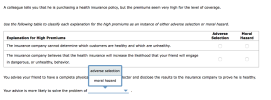 A colleague tells you that he is purchasing a health insurance policy, but the premiums seem very high for the level of coverage. Use the following table to classify each explanation for the high premiums as an instance of either adverse selection or moral hazard. Adverse Selection Moral Hazard Explanation for High Premiums The insurance company cannot determine which customers are healthy and which are unhealthy. The insurance company believes that the health insurance will increase the likelihood that your...
55. The earliest form of insurance was insurance. (a) life (b) health (c) automobile (d) property...
 55. The earliest form of insurance was insurance. (a) life (b) health (c) automobile (d) property and casualty 56. The problem of occurs when those most likely to get large insurance payoffs are the ones who want to purchase insurance the most. (a) asymmetric information (b) moral hazard (c) adverse selection (d) fraudulent behavior 57. To prevent adverse selection, health and life insurance companies may do all the following except (a) charge higher premiums to people with certain pre- existing...
The problem of ________________ in insurance markets is that insurance companies are unable to ______________ ....
The problem of ________________ in insurance markets is that insurance companies are unable to ______________ . Question 8 options: adverse selection; differentiate those with low and high risks reducing moral hazards; sell insurance in unregulated markets adverse selection; find mechanisms to reduce moral hazards adverse selection; sell insurance in unregulated markets
For each scenario, indicate whether it is an example of moral hazard or adverse selection. a. You decide to buy a new ca...
For each scenario, indicate whether it is an example of moral hazard or adverse selection. a. You decide to buy a new car instead of a used car because you are worried about the quality of the used car. moral hazard adverse selection b. You sell your condominium because you fear there will be a large special assessment next year. There has been no official notice of an upcoming assessment. moral hazard adverse selection c. The owner of a company...
The classic application of market failures ascribed to adverse selection and moral hazard were found in...
The classic application of market failures ascribed to adverse selection and moral hazard were found in the health insurance markets. Adverse selection caused market failure in health insurance because insurers were unaware of the health risks their customers faced. They overcame this market failure by taking detailed medical histories and asking about risky practices such as smoking or extreme sports. Moral hazard caused market failure because insurers weren’t able to monitor customer behaviour (e.g., weight gain, drug use, taking up...
Consider the problem arising from asymmetric information, Consider government-provided health insurance, such as OHIP in Ontario,...
Consider the problem arising from asymmetric information, Consider government-provided health insurance, such as OHIP in Ontario, and government-mandated insurance, such as Obamacare in the United States. Are such programs intended to combat adverse selection or moral hazard? Briefly characterize the tradeoff between adverse selection and moral hazard in respect of health insurance public policy.
Health insurers face the problem of adverse selection. Define adverse selection in the context of the health insurance m...
Health insurers face the problem of adverse selection. Define adverse selection in the context of the health insurance market. Explain the consequences of adverse selection on health insurance premiums (consider the expected utility/risk aversion model). What measures have health insurers historically taken to minimize the effects of adverse selection? What restrictions do the ACA reforms place on the ability of insurers to avoid adverse selection? What are the likely consequences on health insurance premiums?
 How do insurers attempt to control for adverse selection and moral hazard problems in health insurance? Give four examples.
 A colleague tells you that he is purchasing a health insurance policy, but the premiums seem very high for the level of coverage. Use the following table to classify each explanation for the high premiums as an instance of either adverse selection or moral hazard. Adverse Selection Moral Hazard Explanation for High Premiums The insurance company cannot determine which customers are healthy and which are unhealthy. The insurance company believes that the health insurance will increase the likelihood that your...
 55. The earliest form of insurance was insurance. (a) life (b) health (c) automobile (d) property and casualty 56. The problem of occurs when those most likely to get large insurance payoffs are the ones who want to purchase insurance the most. (a) asymmetric information (b) moral hazard (c) adverse selection (d) fraudulent behavior 57. To prevent adverse selection, health and life insurance companies may do all the following except (a) charge higher premiums to people with certain pre- existing...
Most questions answered within 3 hours.
-
Where is the error in this code sequence?
String s1 = "Hello";
String s2 = "ello";...
asked 11 months ago -
Financial data for Joel de Paris, Inc., for last year
follow:
Joel de Paris, Inc.
Balance...
asked 11 months ago -
Consider this reaction:
Al2(SO4)3 (aq)+ BaCl3
(aq) Al2Cl6 (aq)- +
3BaSO4(s) . What is the...
asked 11 months ago -
Suppose that Savneet is considering increasing her
recent random sample from 20 car rentals to 40...
asked 11 months ago -
Trucks arrive at an unloading terminal at an average rate of 120
per hour.
Trucks arrive...
asked 11 months ago -
Why are methanol and ethanol completely soluble in water while
octanol is not very little soluble....
asked 11 months ago -
A facilities manager at a university reads in a research report
that the mean amount of...
asked 11 months ago -
When the CuSO4 is rehydrated by adding water to the anhydrous
compound, is this an endothermic...
asked 11 months ago -
A ray of sunlight is passing from diamond into crown glass; the
angle of incidence is...
asked 11 months ago -
A block of mass 0.249 kg is placed on top of a light, vertical
spring of...
asked 11 months ago -
how do the kidneys compensate in the presences of acidosis
a) trigger hyperventilate
b) reserve acid...
asked 11 months ago -
Question 501 pts
The rental rate of capital to the firm increases. Which of the
following...
asked 11 months ago