
Homework Answers
This is the example of bayesian problem,
To calculate the p(u/y) which is posterior distribution we have formula,
p(u/y)=(p(y/u)*p(u))/p(y)
so first we need to calculate p(y/u)
here prior distribution is 


The probability density function of Yi is,
p(Yi/


since y1,y2...yn are independent,the likelihood is,
p(y/u)=


The prior is,
p(u) =(2


p(y)=(2


p(u/y)=(p(y/u)p(u)/p(y)
(p(y/u)p(u)= [(2


by solving square brackets in exponential and adding and
subtracting by [(


here terms involving 


and another terms involving 


remaining terms are (


after solving these we define some terms .,


the expression which comes in bracket of exponent is ,
{((


posterior pdf for 
p(u/y)=(2


posterior distribution is normal with mean 

NOTE: Solve the exponent brackets as per given instruction above,I've given all the possible terms which will come in exponent brackets.
Add Answer to:
2) Let Yi,., Yn be iid N(a,a2). Let a~ known Find the posterior distribution p(u|3y). This...
,X, be iid N(μχ, σ*), Yi, ,Yn be iid N(Pv, σ*), and X's and Question 2:...
 ,X, be iid N(μχ, σ*), Yi, ,Yn be iid N(Pv, σ*), and X's and Question 2: Let X1, Y's are independent. Let be the pooled variance. Show that Sg(0/n+1/m) is distributed at t with (n+m-2) degrees of freedom.
iid Let Yı, Y2, ..., Yn N(u,), where the population mean y and population variance o...
 iid Let Yı, Y2, ..., Yn N(u,), where the population mean y and population variance o are both unknown. Show that the Method of Moments (MOM) estimators of u and o? are given by n i =Y, Y n =1 72 = n-1 S2 (Y; -Y) n n i=1 Note: In this case, (Y, S?) is a sufficient statistic for (u, o?). The MOM estimators of u and o2 are therefore functions of a sufficient statistic.
Yi, Y2...., Yn is a random sample from the Uniform distribution ([a, b]). Let u to...
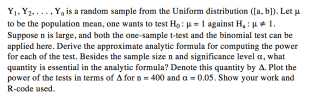 Yi, Y2...., Yn is a random sample from the Uniform distribution ([a, b]). Let u to be the population mean, one wants to test Ho : μ = 1 against Ha : μ 1. Suppose n is large, and both the one-sample t-test and the binomial test can be applied here. Derive the approximate analytic formula for computing the power for each of the test. Besides the sample size n and significance level α, what quantity is essential in the...
Could I grab some help on problem 2? Thank you 2. Suppose Yi, Yn are iid...
 Could I grab some help on problem 2? Thank you
2. Suppose Yi, Yn are iid normal random variables with normal distribution with unknown mean and variance, μ and ơ2. Let Y ni Y. For this problem you may not assume that n is large. n (a) What is the distribution of Y? (b) What is the distribution of Z = (yo)' + ( μ)' + (⅓ュ)? (o) What is the distribution of ta yis (d) What is the distribution...
Could I grab some help on problem 2? Thank you
2. Suppose Yi, Yn are iid normal random variables with normal distribution with unknown mean and variance, μ and ơ2. Let Y ni Y. For this problem you may not assume that n is large. n (a) What is the distribution of Y? (b) What is the distribution of Z = (yo)' + ( μ)' + (⅓ュ)? (o) What is the distribution of ta yis (d) What is the distribution...
: Let Yi, ½' . . . , Yn be an iid random sample from an exponential distribution with parameter where θ > 0. Here each Y, represents the lifetime of the ith battery, while θ represents the the...
 : Let Yi, ½' . . . , Yn be an iid random sample from an exponential distribution with parameter where θ > 0. Here each Y, represents the lifetime of the ith battery, while θ represents the theoretical average lifetime. The pdf of each Y, is therefore given by fy (y) ei-1,2,...,n Consider the empirical average lifetime of the sample of n batteries given by Let a E R be a nonnegative real number. Consider the event A, defined...
Let y,p ~iid Exp (0), for i = 1, . . . , n. (p(y|0) for...
 Let y,p ~iid Exp (0), for i = 1, . . . , n. (p(y|0) for 6 to be Gamma(a, b), tha distribution of θ BeAy). Assume the prior distribution Find the posterior 2. t is, p(0) -ba/ra)ge-i exp{-be. 3. Find the posterior predictive distribution of a future observation in problem 2
4.(120) Let X1,,,Xn be iid r(, 1) and g(u) given. Let 6n be the MLE of g(4) (1)(60) Find the asymptotic distributio...
 4.(120) Let X1,,,Xn be iid r(, 1) and g(u) given. Let 6n be the MLE of g(4) (1)(60) Find the asymptotic distribution of 6, (2)(60) Find the ARE of T Icc(X) w.r.t. on P(X1> c), c > 0 is i n i1 5.(80) Let X1, ,,Xn be iid with E(X1) = u and Var(X1) limiting distribution of nlog (1 +). o2. Find the where T n(X - 4)/s. - 1 -
4.(120) Let X1,,,Xn be iid r(, 1) and g(u)...
4.(120) Let X1,,,Xn be iid r(, 1) and g(u) given. Let 6n be the MLE of g(4) (1)(60) Find the asymptotic distribution of 6, (2)(60) Find the ARE of T Icc(X) w.r.t. on P(X1> c), c > 0 is i n i1 5.(80) Let X1, ,,Xn be iid with E(X1) = u and Var(X1) limiting distribution of nlog (1 +). o2. Find the where T n(X - 4)/s. - 1 -
4.(120) Let X1,,,Xn be iid r(, 1) and g(u)...
Suppose Yı, Y2, ..., Yn|7 vid N(10, 7-2). The population mean Mo is known. The un-...
 Suppose Yı, Y2, ..., Yn|7 vid N(10, 7-2). The population mean Mo is known. The un- known parameter T > 0, which is the inverse of the population variance, is called the precision. The pdf of N(Mo, T-1) is given by Syl-(wl=) = Vb exp (-5(v – wo)"] Let's now derive the posterior distribution of t from the Bayesian perspective. (a) Define U = (Y; – Mo)? i=1 Show that U is a sufficient statistic for t using the Factorization...
1. Suppose that X, X, X, are iid Berwulli(p),0 <p<1. Let U. - x Show that,...
 1. Suppose that X, X, X, are iid Berwulli(p),0 <p<1. Let U. - x Show that, U, can be approximated by the N (np, np(1-P) distribution, for large n and fixed <p<1. 2. Suppose that X1, X3, X. are iid N ( 0°). Where and a both assumed to be unknown. Let @ -( a). Find jointly sufficient statistics for .
3.4 Let X,, X be a random sample of size n from the U(Q,62) distribution, 6,...
 3.4 Let X,, X be a random sample of size n from the U(Q,62) distribution, 6, and let Y, and Yn be the smallest and the largest order statistics of the Xs (i) Use formulas (28) and (29) in Chapter 6 to obtain the p.d.f.'s of Y and Y and then, by calculating depending only on Yi and 1,- Part i. (Note: it is not saying to find the joint pdf of Yi and Yn Find their marginal Theorem 13...
 ,X, be iid N(μχ, σ*), Yi, ,Yn be iid N(Pv, σ*), and X's and Question 2: Let X1, Y's are independent. Let be the pooled variance. Show that Sg(0/n+1/m) is distributed at t with (n+m-2) degrees of freedom.
 iid Let Yı, Y2, ..., Yn N(u,), where the population mean y and population variance o are both unknown. Show that the Method of Moments (MOM) estimators of u and o? are given by n i =Y, Y n =1 72 = n-1 S2 (Y; -Y) n n i=1 Note: In this case, (Y, S?) is a sufficient statistic for (u, o?). The MOM estimators of u and o2 are therefore functions of a sufficient statistic.
 Yi, Y2...., Yn is a random sample from the Uniform distribution ([a, b]). Let u to be the population mean, one wants to test Ho : μ = 1 against Ha : μ 1. Suppose n is large, and both the one-sample t-test and the binomial test can be applied here. Derive the approximate analytic formula for computing the power for each of the test. Besides the sample size n and significance level α, what quantity is essential in the...
 Could I grab some help on problem 2? Thank you
2. Suppose Yi, Yn are iid normal random variables with normal distribution with unknown mean and variance, μ and ơ2. Let Y ni Y. For this problem you may not assume that n is large. n (a) What is the distribution of Y? (b) What is the distribution of Z = (yo)' + ( μ)' + (⅓ュ)? (o) What is the distribution of ta yis (d) What is the distribution...
Could I grab some help on problem 2? Thank you
2. Suppose Yi, Yn are iid normal random variables with normal distribution with unknown mean and variance, μ and ơ2. Let Y ni Y. For this problem you may not assume that n is large. n (a) What is the distribution of Y? (b) What is the distribution of Z = (yo)' + ( μ)' + (⅓ュ)? (o) What is the distribution of ta yis (d) What is the distribution...
 : Let Yi, ½' . . . , Yn be an iid random sample from an exponential distribution with parameter where θ > 0. Here each Y, represents the lifetime of the ith battery, while θ represents the theoretical average lifetime. The pdf of each Y, is therefore given by fy (y) ei-1,2,...,n Consider the empirical average lifetime of the sample of n batteries given by Let a E R be a nonnegative real number. Consider the event A, defined...
 Let y,p ~iid Exp (0), for i = 1, . . . , n. (p(y|0) for 6 to be Gamma(a, b), tha distribution of θ BeAy). Assume the prior distribution Find the posterior 2. t is, p(0) -ba/ra)ge-i exp{-be. 3. Find the posterior predictive distribution of a future observation in problem 2
 4.(120) Let X1,,,Xn be iid r(, 1) and g(u) given. Let 6n be the MLE of g(4) (1)(60) Find the asymptotic distribution of 6, (2)(60) Find the ARE of T Icc(X) w.r.t. on P(X1> c), c > 0 is i n i1 5.(80) Let X1, ,,Xn be iid with E(X1) = u and Var(X1) limiting distribution of nlog (1 +). o2. Find the where T n(X - 4)/s. - 1 -
4.(120) Let X1,,,Xn be iid r(, 1) and g(u)...
4.(120) Let X1,,,Xn be iid r(, 1) and g(u) given. Let 6n be the MLE of g(4) (1)(60) Find the asymptotic distribution of 6, (2)(60) Find the ARE of T Icc(X) w.r.t. on P(X1> c), c > 0 is i n i1 5.(80) Let X1, ,,Xn be iid with E(X1) = u and Var(X1) limiting distribution of nlog (1 +). o2. Find the where T n(X - 4)/s. - 1 -
4.(120) Let X1,,,Xn be iid r(, 1) and g(u)...
 Suppose Yı, Y2, ..., Yn|7 vid N(10, 7-2). The population mean Mo is known. The un- known parameter T > 0, which is the inverse of the population variance, is called the precision. The pdf of N(Mo, T-1) is given by Syl-(wl=) = Vb exp (-5(v – wo)"] Let's now derive the posterior distribution of t from the Bayesian perspective. (a) Define U = (Y; – Mo)? i=1 Show that U is a sufficient statistic for t using the Factorization...
 1. Suppose that X, X, X, are iid Berwulli(p),0 <p<1. Let U. - x Show that, U, can be approximated by the N (np, np(1-P) distribution, for large n and fixed <p<1. 2. Suppose that X1, X3, X. are iid N ( 0°). Where and a both assumed to be unknown. Let @ -( a). Find jointly sufficient statistics for .
 3.4 Let X,, X be a random sample of size n from the U(Q,62) distribution, 6, and let Y, and Yn be the smallest and the largest order statistics of the Xs (i) Use formulas (28) and (29) in Chapter 6 to obtain the p.d.f.'s of Y and Y and then, by calculating depending only on Yi and 1,- Part i. (Note: it is not saying to find the joint pdf of Yi and Yn Find their marginal Theorem 13...
Most questions answered within 3 hours.
-
Where is the error in this code sequence?
String s1 = "Hello";
String s2 = "ello";...
asked 11 months ago -
Financial data for Joel de Paris, Inc., for last year
follow:
Joel de Paris, Inc.
Balance...
asked 11 months ago -
Consider this reaction:
Al2(SO4)3 (aq)+ BaCl3
(aq) Al2Cl6 (aq)- +
3BaSO4(s) . What is the...
asked 11 months ago -
Suppose that Savneet is considering increasing her
recent random sample from 20 car rentals to 40...
asked 11 months ago -
Trucks arrive at an unloading terminal at an average rate of 120
per hour.
Trucks arrive...
asked 11 months ago -
Why are methanol and ethanol completely soluble in water while
octanol is not very little soluble....
asked 11 months ago -
A facilities manager at a university reads in a research report
that the mean amount of...
asked 11 months ago -
When the CuSO4 is rehydrated by adding water to the anhydrous
compound, is this an endothermic...
asked 11 months ago -
A ray of sunlight is passing from diamond into crown glass; the
angle of incidence is...
asked 11 months ago -
A block of mass 0.249 kg is placed on top of a light, vertical
spring of...
asked 11 months ago -
how do the kidneys compensate in the presences of acidosis
a) trigger hyperventilate
b) reserve acid...
asked 11 months ago -
Question 501 pts
The rental rate of capital to the firm increases. Which of the
following...
asked 11 months ago