1. Calculate the heat (expressed in calories) required to heat 115 g of water from 15.4^C...
1. Calculate the heat (expressed in calories) required to heat 115 g of water from 15.4^C to 91.4^C
2. Calculate the heat (in calories) lost by 115 g of water as it cools from 91.4^C to 15.4^C
3. Calculate the temperature change caused by absorption of 3.85 kcal heat by 75.4 g water
4. Calculate the final temperature of 75.4 g of water originally at 12.6^C after it absorbs 3.85 kcal of heat
5. A 23.9 g piece of metal heated to 97.8^C is placed in 52.4 g water at 21.9^C. After the metal is added, the temperature of the water rises to 29.9^C. Calculate the specific heat of the metal. Express your answer in the units of cal/g^C
Homework Answers

Add Answer to:
1. Calculate the heat (expressed in calories) required to heat
115 g of water from 15.4^C...
Problems 1. Calculate the heat (expressed in calories) required to heat 115 g of water from 15.4°C to 91.4 °C.
 Problems 1. Calculate the heat (expressed in calories) required to heat 115 g of water from 15.4°C to 91.4 °C.
5. A 23.9 g piece of metal heated to 97.8 °C is placed in 52.4 g...
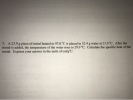 5. A 23.9 g piece of metal heated to 97.8 °C is placed in 52.4 g water at 21.9 °C. After the metal is added, the temperature of the water rises to 29.9 °C. Calculate the specific heat of the metal. Express your answer in the units of cal/g°C.
2. Calculate the heat (in calories) lost by 115 g of water as it cools from...
 2. Calculate the heat (in calories) lost by 115 g of water as it cools from 91.4 °C to 15.4 °C.
4. Calculate the final temperature of 75.4 g water originally at 12.6 °C after it absorbs...
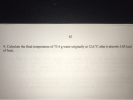 4. Calculate the final temperature of 75.4 g water originally at 12.6 °C after it absorbs 3.85 kcal of heat.
3.Calculate the temperature change caused by the absorption of 3.85 kcal heat by 75.4 g water.
 3.Calculate the temperature change caused by the absorption of 3.85 kcal heat by 75.4 g water.
How much heat is required to raise the temperature of 20.2 g of water from -25 °C to 115 °C? heat: kcal
 How much heat is required to raise the temperature of 20.2 g of water from -25 °C to 115 °C? heat: kcal
Find what heat in calories (cal) is required to increase the temperature of 52 g water...
 Find what heat in calories (cal) is required to increase the temperature of 52 g water from 0°C to 50 °C The specific heat capacity of water is 1 cal/g. C Express your answer to two significant figures and include the appropriate units. Calculate the quantity of heat absorbed by 12 g of water that warms from 30°C to 82 °C. Express your answer to two significant figures and include the appropriate units.
1) For part A, calculate q (the heat lost in calories) for copper and lead. The...
1) For part A, calculate q (the heat lost in calories) for copper and lead. The specific heats of these metals are in the background section. Then calculate q (the heat gained in calories) for the water in each case. Remember that you used 25.0 g of water in the experiment. Show your calculations 2)The heat lost by the metal and the heat gained by the water should be the same. Are they? If not, list possible sources of error....
Use the heat equation to calculate the energy, in joules and calories, for each of the...
Use the heat equation to calculate the energy, in joules and calories, for each of the following (see the table): Specific Heats for Some Substances Substance cal/g ∘Ccal/g ∘C J/g ∘CJ/g ∘C Elements Aluminum, Al(s)Al(s) 0.214 0.897 Copper, Cu(s)Cu(s) 0.0920 0.385 Gold, Au(s)Au(s) 0.0308 0.129 Iron, Fe(s)Fe(s) 0.108 0.452 Silver, Ag(s)Ag(s) 0.0562 0.235 Titanium, Ti(s)Ti(s) 0.125 0.523 Compounds Ammonia, NH3(s)NH3(s) 0.488 2.04 Ethanol, C2H6O(s)C2H6O(s) 0.588 2.46 Sodium chloride, NaCl(s)NaCl(s) 0.207 0.864 Water, H2O(s)H2O(s) 1.00 4.184 Water, H2O(s)H2O(s) 0.485 2.03 a.)...
How much heat is required to raise the temperature of 12.0 g of water from 15.4°C...
 How much heat is required to raise the temperature of 12.0 g of water from 15.4°C to 93.0°C? The specific heat of water is 4.184 J/g.-C. O 223 J O 773 J O 5033 O 467 x103 O 3.90 <103
 Problems 1. Calculate the heat (expressed in calories) required to heat 115 g of water from 15.4°C to 91.4 °C.
 5. A 23.9 g piece of metal heated to 97.8 °C is placed in 52.4 g water at 21.9 °C. After the metal is added, the temperature of the water rises to 29.9 °C. Calculate the specific heat of the metal. Express your answer in the units of cal/g°C.
 2. Calculate the heat (in calories) lost by 115 g of water as it cools from 91.4 °C to 15.4 °C.
 4. Calculate the final temperature of 75.4 g water originally at 12.6 °C after it absorbs 3.85 kcal of heat.
 3.Calculate the temperature change caused by the absorption of 3.85 kcal heat by 75.4 g water.
 How much heat is required to raise the temperature of 20.2 g of water from -25 °C to 115 °C? heat: kcal
 Find what heat in calories (cal) is required to increase the temperature of 52 g water from 0°C to 50 °C The specific heat capacity of water is 1 cal/g. C Express your answer to two significant figures and include the appropriate units. Calculate the quantity of heat absorbed by 12 g of water that warms from 30°C to 82 °C. Express your answer to two significant figures and include the appropriate units.
 How much heat is required to raise the temperature of 12.0 g of water from 15.4°C to 93.0°C? The specific heat of water is 4.184 J/g.-C. O 223 J O 773 J O 5033 O 467 x103 O 3.90 <103
Most questions answered within 3 hours.
-
Where is the error in this code sequence?
String s1 = "Hello";
String s2 = "ello";...
asked 11 months ago -
Financial data for Joel de Paris, Inc., for last year
follow:
Joel de Paris, Inc.
Balance...
asked 11 months ago -
Consider this reaction:
Al2(SO4)3 (aq)+ BaCl3
(aq) Al2Cl6 (aq)- +
3BaSO4(s) . What is the...
asked 11 months ago -
Suppose that Savneet is considering increasing her
recent random sample from 20 car rentals to 40...
asked 11 months ago -
Trucks arrive at an unloading terminal at an average rate of 120
per hour.
Trucks arrive...
asked 11 months ago -
Why are methanol and ethanol completely soluble in water while
octanol is not very little soluble....
asked 11 months ago -
A facilities manager at a university reads in a research report
that the mean amount of...
asked 11 months ago -
When the CuSO4 is rehydrated by adding water to the anhydrous
compound, is this an endothermic...
asked 11 months ago -
A ray of sunlight is passing from diamond into crown glass; the
angle of incidence is...
asked 11 months ago -
A block of mass 0.249 kg is placed on top of a light, vertical
spring of...
asked 11 months ago -
how do the kidneys compensate in the presences of acidosis
a) trigger hyperventilate
b) reserve acid...
asked 11 months ago -
Question 501 pts
The rental rate of capital to the firm increases. Which of the
following...
asked 11 months ago