
Homework Answers
Add Answer to:
input 12V t>0 ok input output Draw a sketch of the output voltage. Be sure to...
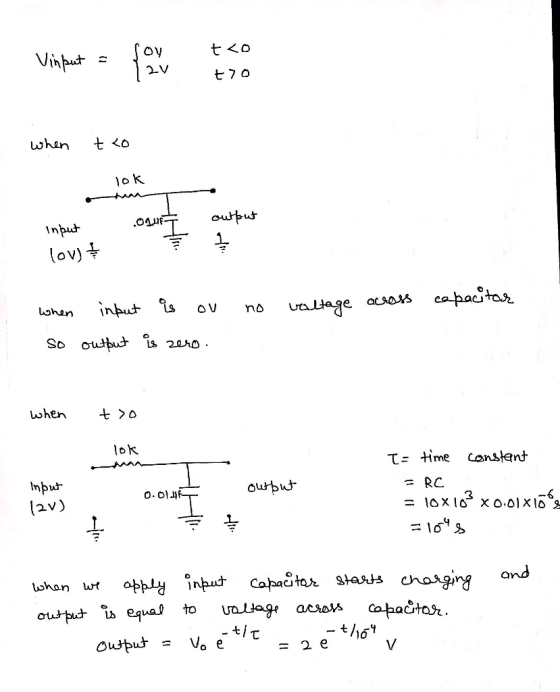
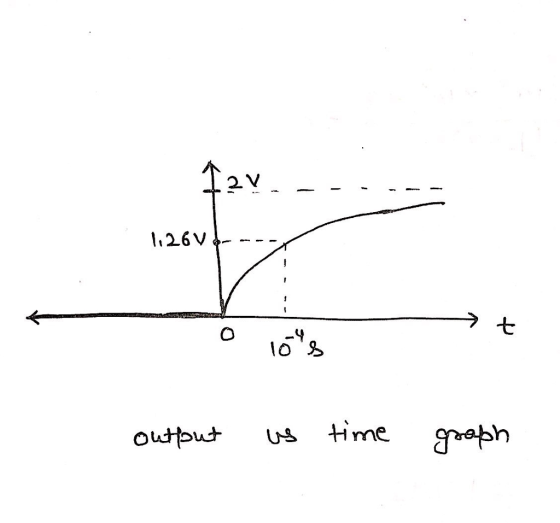
3. In the circuit below, suppose the input voltage is iok Inpu output Draw a sketch...
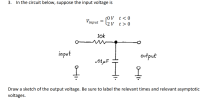 3. In the circuit below, suppose the input voltage is iok Inpu output Draw a sketch of the output voltage. Be sure to label the relevant times and relevant asymptotic voltages. We were unable to transcribe this image
2. For the following circuit, and given input signal, sketch the corresponding output volt) for t>...
 2. For the following circuit, and given input signal, sketch the corresponding output volt) for t> 0. 200 (mH) m , (D) (V) 100.(2) W 1 + 10 - 30 tms) 20 40 v.t (V) I 10 20 30 40 - f(ms)
Problem 10.10-1 72 kS2 The input to this circuit is the voltage source voltage given by...
 Problem 10.10-1 72 kS2 The input to this circuit is the voltage source voltage given by v(t) 2.65cos 310t-15° v 0.5HF The output is the voltage Vo(t)-Acos(310 t + ?) v vi0) ou) where A and ? are constants such that A > 0 and-180° < ? < 180°. Determine the values of the constants A and ?: | V and ?
(b) If R = 4solve and sketch the response of voltage, V(t) when t > 0....
 (b) If R = 4solve and sketch the response of voltage, V(t) when t > 0. Next, obtain the current I flowing through the inductor in Figure Q3(b). [16 marks) t = 0 422 IH wm + + 24 V 0.25 F V(t) R Figure Q3(b)
Sketch Vout at DC as a function of input voltage at DC for-5 V < Vin...
 Sketch Vout at DC as a function of input voltage at DC for-5 V < Vin < 5V. Assume an ideal silicon diode. R1 10k R2 D1 10k
+ 2y = 4u, y(0) = 0, for the following input: Solve: dt 0<t<T u(t) t>T...
 + 2y = 4u, y(0) = 0, for the following input: Solve: dt 0<t<T u(t) t>T Graph the solution (you may use Excel or Matlab) for T= 1sec, 0.1sec, 0.01sec, and 0.001sec. Do you see what is happening to the output? What is happening to the input?!
7.27 Sketch and label, for 0 <t < 6 ms, the current drawn by a 2-mH...
 7.27 Sketch and label, for 0 <t < 6 ms, the current drawn by a 2-mH inductance with zero initial stored energy in re- sponse to the voltage waveform of Figure P7.27 v (V) Figure P7.27
Q3: The switch in the has been open a long time before closing at t=0. Find...
 Q3: The switch in the has been open a long time before closing at t=0. Find il(t) for t> 0. t=0 2k-22 in 62.5H 12V 6 ΚΩ 2.5 UF 9 mA
Sketch Vout at DC as a function of input voltage at DC for-5 V < Vin...
 Sketch Vout at DC as a function of input voltage at DC for-5 V < Vin < 5V. Assume an ideal silicon diode. R1 10k R2 D1 10k
2. Consider a firm with technology that can be represented by the following production function: Input...
 2. Consider a firm with technology that can be represented by the following production function: Input 1 costs wi >0 per unit and input 2 costs w2 >0 per unit. (a) Draw the isoquant associated with an output of 4. Make sure to label any inter- cepts and slopes. (b) Find the firm's long-run cost function.
 3. In the circuit below, suppose the input voltage is iok Inpu output Draw a sketch of the output voltage. Be sure to label the relevant times and relevant asymptotic voltages. We were unable to transcribe this image
 2. For the following circuit, and given input signal, sketch the corresponding output volt) for t> 0. 200 (mH) m , (D) (V) 100.(2) W 1 + 10 - 30 tms) 20 40 v.t (V) I 10 20 30 40 - f(ms)
 Problem 10.10-1 72 kS2 The input to this circuit is the voltage source voltage given by v(t) 2.65cos 310t-15° v 0.5HF The output is the voltage Vo(t)-Acos(310 t + ?) v vi0) ou) where A and ? are constants such that A > 0 and-180° < ? < 180°. Determine the values of the constants A and ?: | V and ?
 (b) If R = 4solve and sketch the response of voltage, V(t) when t > 0. Next, obtain the current I flowing through the inductor in Figure Q3(b). [16 marks) t = 0 422 IH wm + + 24 V 0.25 F V(t) R Figure Q3(b)
 Sketch Vout at DC as a function of input voltage at DC for-5 V < Vin < 5V. Assume an ideal silicon diode. R1 10k R2 D1 10k
 + 2y = 4u, y(0) = 0, for the following input: Solve: dt 0<t<T u(t) t>T Graph the solution (you may use Excel or Matlab) for T= 1sec, 0.1sec, 0.01sec, and 0.001sec. Do you see what is happening to the output? What is happening to the input?!
 7.27 Sketch and label, for 0 <t < 6 ms, the current drawn by a 2-mH inductance with zero initial stored energy in re- sponse to the voltage waveform of Figure P7.27 v (V) Figure P7.27
 Q3: The switch in the has been open a long time before closing at t=0. Find il(t) for t> 0. t=0 2k-22 in 62.5H 12V 6 ΚΩ 2.5 UF 9 mA
 Sketch Vout at DC as a function of input voltage at DC for-5 V < Vin < 5V. Assume an ideal silicon diode. R1 10k R2 D1 10k
 2. Consider a firm with technology that can be represented by the following production function: Input 1 costs wi >0 per unit and input 2 costs w2 >0 per unit. (a) Draw the isoquant associated with an output of 4. Make sure to label any inter- cepts and slopes. (b) Find the firm's long-run cost function.
Most questions answered within 3 hours.
-
Where is the error in this code sequence?
String s1 = "Hello";
String s2 = "ello";...
asked 11 months ago -
Financial data for Joel de Paris, Inc., for last year
follow:
Joel de Paris, Inc.
Balance...
asked 11 months ago -
Consider this reaction:
Al2(SO4)3 (aq)+ BaCl3
(aq) Al2Cl6 (aq)- +
3BaSO4(s) . What is the...
asked 11 months ago -
Suppose that Savneet is considering increasing her
recent random sample from 20 car rentals to 40...
asked 11 months ago -
Trucks arrive at an unloading terminal at an average rate of 120
per hour.
Trucks arrive...
asked 11 months ago -
Why are methanol and ethanol completely soluble in water while
octanol is not very little soluble....
asked 11 months ago -
A facilities manager at a university reads in a research report
that the mean amount of...
asked 11 months ago -
When the CuSO4 is rehydrated by adding water to the anhydrous
compound, is this an endothermic...
asked 11 months ago -
A ray of sunlight is passing from diamond into crown glass; the
angle of incidence is...
asked 11 months ago -
A block of mass 0.249 kg is placed on top of a light, vertical
spring of...
asked 11 months ago -
how do the kidneys compensate in the presences of acidosis
a) trigger hyperventilate
b) reserve acid...
asked 11 months ago -
Question 501 pts
The rental rate of capital to the firm increases. Which of the
following...
asked 11 months ago