Analyze each of the following cycloaddition reactions and answer
the accompanying questions.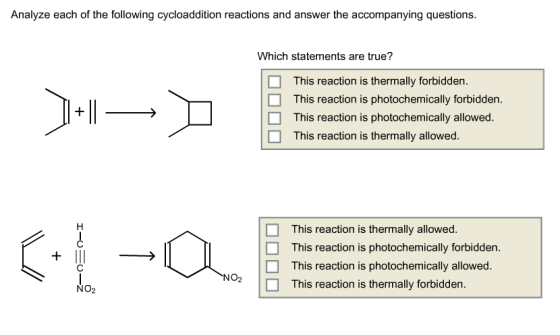
Homework Answers
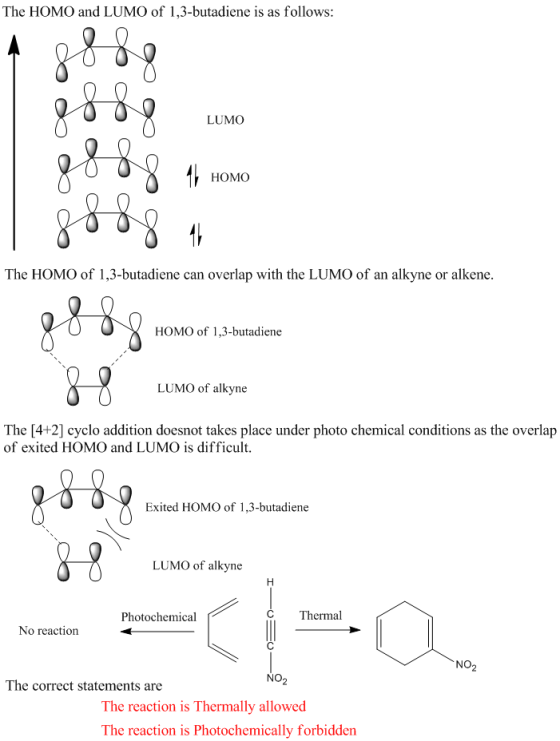
![The HOMO and LUMO of an alkene contains sigle bond is as follows LUMO HOMO Therefore, the [2+2] addition is not possible unde](http://img.homeworklib.com/questions/cf5ddc70-c1b8-11ea-a6a0-7fe62e249a4e.png?x-oss-process=image/resize,w_560)
Add Answer to:
Analyze each of the following cycloaddition reactions and answer the accompanying questions. Analyze each of the...
Problem: a) show that the [4 +4] cycloaddition of two butadiene molecules to give cycloocta-1,5-diene is...
Problem: a) show that the [4 +4] cycloaddition of two butadiene molecules to give cycloocta-1,5-diene is thermally forbidden but photochemically allowed. b) There is a different, thermally allowed cycloaddition of two butadiene molecules. Show this reaction, and explain why it is thermally allowed. (hint: consider the dimerization of cyclopentadiene.)
6. Is the thermal (3+2) cycloaddition between allyl anion and ethylene to give the cyclopentyl carbanion,...
 6. Is the thermal (3+2) cycloaddition between allyl anion and ethylene to give the cyclopentyl carbanion, shown below, a thermally allowed or forbidden reaction? To answer, draw the molecular orbitals for HOMO of the ally! anion and LUMO of ethylene and clearly orient the orbitals in such a way that the orbital interactions are clear. Label the two key orbital interactions as bonding (in-phase) or antibonding (out of phase). (11 pts) G
Define the following terms as they relate to pericyclic reactions: - Conservation of orbital symmetry -...
Define the following terms as they relate to pericyclic reactions: - Conservation of orbital symmetry - -Thermally allowed -Photochemically allowed
this the pre lab questions for The Diels - Alder Cycloaddition Reactio expirment please answer all...
 this the pre lab questions for The Diels -
Alder Cycloaddition Reactio expirment please answer all the
question
If the Diels-Alder reaction is classified as a [4 + 2] cycloaddition reaction, how would you classify the cycloaddition reactions shown below? You are instructed to use 140 mg of cyclopentadiene (d = 0.80 g/mL). It is typically more convenient to measure out a volume of liquid. What volume of cyclopentadiene should be used? In the Diels-Alder reaction that you will be...
this the pre lab questions for The Diels -
Alder Cycloaddition Reactio expirment please answer all the
question
If the Diels-Alder reaction is classified as a [4 + 2] cycloaddition reaction, how would you classify the cycloaddition reactions shown below? You are instructed to use 140 mg of cyclopentadiene (d = 0.80 g/mL). It is typically more convenient to measure out a volume of liquid. What volume of cyclopentadiene should be used? In the Diels-Alder reaction that you will be...
State which of the following reactions are allowed by conservation laws and which is forbidden, and...
 State which of the following reactions are allowed by
conservation laws and which is forbidden, and give the reasons in
either case:
1-
2-
3-
4-
State which of the following reactions are allowed by conservation laws and which is forbidden, and give the reasons in either case: 1- pi^0 arrow e^++e^- 2- P arrow n+e^++ve 3- mu^+ arrow e^++e^-+e^+ 4- mu^+ arrow e^+ + gamma
State which of the following reactions are allowed by
conservation laws and which is forbidden, and give the reasons in
either case:
1-
2-
3-
4-
State which of the following reactions are allowed by conservation laws and which is forbidden, and give the reasons in either case: 1- pi^0 arrow e^++e^- 2- P arrow n+e^++ve 3- mu^+ arrow e^++e^-+e^+ 4- mu^+ arrow e^+ + gamma
4. Complete the following reaction and answer the questions. 4. Complete the following reaction and answer...
 4. Complete the following reaction and answer the questions.
 1. (Structure of LAH) Ph 2. HC1, H2O a. Provide a mechanism of the reaction above. b. Provide two more approaches which can yield the same product in the reaction above. Different reagents and starting material are allowed to use. You need to show the reactions to earn full credits.
4. Complete the following reaction and answer the questions.
4. Complete the following reaction and answer the questions. 1. (Structure of LAH) Ph 2. HC1, H2O a. Provide a mechanism of the reaction above. b. Provide two more approaches which can yield the same product in the reaction above. Different reagents and starting material are allowed to use. You need to show the reactions to earn full credits.
Use the following to answer the questions below: In each of the following multiple-choice questions, characterize...
 Use the following to answer the questions below: In each of the following multiple-choice questions, characterize EACH of the three given statements as being TRUE or FALSE and then indicate the collective true false status of the statements using the choices. a) All three statements are true. b) Two of the three statements are true. c) Only one of the statements is true. d) None of the statements are true. Statements: (1) In the IUPAC nomenclature system, an aldehyde group...
Name Worksheet 8 - Chemical Reactions Directions: Answer each of the following questions. Be sure to...
 Name Worksheet 8 - Chemical Reactions Directions: Answer each of the following questions. Be sure to complete sentences where appropriate. For full credit be sure to show all of your work. Where appropriate anwes should be boxed for clarity, written to the correct number of significant figures, and include proper units. Remember to include phase labels in your balanced chemical reactions. 1. Single Replacement Reactions - Write the correctly balanced chemical equation for cach and write which clement is more...
3. The following reactions used in organic syntheses involve pericyclic reactions. Illustrate the cyclic redistribution of...
 3. The following reactions used in organic syntheses involve pericyclic reactions. Illustrate the cyclic redistribution of electrons for the pericyclic reaction involved in each case and give the name of the type of reaction, e.g. [3,3] sigmatropic rearrangement, ene reaction, or [4+2] cycloaddition. Me ^ OMe Me + Ome 200°C, 12 h Оме ow.cssong reflux, 22 h hy acetophenone (sensitizer) Et,0, 36-48 h
4. Complete the following reaction and answer the questions. 1. (Structure of LAH) 2. HC1, H2O...
 4. Complete the following reaction and answer the questions. 1. (Structure of LAH) 2. HC1, H2O a. Provide a mechanism of the reaction above. b. Provide two more approaches which can yield the same product in the reaction above. Different reagents and starting material are allowed to use. You need to show the reactions to earn full credits.
 6. Is the thermal (3+2) cycloaddition between allyl anion and ethylene to give the cyclopentyl carbanion, shown below, a thermally allowed or forbidden reaction? To answer, draw the molecular orbitals for HOMO of the ally! anion and LUMO of ethylene and clearly orient the orbitals in such a way that the orbital interactions are clear. Label the two key orbital interactions as bonding (in-phase) or antibonding (out of phase). (11 pts) G
 this the pre lab questions for The Diels -
Alder Cycloaddition Reactio expirment please answer all the
question
If the Diels-Alder reaction is classified as a [4 + 2] cycloaddition reaction, how would you classify the cycloaddition reactions shown below? You are instructed to use 140 mg of cyclopentadiene (d = 0.80 g/mL). It is typically more convenient to measure out a volume of liquid. What volume of cyclopentadiene should be used? In the Diels-Alder reaction that you will be...
this the pre lab questions for The Diels -
Alder Cycloaddition Reactio expirment please answer all the
question
If the Diels-Alder reaction is classified as a [4 + 2] cycloaddition reaction, how would you classify the cycloaddition reactions shown below? You are instructed to use 140 mg of cyclopentadiene (d = 0.80 g/mL). It is typically more convenient to measure out a volume of liquid. What volume of cyclopentadiene should be used? In the Diels-Alder reaction that you will be...
 State which of the following reactions are allowed by
conservation laws and which is forbidden, and give the reasons in
either case:
1-
2-
3-
4-
State which of the following reactions are allowed by conservation laws and which is forbidden, and give the reasons in either case: 1- pi^0 arrow e^++e^- 2- P arrow n+e^++ve 3- mu^+ arrow e^++e^-+e^+ 4- mu^+ arrow e^+ + gamma
State which of the following reactions are allowed by
conservation laws and which is forbidden, and give the reasons in
either case:
1-
2-
3-
4-
State which of the following reactions are allowed by conservation laws and which is forbidden, and give the reasons in either case: 1- pi^0 arrow e^++e^- 2- P arrow n+e^++ve 3- mu^+ arrow e^++e^-+e^+ 4- mu^+ arrow e^+ + gamma
 4. Complete the following reaction and answer the questions.
 1. (Structure of LAH) Ph 2. HC1, H2O a. Provide a mechanism of the reaction above. b. Provide two more approaches which can yield the same product in the reaction above. Different reagents and starting material are allowed to use. You need to show the reactions to earn full credits.
4. Complete the following reaction and answer the questions.
4. Complete the following reaction and answer the questions. 1. (Structure of LAH) Ph 2. HC1, H2O a. Provide a mechanism of the reaction above. b. Provide two more approaches which can yield the same product in the reaction above. Different reagents and starting material are allowed to use. You need to show the reactions to earn full credits.
 Use the following to answer the questions below: In each of the following multiple-choice questions, characterize EACH of the three given statements as being TRUE or FALSE and then indicate the collective true false status of the statements using the choices. a) All three statements are true. b) Two of the three statements are true. c) Only one of the statements is true. d) None of the statements are true. Statements: (1) In the IUPAC nomenclature system, an aldehyde group...
 Name Worksheet 8 - Chemical Reactions Directions: Answer each of the following questions. Be sure to complete sentences where appropriate. For full credit be sure to show all of your work. Where appropriate anwes should be boxed for clarity, written to the correct number of significant figures, and include proper units. Remember to include phase labels in your balanced chemical reactions. 1. Single Replacement Reactions - Write the correctly balanced chemical equation for cach and write which clement is more...
 3. The following reactions used in organic syntheses involve pericyclic reactions. Illustrate the cyclic redistribution of electrons for the pericyclic reaction involved in each case and give the name of the type of reaction, e.g. [3,3] sigmatropic rearrangement, ene reaction, or [4+2] cycloaddition. Me ^ OMe Me + Ome 200°C, 12 h Оме ow.cssong reflux, 22 h hy acetophenone (sensitizer) Et,0, 36-48 h
 4. Complete the following reaction and answer the questions. 1. (Structure of LAH) 2. HC1, H2O a. Provide a mechanism of the reaction above. b. Provide two more approaches which can yield the same product in the reaction above. Different reagents and starting material are allowed to use. You need to show the reactions to earn full credits.
Most questions answered within 3 hours.
-
Where is the error in this code sequence?
String s1 = "Hello";
String s2 = "ello";...
asked 10 months ago -
Financial data for Joel de Paris, Inc., for last year
follow:
Joel de Paris, Inc.
Balance...
asked 10 months ago -
Consider this reaction:
Al2(SO4)3 (aq)+ BaCl3
(aq) Al2Cl6 (aq)- +
3BaSO4(s) . What is the...
asked 10 months ago -
Suppose that Savneet is considering increasing her
recent random sample from 20 car rentals to 40...
asked 10 months ago -
Trucks arrive at an unloading terminal at an average rate of 120
per hour.
Trucks arrive...
asked 10 months ago -
Why are methanol and ethanol completely soluble in water while
octanol is not very little soluble....
asked 10 months ago -
A facilities manager at a university reads in a research report
that the mean amount of...
asked 10 months ago -
When the CuSO4 is rehydrated by adding water to the anhydrous
compound, is this an endothermic...
asked 10 months ago -
A ray of sunlight is passing from diamond into crown glass; the
angle of incidence is...
asked 10 months ago -
A block of mass 0.249 kg is placed on top of a light, vertical
spring of...
asked 10 months ago -
how do the kidneys compensate in the presences of acidosis
a) trigger hyperventilate
b) reserve acid...
asked 10 months ago -
Question 501 pts
The rental rate of capital to the firm increases. Which of the
following...
asked 10 months ago