Consider the cycloaddition of hexa-1,3,5-triene with ethene. The HOMO and excited-state HOMO (HOMO*) are shown below....
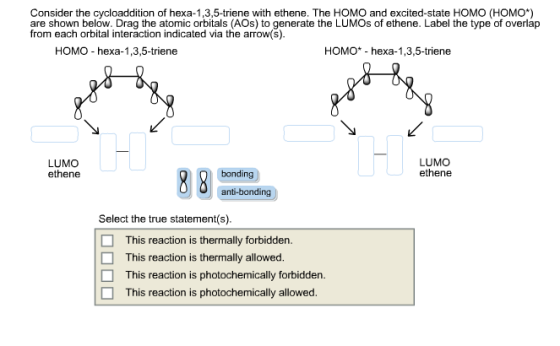
Consider the cycloaddition of hexa-1,3,5-triene with ethene. The HOMO and excited-state HOMO (HOMO*) are shown below. Drag the atomic orbitals (AOs) to generate the LUMOs of ethene. Label the type of overlap from each orbital interaction indicated via the arrow(s).
PLEASE HELP ME
Homework Answers
The question is a little confusing, but what they're saying is on the left you've got the HOMO of hexa-1,3-5-triene. On the right you have the excited state of hexa-1,3,5-triene, which has a different HOMO.Notice that the p orbitals are slightly different (in particular, the ones on the end!).
I have drawn the MO diagram of ethene for you. I've labeled the HOMO and the LUMO for you. Notice that you are supposed to list the LUMO of ethene as part of your response.
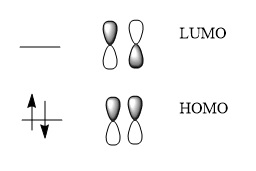
Notice that ethene has two pi electrons. Thus, when drawing the MO diagram, you fill in the lowest energy orbital in which all the p-orbital lobes are in phase (that is, all the shaded/nonshaded parts line up). This gives you a LUMO where the orbitals are out of phase (see how the top lobes are shaded and unshaded). This LUMO is what you should draw as a response for LUMO of ethene.
---
I have drawn the MO interaction figure myself for you, in order to highlight the differences. First, look at the figure from the left:
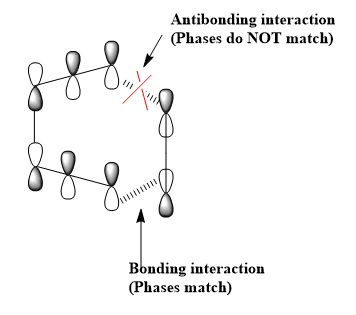
Notice that the phases of the HOMO and LUMO match up on one end but not on the other. Since there is one bonding interaction and one antibonding interaction, the reaction does not proceed. There is no net bonding interaction.
---
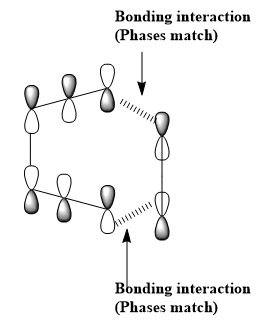
Notice that for the figure from the right, there are two bonding interactions now, because both phases match when the HOMO and LUMOs interact.
---
What does all this mean? Well, it means two things. (a) the reaction is thermally forbidden and (d) the reaction is photochemically allowed.
How do you know this? The answer is pretty simple. If the ground-state HOMO (i.e. non-excited state) has overall bonding interactions, then the reaction is thermally allowed. If there are no net bonding interactions in the ground-state HOMO, then the reaction is thermally forbidden. Notice that for the system given in the problem, this is the case.
If the excited-state HOMO has overall bonding interactions, the reaction is photochemically allowed because in order to get to this HOMO, you had to promote an electron with light. Notice that this is the case for this problem. If there are no net bonding interacions in the excited-state HOMO, then the reaction is photochemically forbidden.
Hope this helps!

Add Answer to:
Consider the cycloaddition of hexa-1,3,5-triene with ethene. The HOMO and excited-state HOMO (HOMO*) are shown below....
#2 2. Below is a molecular orbital (MO) diagram for 1,3,5 hexatriene in the excited state....
 #2
2. Below is a molecular orbital (MO) diagram for 1,3,5 hexatriene in the excited state. Please label the antibonding MO's, the bonding MO's, the HOMO, the LUMO and the nodes. (5 pt) 05 - antisymmetric 388 382388 388 symmetric antisymmetric Energy ton +- symmetric energy of the patomic orbitals > t antisymmetric no T symmetric molecular orbitals energy levels 2011 Production,
#2
2. Below is a molecular orbital (MO) diagram for 1,3,5 hexatriene in the excited state. Please label the antibonding MO's, the bonding MO's, the HOMO, the LUMO and the nodes. (5 pt) 05 - antisymmetric 388 382388 388 symmetric antisymmetric Energy ton +- symmetric energy of the patomic orbitals > t antisymmetric no T symmetric molecular orbitals energy levels 2011 Production,
 #2
2. Below is a molecular orbital (MO) diagram for 1,3,5 hexatriene in the excited state. Please label the antibonding MO's, the bonding MO's, the HOMO, the LUMO and the nodes. (5 pt) 05 - antisymmetric 388 382388 388 symmetric antisymmetric Energy ton +- symmetric energy of the patomic orbitals > t antisymmetric no T symmetric molecular orbitals energy levels 2011 Production,
#2
2. Below is a molecular orbital (MO) diagram for 1,3,5 hexatriene in the excited state. Please label the antibonding MO's, the bonding MO's, the HOMO, the LUMO and the nodes. (5 pt) 05 - antisymmetric 388 382388 388 symmetric antisymmetric Energy ton +- symmetric energy of the patomic orbitals > t antisymmetric no T symmetric molecular orbitals energy levels 2011 Production,
Most questions answered within 3 hours.
-
Where is the error in this code sequence?
String s1 = "Hello";
String s2 = "ello";...
asked 10 months ago -
Financial data for Joel de Paris, Inc., for last year
follow:
Joel de Paris, Inc.
Balance...
asked 10 months ago -
Consider this reaction:
Al2(SO4)3 (aq)+ BaCl3
(aq) Al2Cl6 (aq)- +
3BaSO4(s) . What is the...
asked 10 months ago -
Suppose that Savneet is considering increasing her
recent random sample from 20 car rentals to 40...
asked 10 months ago -
Trucks arrive at an unloading terminal at an average rate of 120
per hour.
Trucks arrive...
asked 10 months ago -
Why are methanol and ethanol completely soluble in water while
octanol is not very little soluble....
asked 10 months ago -
A facilities manager at a university reads in a research report
that the mean amount of...
asked 10 months ago -
When the CuSO4 is rehydrated by adding water to the anhydrous
compound, is this an endothermic...
asked 10 months ago -
A ray of sunlight is passing from diamond into crown glass; the
angle of incidence is...
asked 10 months ago -
A block of mass 0.249 kg is placed on top of a light, vertical
spring of...
asked 10 months ago -
how do the kidneys compensate in the presences of acidosis
a) trigger hyperventilate
b) reserve acid...
asked 10 months ago -
Question 501 pts
The rental rate of capital to the firm increases. Which of the
following...
asked 10 months ago