You drive down the road at 29 m/s (65 mi/h) in a car whose tires have...
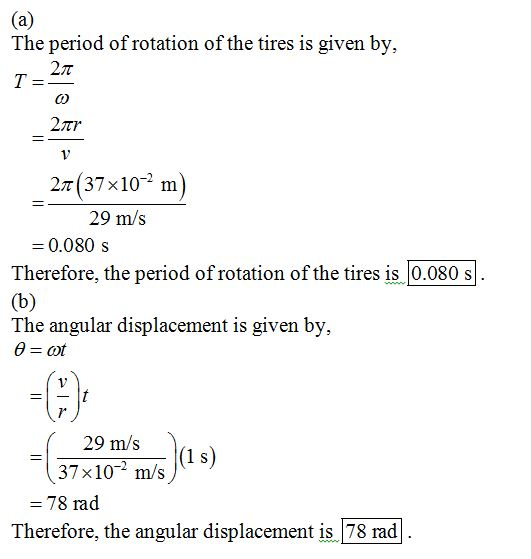
You drive down the road at 29 m/s (65 mi/h) in a car whose tires have a radius of 37 cm.
a) What is the period of rotation of the tires?
Express your answer to two significant figures and include appropriate units.
b) Through what angle does a tire rotate in one second?
Express your answer to two significant figures and include appropriate units.
Homework Answers
Add Answer to:
You drive down the road at 29 m/s (65 mi/h) in a car whose tires
have...
As you drive down the road at 14 m/s, you press on the gas pedal and...
As you drive down the road at 14 m/s, you press on the gas pedal and speed up with a uniform acceleration of 1.22 m/s^2 for 0.65 s. If the tires on your car have a radius of 33 cm, what is their angular displacement during this period of acceleration? Answer should be in radians.
As you drive down the road at 18 m/s , you press on the gas pedal...
As you drive down the road at 18 m/s , you press on the gas pedal and speed up with a uniform acceleration of 1.22 m/s2 for 0.70 s If the tires on your car have a radius of 33 cm, what is their angular displacement during this period of acceleration?
Your car tire is rotating at 3.4 rev/s when suddenly you press down hard on the...
 Your car tire is rotating at 3.4 rev/s when suddenly you press
down hard on the accelerator. After traveling 240 m, the tire's
rotation has increased to 6.6 rev/s. The radius of the tire is 32
cm.
What was the tire's angular acceleration? Give your answer in
rad/s^2.
Express the answer using two significant digits.
The answer I got is, approximately, 0.013405, but, apparently,
it's wrong.
Problem 4.67 Your car tire is rotating at 3.4 rev/s when suddenly you press...
Your car tire is rotating at 3.4 rev/s when suddenly you press
down hard on the accelerator. After traveling 240 m, the tire's
rotation has increased to 6.6 rev/s. The radius of the tire is 32
cm.
What was the tire's angular acceleration? Give your answer in
rad/s^2.
Express the answer using two significant digits.
The answer I got is, approximately, 0.013405, but, apparently,
it's wrong.
Problem 4.67 Your car tire is rotating at 3.4 rev/s when suddenly you press...
Your car tire is rotating at 3.8 rev/s when suddenly you press down hard on the...
 Your car tire is rotating at 3.8 rev/s when suddenly you press down hard on the accelerator. After traveling 260 m the tire's rotation has increased to 5.6 rev/s. The radius of the tire is 32 cm. What was the tire's angular acceleration? Give your answer in rad/s Express your answer using two significant figures rad/s2
Const Part A The tires of a car make 78 revolutions as the car reduces its...
 Const Part A The tires of a car make 78 revolutions as the car reduces its speed uniformly from 90.0 km/h to 60.0 km/h. The tires have a diameter of 0.88 m. What was the angular acceleration of the tires? Express your answer using two significant figures. a = -1.8 rad/s? Subm Previous Answers Correct Part B If the car continues to decelerate at this rate, how much more time is required for it to stop? Express your answer to...
The tires of a car make 83 revolutions as the car reduces its speed uniformly from...
The tires of a car make 83 revolutions as the car reduces its speed uniformly from 90.0 km/h to 63.0 km/h. The tires have a diameter of 0.82 m. Part A What was the angular acceleration of the tires? Express your answer using two significant figures. α = rad/s2 Part B If the car continues to decelerate at this rate, how much more time is required for it to stop? Express your answer to two significant figures and include the...
A stunt man drives a car at a speed of 20 m/s off a 26-m-high cliff....
A stunt man drives a car at a speed of 20 m/s off a 26-m-high cliff. The road leading to the cliff is inclined upward at an angle of 20∘ Part A: How far from the base of the cliff does the car land? Express your answer to two significant figures and include the appropriate units. Part B: What is the car's impact speed? Express your answer to two significant figures and include the appropriate units.
Mark pushes his broken car 140 m down the block to his friend's house. He has to exert a 160 N horizontal force to push...
Mark pushes his broken car 140 m down the block to his friend's house. He has to exert a 160 N horizontal force to push the car at a constant speed. How much thermal energy is created in the tires and road during this short trip? Express your answer to two significant figures and include the appropriate units.
The tires of a car make 95 revolutions as the car reduces its speed uniformly from...
The tires of a car make 95 revolutions as the car reduces its speed uniformly from 95.0 km/hkm/h to 55.0 km/hkm/h. The tires have a diameter of 0.88 m Angular acceleration of the tires: -2 rad/s2 A. If the car continues to decelerate at this rate, how much more time is required for it to stop? Express your answer to two significant figures and include the appropriate units. B. If the car continues to decelerate at this rate, how far...
The gauge pressure in each of the four tires of an automobile is 240 kPa ....
The gauge pressure in each of the four tires of an automobile is 240 kPa . If each tire has a "footprint" of 150 cm2 (area touching the ground), determine the mass of the car. Express your answer to two significant figures and include the appropriate units.
 Your car tire is rotating at 3.4 rev/s when suddenly you press
down hard on the accelerator. After traveling 240 m, the tire's
rotation has increased to 6.6 rev/s. The radius of the tire is 32
cm.
What was the tire's angular acceleration? Give your answer in
rad/s^2.
Express the answer using two significant digits.
The answer I got is, approximately, 0.013405, but, apparently,
it's wrong.
Problem 4.67 Your car tire is rotating at 3.4 rev/s when suddenly you press...
Your car tire is rotating at 3.4 rev/s when suddenly you press
down hard on the accelerator. After traveling 240 m, the tire's
rotation has increased to 6.6 rev/s. The radius of the tire is 32
cm.
What was the tire's angular acceleration? Give your answer in
rad/s^2.
Express the answer using two significant digits.
The answer I got is, approximately, 0.013405, but, apparently,
it's wrong.
Problem 4.67 Your car tire is rotating at 3.4 rev/s when suddenly you press...
 Your car tire is rotating at 3.8 rev/s when suddenly you press down hard on the accelerator. After traveling 260 m the tire's rotation has increased to 5.6 rev/s. The radius of the tire is 32 cm. What was the tire's angular acceleration? Give your answer in rad/s Express your answer using two significant figures rad/s2
 Const Part A The tires of a car make 78 revolutions as the car reduces its speed uniformly from 90.0 km/h to 60.0 km/h. The tires have a diameter of 0.88 m. What was the angular acceleration of the tires? Express your answer using two significant figures. a = -1.8 rad/s? Subm Previous Answers Correct Part B If the car continues to decelerate at this rate, how much more time is required for it to stop? Express your answer to...
Most questions answered within 3 hours.
-
Where is the error in this code sequence?
String s1 = "Hello";
String s2 = "ello";...
asked 11 months ago -
Financial data for Joel de Paris, Inc., for last year
follow:
Joel de Paris, Inc.
Balance...
asked 11 months ago -
Consider this reaction:
Al2(SO4)3 (aq)+ BaCl3
(aq) Al2Cl6 (aq)- +
3BaSO4(s) . What is the...
asked 11 months ago -
Suppose that Savneet is considering increasing her
recent random sample from 20 car rentals to 40...
asked 11 months ago -
Trucks arrive at an unloading terminal at an average rate of 120
per hour.
Trucks arrive...
asked 11 months ago -
Why are methanol and ethanol completely soluble in water while
octanol is not very little soluble....
asked 11 months ago -
A facilities manager at a university reads in a research report
that the mean amount of...
asked 11 months ago -
When the CuSO4 is rehydrated by adding water to the anhydrous
compound, is this an endothermic...
asked 11 months ago -
A ray of sunlight is passing from diamond into crown glass; the
angle of incidence is...
asked 11 months ago -
A block of mass 0.249 kg is placed on top of a light, vertical
spring of...
asked 11 months ago -
how do the kidneys compensate in the presences of acidosis
a) trigger hyperventilate
b) reserve acid...
asked 11 months ago -
Question 501 pts
The rental rate of capital to the firm increases. Which of the
following...
asked 11 months ago