
Homework Answers
heptane
note:
the molecular ion peak is at m/z = 100 ---> indicates the molecular weight of the compound = 100
only heptane has a molecular weight of 100
Add Answer to:
please explain.... Select the compound that was used to generate the mass spectrum. heptane hexane 2,4-dimethylpentane...
Select the compound that was used to generate the mass spectrum. Select the compound that was...
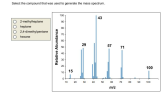 Select the compound that was used to generate the mass
spectrum.
Select the compound that was used to generate the mass spectrum. 2-methylheptane heptane 2,4-dimethylpentane hexane
Select the compound that was used to generate the mass
spectrum.
Select the compound that was used to generate the mass spectrum. 2-methylheptane heptane 2,4-dimethylpentane hexane
What is the IUPAC name of the following compound? CH3-(CH2)5-CH3 Heptane O Hexane 1,6-dimethylpentane Octane 1-Heptene
 What is the IUPAC name of the following compound? CH3-(CH2)5-CH3 Heptane O Hexane 1,6-dimethylpentane Octane 1-Heptene
Question 3 (10 points) What is the IUPAC name of this compound? 2-methylhexane 2.2-dimethylpentane 2.4-dimethylpentane heptane...
 Question 3 (10 points) What is the IUPAC name of this compound? 2-methylhexane 2.2-dimethylpentane 2.4-dimethylpentane heptane 1.1.3-trimethylbutane Question 4 (10 points) What is the IUPAC name of the alkyl group CH CH.CH
A chemist obtains a mass spectrum of an unknown compound and notices a profound M+2 of...
A chemist obtains a mass spectrum of an unknown compound and notices a profound M+2 of approximately 33% intensity. What compound could this be? A: 3-chloropentane B: 2-bromohexane C: T-butyl alcohol D: HExane E: 2-iodohexane Please walk me through arriving to the right answer thx
which liquid has the strongest intermolecular forces? explain please methanol,ethanol,1-propanol,1-butane,n-hexane,n-heptane,n-octane,acetone,2-propanol
which liquid has the strongest intermolecular forces? explain please methanol,ethanol,1-propanol,1-butane,n-hexane,n-heptane,n-octane,acetone,2-propanol
Name: Starting with the mass spectrum of n-heptane What is the molecular ion? What fragment is...
 Name: Starting with the mass spectrum of n-heptane What is the molecular ion? What fragment is lost to generate the ion with m/z =71? What cation does the peak at m/z = 43 represent? What group does the spacing between each set of ions represent? Why is the peak at (M-15), corresponding to loss of -CH3 so small? Draw the structure of 2,4-dimethylpentane What is the structure of the ion responsible for m/z = 85? Relative Intensity What is the...
Explain which solvent mix, either 100% hexane or the 50%/50% hexane/dichloromethane, was used to produce the...
Explain which solvent mix, either 100% hexane or the 50%/50% hexane/dichloromethane, was used to produce the results shown in Table. Be sure explain thoroughly why the compounds traveled as indicated in terms of the solvent-compound IMF interactions. Results of several TLC experiments: Experiment Compounds used Compound that traveled furthest on TLC plate 1 Nonane 2-Nonanol Nonane 2 Nonane 1-Nonene Nonane 3 2-Nonanone Nonanoic acid 2-Nonanone
Chemistry help! What compound is this? The IR Spectrum and Mass Spectrum graphs are below: Please identify peaks and explain, thanks! INFRARED SPECTRUM 0.8 0.6 0.4F 0.2 3000 2000 Wavenumber (cm-1) 10...
 Chemistry help!
What compound is this? The IR Spectrum and Mass Spectrum graphs
are below:
Please identify peaks and explain, thanks!
INFRARED SPECTRUM 0.8 0.6 0.4F 0.2 3000 2000 Wavenumber (cm-1) 1000 MASS SPECTRUM 100 80 60 40 20 0.0 45 m/z 75 0.0 15 30 60 90
INFRARED SPECTRUM 0.8 0.6 0.4F 0.2 3000 2000 Wavenumber (cm-1) 1000 MASS SPECTRUM 100 80 60 40 20 0.0 45 m/z 75 0.0 15 30 60 90
Chemistry help!
What compound is this? The IR Spectrum and Mass Spectrum graphs
are below:
Please identify peaks and explain, thanks!
INFRARED SPECTRUM 0.8 0.6 0.4F 0.2 3000 2000 Wavenumber (cm-1) 1000 MASS SPECTRUM 100 80 60 40 20 0.0 45 m/z 75 0.0 15 30 60 90
INFRARED SPECTRUM 0.8 0.6 0.4F 0.2 3000 2000 Wavenumber (cm-1) 1000 MASS SPECTRUM 100 80 60 40 20 0.0 45 m/z 75 0.0 15 30 60 90
(Please number answers) 1. Write the condensed structural formula for the following: a) 2,3-dimethylhexane b) 2,4-dimethylpentane...
 (Please number answers)
1. Write the condensed structural formula for the following: a) 2,3-dimethylhexane b) 2,4-dimethylpentane 2. Give the systematic name for each of the following alkanes: CH, a) CH3-CH-CH, CH b) CH-CH-CH-CH2-CH, CH,CH; 3. Describe the differences between alkanes, alkenes, and alkynes. 4. Write the condensed structural formula for the 3 structural isomers of hydrocarbons containing 5 carbons and 12 hydrogens. 5. What is the correct scientific definition of an organic chemical? 6. Write condensed formulas and provide IUPAC...
(Please number answers)
1. Write the condensed structural formula for the following: a) 2,3-dimethylhexane b) 2,4-dimethylpentane 2. Give the systematic name for each of the following alkanes: CH, a) CH3-CH-CH, CH b) CH-CH-CH-CH2-CH, CH,CH; 3. Describe the differences between alkanes, alkenes, and alkynes. 4. Write the condensed structural formula for the 3 structural isomers of hydrocarbons containing 5 carbons and 12 hydrogens. 5. What is the correct scientific definition of an organic chemical? 6. Write condensed formulas and provide IUPAC...
I need these answered please Figure 1. Infrared spectrum of 2-2,4-dinitrobenzyl)pyridine, 4000 3500 3000 2500 2000...
 I need these answered please
Figure 1. Infrared spectrum of 2-2,4-dinitrobenzyl)pyridine, 4000 3500 3000 2500 2000 Figure 2. Mass Spectrum of 2-(2,4-dinitrobenzylpyridine. Scan 44B (3.434 min), BZPYN42.D 700000 600000 500000 400000 300000 200000 139 154 100000 78 5163 7092100 70 101 117 127 229 242258 40 50 60 70 80 90 100 110 120 130 140 150 160 170 180 190 200 210 220 230 240 250 260 Post-Lab Report (due next week). Your Post-Lab Report should contain the following:...
I need these answered please
Figure 1. Infrared spectrum of 2-2,4-dinitrobenzyl)pyridine, 4000 3500 3000 2500 2000 Figure 2. Mass Spectrum of 2-(2,4-dinitrobenzylpyridine. Scan 44B (3.434 min), BZPYN42.D 700000 600000 500000 400000 300000 200000 139 154 100000 78 5163 7092100 70 101 117 127 229 242258 40 50 60 70 80 90 100 110 120 130 140 150 160 170 180 190 200 210 220 230 240 250 260 Post-Lab Report (due next week). Your Post-Lab Report should contain the following:...
 Select the compound that was used to generate the mass
spectrum.
Select the compound that was used to generate the mass spectrum. 2-methylheptane heptane 2,4-dimethylpentane hexane
Select the compound that was used to generate the mass
spectrum.
Select the compound that was used to generate the mass spectrum. 2-methylheptane heptane 2,4-dimethylpentane hexane
 What is the IUPAC name of the following compound? CH3-(CH2)5-CH3 Heptane O Hexane 1,6-dimethylpentane Octane 1-Heptene
 Question 3 (10 points) What is the IUPAC name of this compound? 2-methylhexane 2.2-dimethylpentane 2.4-dimethylpentane heptane 1.1.3-trimethylbutane Question 4 (10 points) What is the IUPAC name of the alkyl group CH CH.CH
 Name: Starting with the mass spectrum of n-heptane What is the molecular ion? What fragment is lost to generate the ion with m/z =71? What cation does the peak at m/z = 43 represent? What group does the spacing between each set of ions represent? Why is the peak at (M-15), corresponding to loss of -CH3 so small? Draw the structure of 2,4-dimethylpentane What is the structure of the ion responsible for m/z = 85? Relative Intensity What is the...
 Chemistry help!
What compound is this? The IR Spectrum and Mass Spectrum graphs
are below:
Please identify peaks and explain, thanks!
INFRARED SPECTRUM 0.8 0.6 0.4F 0.2 3000 2000 Wavenumber (cm-1) 1000 MASS SPECTRUM 100 80 60 40 20 0.0 45 m/z 75 0.0 15 30 60 90
INFRARED SPECTRUM 0.8 0.6 0.4F 0.2 3000 2000 Wavenumber (cm-1) 1000 MASS SPECTRUM 100 80 60 40 20 0.0 45 m/z 75 0.0 15 30 60 90
Chemistry help!
What compound is this? The IR Spectrum and Mass Spectrum graphs
are below:
Please identify peaks and explain, thanks!
INFRARED SPECTRUM 0.8 0.6 0.4F 0.2 3000 2000 Wavenumber (cm-1) 1000 MASS SPECTRUM 100 80 60 40 20 0.0 45 m/z 75 0.0 15 30 60 90
INFRARED SPECTRUM 0.8 0.6 0.4F 0.2 3000 2000 Wavenumber (cm-1) 1000 MASS SPECTRUM 100 80 60 40 20 0.0 45 m/z 75 0.0 15 30 60 90
 (Please number answers)
1. Write the condensed structural formula for the following: a) 2,3-dimethylhexane b) 2,4-dimethylpentane 2. Give the systematic name for each of the following alkanes: CH, a) CH3-CH-CH, CH b) CH-CH-CH-CH2-CH, CH,CH; 3. Describe the differences between alkanes, alkenes, and alkynes. 4. Write the condensed structural formula for the 3 structural isomers of hydrocarbons containing 5 carbons and 12 hydrogens. 5. What is the correct scientific definition of an organic chemical? 6. Write condensed formulas and provide IUPAC...
(Please number answers)
1. Write the condensed structural formula for the following: a) 2,3-dimethylhexane b) 2,4-dimethylpentane 2. Give the systematic name for each of the following alkanes: CH, a) CH3-CH-CH, CH b) CH-CH-CH-CH2-CH, CH,CH; 3. Describe the differences between alkanes, alkenes, and alkynes. 4. Write the condensed structural formula for the 3 structural isomers of hydrocarbons containing 5 carbons and 12 hydrogens. 5. What is the correct scientific definition of an organic chemical? 6. Write condensed formulas and provide IUPAC...
 I need these answered please
Figure 1. Infrared spectrum of 2-2,4-dinitrobenzyl)pyridine, 4000 3500 3000 2500 2000 Figure 2. Mass Spectrum of 2-(2,4-dinitrobenzylpyridine. Scan 44B (3.434 min), BZPYN42.D 700000 600000 500000 400000 300000 200000 139 154 100000 78 5163 7092100 70 101 117 127 229 242258 40 50 60 70 80 90 100 110 120 130 140 150 160 170 180 190 200 210 220 230 240 250 260 Post-Lab Report (due next week). Your Post-Lab Report should contain the following:...
I need these answered please
Figure 1. Infrared spectrum of 2-2,4-dinitrobenzyl)pyridine, 4000 3500 3000 2500 2000 Figure 2. Mass Spectrum of 2-(2,4-dinitrobenzylpyridine. Scan 44B (3.434 min), BZPYN42.D 700000 600000 500000 400000 300000 200000 139 154 100000 78 5163 7092100 70 101 117 127 229 242258 40 50 60 70 80 90 100 110 120 130 140 150 160 170 180 190 200 210 220 230 240 250 260 Post-Lab Report (due next week). Your Post-Lab Report should contain the following:...
Most questions answered within 3 hours.
-
Where is the error in this code sequence?
String s1 = "Hello";
String s2 = "ello";...
asked 10 months ago -
Financial data for Joel de Paris, Inc., for last year
follow:
Joel de Paris, Inc.
Balance...
asked 10 months ago -
Consider this reaction:
Al2(SO4)3 (aq)+ BaCl3
(aq) Al2Cl6 (aq)- +
3BaSO4(s) . What is the...
asked 10 months ago -
Suppose that Savneet is considering increasing her
recent random sample from 20 car rentals to 40...
asked 10 months ago -
Trucks arrive at an unloading terminal at an average rate of 120
per hour.
Trucks arrive...
asked 10 months ago -
Why are methanol and ethanol completely soluble in water while
octanol is not very little soluble....
asked 10 months ago -
A facilities manager at a university reads in a research report
that the mean amount of...
asked 10 months ago -
When the CuSO4 is rehydrated by adding water to the anhydrous
compound, is this an endothermic...
asked 10 months ago -
A ray of sunlight is passing from diamond into crown glass; the
angle of incidence is...
asked 10 months ago -
A block of mass 0.249 kg is placed on top of a light, vertical
spring of...
asked 10 months ago -
how do the kidneys compensate in the presences of acidosis
a) trigger hyperventilate
b) reserve acid...
asked 10 months ago -
Question 501 pts
The rental rate of capital to the firm increases. Which of the
following...
asked 10 months ago