
Homework Answers
Add Answer to:
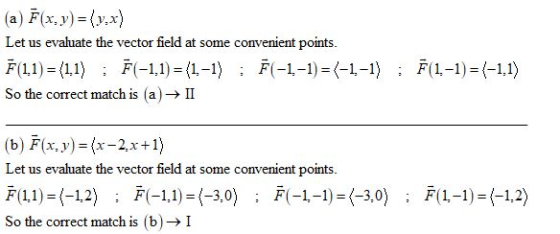
(816.1) Match the vector fieldF with the plots I-IV 3 (x, y)(y,x) (a) MAD K) 10...
10. Determine the values of k for which the system of linear equations has (i) no solution vector...
 10. Determine the values of k for which the system of linear equations has (i) no solution vector, (ii) a unique solution vector, (iii) more than one solution vector (x, y, z): (a) kx+ y+ z= (b) 2x + (k-1)y + (3-k)2-1 2y + (k-3): = 2 x+ky + z = 1 -2y+ x 2x + ky- z =-2 (c) x + 2y + k= 1 (d) -3z =-3
10. Determine the values of k for which the system of...
10. Determine the values of k for which the system of linear equations has (i) no solution vector, (ii) a unique solution vector, (iii) more than one solution vector (x, y, z): (a) kx+ y+ z= (b) 2x + (k-1)y + (3-k)2-1 2y + (k-3): = 2 x+ky + z = 1 -2y+ x 2x + ky- z =-2 (c) x + 2y + k= 1 (d) -3z =-3
10. Determine the values of k for which the system of...
Given the function ry g(x, y) = g(x, y) lim (x,y)(0,0) a. Evaluate iii. Along the line y i. Along the x-axis: x: iv....
 Given the function ry g(x, y) = g(x, y) lim (x,y)(0,0) a. Evaluate iii. Along the line y i. Along the x-axis: x: iv. Along y x2: ii. Along the y-axis: g(x, y) exist? If yes, find the limit. If no, explain why not. b. Does lim (r,y)(0,0) c. Is g continuous at (0,0)? Why or why not? d. The graphs below show the surface and contour plots of g (graphed using WolframAlpha). Explain how the graphs explain your answers...
Which of the following plots corresponds to the vector field F(x, y) (20,-2)? 0 0 2...
 Which of the following plots corresponds to the vector field F(x, y) (20,-2)? 0 0 2 0 -1 0 Y 0 2 o 2 1 0
Match the graphs of the parametric equations x = f(t) and y = g(t) in (a)- (d) with the parametric curves labeled I-IV
 Match the graphs of the parametric equations x = f(t) and y = g(t) in (a)- (d) with the parametric curves labeled I-IV.
need help visualizing this problem, The problem states to sketch the vector field by drawing a diagram. 10. F(x, y, )i +...
 need help visualizing this problem, The problem states to sketch the
vector field by drawing a diagram.
10. F(x, y, )i +k
10. F(x, y, )i +k
need help visualizing this problem, The problem states to sketch the
vector field by drawing a diagram.
10. F(x, y, )i +k
10. F(x, y, )i +k
Let βˆ = (X′X)−1X′y where y ∼ N(Xβ,σ2I), X is an n×(k+1) matrix, and β is a (k+1)×1 vector. Are βˆ′A′[A(X′X)−1A′]−1Aβˆ a...
 Let βˆ = (X′X)−1X′y where y ∼
N(Xβ,σ2I), X is an n×(k+1) matrix, and β is a (k+1)×1 vector. Are
βˆ′A′[A(X′X)−1A′]−1Aβˆ and y′[I − X(X′X)−1X′]y independent?
Let B (X'X)-X'y where y ~ N(XB,02I), X is an n x (k+ 1) matrix, and B is a (k+1) x1 vector Are BA A (X'X)-A]-AB and yI - X(X'X)-xy independent?
Let B (X'X)-X'y where y ~ N(XB,02I), X is an n x (k+ 1) matrix, and B is a (k+1) x1 vector Are...
Let βˆ = (X′X)−1X′y where y ∼
N(Xβ,σ2I), X is an n×(k+1) matrix, and β is a (k+1)×1 vector. Are
βˆ′A′[A(X′X)−1A′]−1Aβˆ and y′[I − X(X′X)−1X′]y independent?
Let B (X'X)-X'y where y ~ N(XB,02I), X is an n x (k+ 1) matrix, and B is a (k+1) x1 vector Are BA A (X'X)-A]-AB and yI - X(X'X)-xy independent?
Let B (X'X)-X'y where y ~ N(XB,02I), X is an n x (k+ 1) matrix, and B is a (k+1) x1 vector Are...
2.14 Determine if the following DT systems are invertible. If yes, find the inverse systems (i) y[k](k 1)x [k 2]; : - |...
 2.14 Determine if the following DT systems are invertible. If yes, find the inverse systems (i) y[k](k 1)x [k 2]; : - |k x [m 2] (ii) y[k] m=0 S[k 2m] (iii) y[k]xk] m=-00 (iv) y[k]xk +2]2x[k1]- 6x[k]2x[k - 11xk - 2] (v) yk]2y[k 11yk 2]x [k].
2.14 Determine if the following DT systems are invertible. If yes, find the inverse systems (i) y[k](k 1)x [k 2]; : - |k x [m 2] (ii) y[k] m=0 S[k 2m] (iii) y[k]xk]...
2.14 Determine if the following DT systems are invertible. If yes, find the inverse systems (i) y[k](k 1)x [k 2]; : - |k x [m 2] (ii) y[k] m=0 S[k 2m] (iii) y[k]xk] m=-00 (iv) y[k]xk +2]2x[k1]- 6x[k]2x[k - 11xk - 2] (v) yk]2y[k 11yk 2]x [k].
2.14 Determine if the following DT systems are invertible. If yes, find the inverse systems (i) y[k](k 1)x [k 2]; : - |k x [m 2] (ii) y[k] m=0 S[k 2m] (iii) y[k]xk]...
10.) (19 pts.) Verify Stoke's Theorem for the Vector Field F(x, y, z) = (-y)ī+(x)]+(z)k, where...
 10.) (19 pts.) Verify Stoke's Theorem for the Vector Field F(x, y, z) = (-y)ī+(x)]+(z)k, where Surface S is that portion of the paraboloid z = 6 - 22 - y2, which lies above the plane z = 2.
8.) (12 pts.) Find the Flux of the Vector Field F(x, y, z) = (z)i +...
 8.) (12 pts.) Find the Flux of the Vector Field F(x, y, z) = (z)i + (x)} + (y)k through Surface S, which is that portion of the plane 2++2 = 3 is the 1st octant, and r is the unit normal vector pointing away from the origin.
For the following pair of sequences, calculate the DT convolution y[k] = x[k] * h[k] using...
 For the following pair of sequences, calculate the DT
convolution y[k] = x[k] * h[k] using (i) the graphical approach and
(ii) the sliding tape method
compare the two results to make sure they match
k0gk-3 0 otherwise 2 -1sk2 otherwise; and h[k]=10
For the following pair of sequences, calculate the DT
convolution y[k] = x[k] * h[k] using (i) the graphical approach and
(ii) the sliding tape method
compare the two results to make sure they match
k0gk-3 0 otherwise 2 -1sk2 otherwise; and h[k]=10
 10. Determine the values of k for which the system of linear equations has (i) no solution vector, (ii) a unique solution vector, (iii) more than one solution vector (x, y, z): (a) kx+ y+ z= (b) 2x + (k-1)y + (3-k)2-1 2y + (k-3): = 2 x+ky + z = 1 -2y+ x 2x + ky- z =-2 (c) x + 2y + k= 1 (d) -3z =-3
10. Determine the values of k for which the system of...
10. Determine the values of k for which the system of linear equations has (i) no solution vector, (ii) a unique solution vector, (iii) more than one solution vector (x, y, z): (a) kx+ y+ z= (b) 2x + (k-1)y + (3-k)2-1 2y + (k-3): = 2 x+ky + z = 1 -2y+ x 2x + ky- z =-2 (c) x + 2y + k= 1 (d) -3z =-3
10. Determine the values of k for which the system of...
 Given the function ry g(x, y) = g(x, y) lim (x,y)(0,0) a. Evaluate iii. Along the line y i. Along the x-axis: x: iv. Along y x2: ii. Along the y-axis: g(x, y) exist? If yes, find the limit. If no, explain why not. b. Does lim (r,y)(0,0) c. Is g continuous at (0,0)? Why or why not? d. The graphs below show the surface and contour plots of g (graphed using WolframAlpha). Explain how the graphs explain your answers...
 Which of the following plots corresponds to the vector field F(x, y) (20,-2)? 0 0 2 0 -1 0 Y 0 2 o 2 1 0
 need help visualizing this problem, The problem states to sketch the
vector field by drawing a diagram.
10. F(x, y, )i +k
10. F(x, y, )i +k
need help visualizing this problem, The problem states to sketch the
vector field by drawing a diagram.
10. F(x, y, )i +k
10. F(x, y, )i +k
 Let βˆ = (X′X)−1X′y where y ∼
N(Xβ,σ2I), X is an n×(k+1) matrix, and β is a (k+1)×1 vector. Are
βˆ′A′[A(X′X)−1A′]−1Aβˆ and y′[I − X(X′X)−1X′]y independent?
Let B (X'X)-X'y where y ~ N(XB,02I), X is an n x (k+ 1) matrix, and B is a (k+1) x1 vector Are BA A (X'X)-A]-AB and yI - X(X'X)-xy independent?
Let B (X'X)-X'y where y ~ N(XB,02I), X is an n x (k+ 1) matrix, and B is a (k+1) x1 vector Are...
Let βˆ = (X′X)−1X′y where y ∼
N(Xβ,σ2I), X is an n×(k+1) matrix, and β is a (k+1)×1 vector. Are
βˆ′A′[A(X′X)−1A′]−1Aβˆ and y′[I − X(X′X)−1X′]y independent?
Let B (X'X)-X'y where y ~ N(XB,02I), X is an n x (k+ 1) matrix, and B is a (k+1) x1 vector Are BA A (X'X)-A]-AB and yI - X(X'X)-xy independent?
Let B (X'X)-X'y where y ~ N(XB,02I), X is an n x (k+ 1) matrix, and B is a (k+1) x1 vector Are...
 2.14 Determine if the following DT systems are invertible. If yes, find the inverse systems (i) y[k](k 1)x [k 2]; : - |k x [m 2] (ii) y[k] m=0 S[k 2m] (iii) y[k]xk] m=-00 (iv) y[k]xk +2]2x[k1]- 6x[k]2x[k - 11xk - 2] (v) yk]2y[k 11yk 2]x [k].
2.14 Determine if the following DT systems are invertible. If yes, find the inverse systems (i) y[k](k 1)x [k 2]; : - |k x [m 2] (ii) y[k] m=0 S[k 2m] (iii) y[k]xk]...
2.14 Determine if the following DT systems are invertible. If yes, find the inverse systems (i) y[k](k 1)x [k 2]; : - |k x [m 2] (ii) y[k] m=0 S[k 2m] (iii) y[k]xk] m=-00 (iv) y[k]xk +2]2x[k1]- 6x[k]2x[k - 11xk - 2] (v) yk]2y[k 11yk 2]x [k].
2.14 Determine if the following DT systems are invertible. If yes, find the inverse systems (i) y[k](k 1)x [k 2]; : - |k x [m 2] (ii) y[k] m=0 S[k 2m] (iii) y[k]xk]...
 10.) (19 pts.) Verify Stoke's Theorem for the Vector Field F(x, y, z) = (-y)ī+(x)]+(z)k, where Surface S is that portion of the paraboloid z = 6 - 22 - y2, which lies above the plane z = 2.
 8.) (12 pts.) Find the Flux of the Vector Field F(x, y, z) = (z)i + (x)} + (y)k through Surface S, which is that portion of the plane 2++2 = 3 is the 1st octant, and r is the unit normal vector pointing away from the origin.
 For the following pair of sequences, calculate the DT
convolution y[k] = x[k] * h[k] using (i) the graphical approach and
(ii) the sliding tape method
compare the two results to make sure they match
k0gk-3 0 otherwise 2 -1sk2 otherwise; and h[k]=10
For the following pair of sequences, calculate the DT
convolution y[k] = x[k] * h[k] using (i) the graphical approach and
(ii) the sliding tape method
compare the two results to make sure they match
k0gk-3 0 otherwise 2 -1sk2 otherwise; and h[k]=10
Most questions answered within 3 hours.
-
Where is the error in this code sequence?
String s1 = "Hello";
String s2 = "ello";...
asked 10 months ago -
Financial data for Joel de Paris, Inc., for last year
follow:
Joel de Paris, Inc.
Balance...
asked 10 months ago -
Consider this reaction:
Al2(SO4)3 (aq)+ BaCl3
(aq) Al2Cl6 (aq)- +
3BaSO4(s) . What is the...
asked 10 months ago -
Suppose that Savneet is considering increasing her
recent random sample from 20 car rentals to 40...
asked 10 months ago -
Trucks arrive at an unloading terminal at an average rate of 120
per hour.
Trucks arrive...
asked 10 months ago -
Why are methanol and ethanol completely soluble in water while
octanol is not very little soluble....
asked 10 months ago -
A facilities manager at a university reads in a research report
that the mean amount of...
asked 10 months ago -
When the CuSO4 is rehydrated by adding water to the anhydrous
compound, is this an endothermic...
asked 10 months ago -
A ray of sunlight is passing from diamond into crown glass; the
angle of incidence is...
asked 10 months ago -
A block of mass 0.249 kg is placed on top of a light, vertical
spring of...
asked 10 months ago -
how do the kidneys compensate in the presences of acidosis
a) trigger hyperventilate
b) reserve acid...
asked 10 months ago -
Question 501 pts
The rental rate of capital to the firm increases. Which of the
following...
asked 10 months ago