A fullback preparing to carry the football starts from rest and accelerates straight ahead. He is...
A fullback preparing to carry the football starts from rest and accelerates straight ahead. He is handed the ball just before he reaches the line of scrimmage. Assume that the fullback accelerates uniformly (even during the handoff), reaching the line with a velocity of 7.56 m/s. If he takes 1.04 s to reach the line, how far behind it did he start?
Homework Answers
here,
final speed of ball , v = 7.56 m/s
time taken , t = 1.04 s
let the accelration be a
using first equation of motion
v = u + a * t
7.56 = 0 + a * 1.04
solving for a
a = 7.27 m/s^2
the distance travelled while accelrating , s = u * t + 0.5 * a * t^2
s = 0 + 0.5 * 7.27 * 1.04^2 m
s = 3.93 m
Add Answer to:
A fullback preparing to carry the football starts from rest and accelerates straight ahead. He is...
A fullback preparing to carry the football starts from rest and accelerates straight ahead. He is...
A fullback preparing to carry the football starts from rest and accelerates straight ahead. He is handed the ball just before he reaches the line of scrimmage. Assume that the fullback accelerates uniformly (even during the handoff), reaching the line with a velocity of 8.04 m/s. If he takes 1.17 s to reach the line, how far behind it did he start?
17 A fullback preparing to carry the football starts from rest and accelerates straight ahead. He...
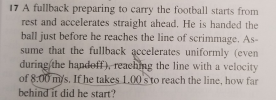 17 A fullback preparing to carry the football starts from rest and accelerates straight ahead. He is handed the ball just before he reaches the line of scrimmage. As- sume that the fullback accelerates uniformly (even the handeff), reaching the line with a velocity of 8:00 m)s. If he takes 1.00 s to reach the line, how far during/ hetsng mil ths takes 1the line, far behind it did he start?
An electric vehicle starts from rest and accelerates at a rate of 2.0 m/s2 in a...
An electric vehicle starts from rest and accelerates at a rate of 2.0 m/s2 in a straight line until it reaches a speed of 22 m/s. The vehicle then slows at a constant rate of 1.2 m/s2 until it stops. (a) How much time elapses from start to stop? (b) How far does the vehicle move from start to stop?
An electric vehicle starts from rest and accelerates at a rate of 1.8 m/s2 in a...
An electric vehicle starts from rest and accelerates at a rate of 1.8 m/s2 in a straight line until it reaches a speed of 18 m/s. The vehicle then slows at a constant rate of 1.4 m/s2 until it stops. (a) How much time elapses from start to stop? (b) How far does the vehicle move from start to stop?
An electric vehicle starts from rest and accelerates at a rate of 1.6 m/s^4 in a...
 An electric vehicle starts from rest and accelerates at a rate of 1.6 m/s^4 in a straight line until it reaches a speed of 23 m/s. The vehicle then slows at a constant rate of 1.2 m/s^2 until It stops, How much time elapses from start to stop? How far does the vehicle move from start to stop?
An electric vehicle starts from rest and accelerates at a rate of 2.2 m/s2 in a...
An electric vehicle starts from rest and accelerates at a rate of 2.2 m/s2 in a straight line until it reaches a speed of 22 m/s. The vehicle then slows at a constant rate of 1.0 m/s2 until it stops.(a) How much time elapses from start to stop (in seconds)?(b) How far does the vehicle travel from start to stop (in meters)?
An electric vehicle starts from rest and accelerates at a rate of 2 m/s2 in a straight line until it reaches a speed of 20 m/s
An electric vehicle starts from rest and accelerates at a rate of 2 m/s2 in a straight line until it reaches a speed of 20 m/s. The vehicle then slows at a constant rate of 1 m/s2 until it stops. (a) How much time elapses from start to stop? (b) How far does the vehicle travel from start to stop?
Chapter 02, Problem 025 An electric vehicle starts from rest and accelerates at a rate of...
 Chapter 02, Problem 025 An electric vehicle starts from rest and accelerates at a rate of 2.2 m/s in a straight line until it reaches a speed of 20 m/s. The vehicle then slows at a constant rate of 1.2 m/s until it stops. (a) How much time elapses from start to stop? (b) How far does the vehicle move from start to stop? Units (a) Number (b) Number Units
A ball starts at rest on the top of a ramp. This amp accelerates the ball...
A ball starts at rest on the top of a ramp. This amp accelerates the ball at a rate of 1.5 m/s. The ball takes 3s to roll down the ramp and then hits a patch of rough flat ground. On the ground, the ball accelerates at a rate of -5m/s until it stops. How long after the ball reaches the ground does it take for the ball to stop? Draw a diagram of the scenario labeling the information given...
A particle starts from rest and accelerates uniformly in a straight line. The particle travels a...
A particle starts from rest and accelerates uniformly in a straight line. The particle travels a distance of 6.70 m in 2.50 s . How fast, in miles/hour (mph), will the particle be traveling after a time of 4.50 s has elapsed? Assume 1 mile=1609.34 m. Express your answer using three significant figures.
 17 A fullback preparing to carry the football starts from rest and accelerates straight ahead. He is handed the ball just before he reaches the line of scrimmage. As- sume that the fullback accelerates uniformly (even the handeff), reaching the line with a velocity of 8:00 m)s. If he takes 1.00 s to reach the line, how far during/ hetsng mil ths takes 1the line, far behind it did he start?
 An electric vehicle starts from rest and accelerates at a rate of 1.6 m/s^4 in a straight line until it reaches a speed of 23 m/s. The vehicle then slows at a constant rate of 1.2 m/s^2 until It stops, How much time elapses from start to stop? How far does the vehicle move from start to stop?
 Chapter 02, Problem 025 An electric vehicle starts from rest and accelerates at a rate of 2.2 m/s in a straight line until it reaches a speed of 20 m/s. The vehicle then slows at a constant rate of 1.2 m/s until it stops. (a) How much time elapses from start to stop? (b) How far does the vehicle move from start to stop? Units (a) Number (b) Number Units
Most questions answered within 3 hours.
-
Where is the error in this code sequence?
String s1 = "Hello";
String s2 = "ello";...
asked 11 months ago -
Financial data for Joel de Paris, Inc., for last year
follow:
Joel de Paris, Inc.
Balance...
asked 11 months ago -
Consider this reaction:
Al2(SO4)3 (aq)+ BaCl3
(aq) Al2Cl6 (aq)- +
3BaSO4(s) . What is the...
asked 11 months ago -
Suppose that Savneet is considering increasing her
recent random sample from 20 car rentals to 40...
asked 11 months ago -
Trucks arrive at an unloading terminal at an average rate of 120
per hour.
Trucks arrive...
asked 11 months ago -
Why are methanol and ethanol completely soluble in water while
octanol is not very little soluble....
asked 11 months ago -
A facilities manager at a university reads in a research report
that the mean amount of...
asked 11 months ago -
When the CuSO4 is rehydrated by adding water to the anhydrous
compound, is this an endothermic...
asked 11 months ago -
A ray of sunlight is passing from diamond into crown glass; the
angle of incidence is...
asked 11 months ago -
A block of mass 0.249 kg is placed on top of a light, vertical
spring of...
asked 11 months ago -
how do the kidneys compensate in the presences of acidosis
a) trigger hyperventilate
b) reserve acid...
asked 11 months ago -
Question 501 pts
The rental rate of capital to the firm increases. Which of the
following...
asked 11 months ago