A 740N student is standing on a frictionless frozen pond with a radius of 5.2 meters....
A 740N student is standing on a frictionless frozen pond with a radius of 5.2 meters. He throws a 3.2 kg textbook toward the shore at 5.6m/s. Gravity = 9.81m/s^2. How long does it take the student to reach the shore in seconds?
Homework Answers
Mass of student
M=740/9.81 =75.433 Kg
By Conservation of momentum
MV+mv =0
75.433*V+3.2*5.6=0
V=-17.92/75.433=-0.23756 m/s
V=0.23756 m/s (in opposite direction to book)
Time taken by student to reach the shore is
t=d/V =5.2/0.23756
t=21.89 s =21.9 s
Add Answer to:
A 740N student is standing on a frictionless frozen pond with a radius of 5.2 meters....
A 725 N man stands in the middle of a frozen pond of radius 9.0 m....
A 725 N man stands in the middle of a frozen pond of radius 9.0 m. He is unable to get to the other side because of a lack of friction between his shoes and the ice. To overcome this difficulty, he throws his 1.2 kg physics textbook horizontally toward the north shore at a speed of 9.0 m/s. How long does it take him to reach the south shore? s
A 714-N man stands in the middle of a frozen pond of radius 9.0 m. He...
A 714-N man stands in the middle of a frozen pond of radius 9.0 m. He is unable to get to the other side because of a lack of friction between his shoes and the ice. To overcome this difficulty, he throws his 1.2-kg physics textbook horizontally toward the north shore at a speed of 9.0 m/s. How long does it take him to reach the south shore S
(b) Once again, you're standing on the center of a frozen, frictionless pond. This time, your...
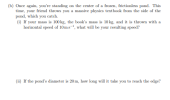 (b) Once again, you're standing on the center of a frozen, frictionless pond. This time, your friend throws you a massive physics textbook from the side of the pond, which you catch. (i) If your mass is 100 kg, the book's mass is 10 kg, and it is thrown with a horizontal speed of 10ms-4, what will be your resulting speed? (ii) If the pond's diameter is 20m, how long will it take you to reach the edge?
A 735 N man stands in the middle of afrozen pond of radius 7M m. He...
 A 735 N man stands in the middle of afrozen pond of radius 7M m. He is unable to get to the other side because of a lack of friction between hisshoes and the ice To overcome this difficulty, he throws his 1.2kg physics textbook horizontally toward the north shore at a speed of 7.0 m/s. How long does it take him to reach the south shore?
D Question 3 1 pts A stranded 103 kg man is motionless on a frozen, frictionless...
 D Question 3 1 pts A stranded 103 kg man is motionless on a frozen, frictionless pond. To get to the shore. he throws his 8 kg backpack at 3 m/s away from the shore. How fast (speed in m/s) does the man move? ROUND ANSWER TO TWO DECIMAL PLACES.
A hockey player is standing on his skates on a frozen pond when an opposing player,...
A hockey player is standing on his skates on a frozen pond when an opposing player, moving with a uniform speed of 2.0 m/s, skates by with the puck. After 1.20 s, the first player makes up his mind to chase his opponent. If he accelerates uniformly at 0.40 m/s2, determine each of the following. (a) How long does it take him to catch his opponent? (Assume the player with the puck remains in motion at constant speed.) s (b)...
A hockey player is standing on his skates on a frozen pond when an opposing player,...
A hockey player is standing on his skates on a frozen pond when an opposing player, moving with a uniform speed of 2.0 m/s, skates by with the puck. After 2.40 s, the first player makes up his mind to chase his opponent. If he accelerates uniformly at 0.24 m/s2, determine each of the following. (a) How long does it take him to catch his opponent? (Assume the player with the puck remains in motion at constant speed.) s (b)...
A hockey player is standing on his skates on a frozen pond when an opposing player,...
A hockey player is standing on his skates on a frozen pond when an opposing player, moving with a uniform speed of 2.0 m/s, skates by with the puck. After 2.80 s, the first player makes up his mind to chase his opponent. If he accelerates uniformly at 0.12 m/s2, determine each of the following. (a) How long does it take him to catch his opponent? (Assume the player with the puck remains in motion at constant speed.) ___ s...
A hockey player is standing on his skates on a frozen pond when an opposing player,...
A hockey player is standing on his skates on a frozen pond when an opposing player, moving with a uniform speed of 2.0 m/s, skates by with the puck. After 2.80 s, the first player makes up his mind to chase his opponent. If he accelerates uniformly at 0.44 m/s7, determine each of the following (a) How long does it take him to catch his opponent? (Assume the player with the puck remains in motion at constant speed.) (b) How...
A hockey player is standing on his skates on a frozen pond when an opposing player,...
A hockey player is standing on his skates on a frozen pond when an opposing player, moving with a uniform speed of 4.0 m/s, skates by with the puck. After 1.20 s, the first player makes up his mind to chase his opponent. If he accelerates uniformly at 0.16 m/s2, determine each of the following. (a) How long does it take him to catch his opponent? (Assume the player with the puck remains in motion at constant speed.) (b) How...
 (b) Once again, you're standing on the center of a frozen, frictionless pond. This time, your friend throws you a massive physics textbook from the side of the pond, which you catch. (i) If your mass is 100 kg, the book's mass is 10 kg, and it is thrown with a horizontal speed of 10ms-4, what will be your resulting speed? (ii) If the pond's diameter is 20m, how long will it take you to reach the edge?
 A 735 N man stands in the middle of afrozen pond of radius 7M m. He is unable to get to the other side because of a lack of friction between hisshoes and the ice To overcome this difficulty, he throws his 1.2kg physics textbook horizontally toward the north shore at a speed of 7.0 m/s. How long does it take him to reach the south shore?
 D Question 3 1 pts A stranded 103 kg man is motionless on a frozen, frictionless pond. To get to the shore. he throws his 8 kg backpack at 3 m/s away from the shore. How fast (speed in m/s) does the man move? ROUND ANSWER TO TWO DECIMAL PLACES.
Most questions answered within 3 hours.
-
Where is the error in this code sequence?
String s1 = "Hello";
String s2 = "ello";...
asked 10 months ago -
Financial data for Joel de Paris, Inc., for last year
follow:
Joel de Paris, Inc.
Balance...
asked 10 months ago -
Consider this reaction:
Al2(SO4)3 (aq)+ BaCl3
(aq) Al2Cl6 (aq)- +
3BaSO4(s) . What is the...
asked 10 months ago -
Suppose that Savneet is considering increasing her
recent random sample from 20 car rentals to 40...
asked 10 months ago -
Trucks arrive at an unloading terminal at an average rate of 120
per hour.
Trucks arrive...
asked 10 months ago -
Why are methanol and ethanol completely soluble in water while
octanol is not very little soluble....
asked 10 months ago -
A facilities manager at a university reads in a research report
that the mean amount of...
asked 10 months ago -
When the CuSO4 is rehydrated by adding water to the anhydrous
compound, is this an endothermic...
asked 10 months ago -
A ray of sunlight is passing from diamond into crown glass; the
angle of incidence is...
asked 10 months ago -
A block of mass 0.249 kg is placed on top of a light, vertical
spring of...
asked 10 months ago -
how do the kidneys compensate in the presences of acidosis
a) trigger hyperventilate
b) reserve acid...
asked 10 months ago -
Question 501 pts
The rental rate of capital to the firm increases. Which of the
following...
asked 10 months ago