
Homework Answers
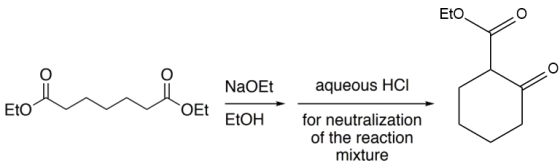
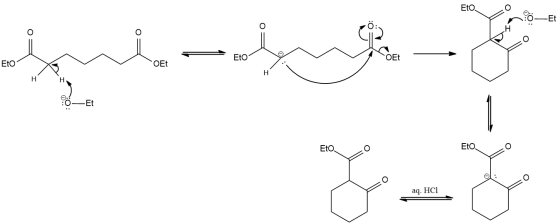
Dieckmann condensation gives cyclic  -keto ester as the product.
Mechanism:
Add Answer to:
1. Draw the major organic product of the following reaction. Include stereochemistry if appropriate. aqueous HC...
1. Draw the major organic product of the following reaction. Include stereochemistry if appropriate NaOEt aqueous...
 1. Draw the major organic product of the following reaction. Include stereochemistry if appropriate NaOEt aqueous HC EtO OEt EtOH for neutralization of the reaction mixture 2. Draw the major organic product of the following reaction. NMR spectra are provided for this product 200 180 160 140 120 100 80 60 40 NaOH CH3 ethanol heat 10 9 8 6 5 4. 2 1
Draw the major organic product(s) of the following reactions including stereochemistry when it is appropriate.
 Draw the major organic product(s) of the following reactions including stereochemistry when it is appropriate. Draw the major organic product(s) of the following reaction
Draw the organic product formed in the following reaction. OEt [1] NaOEt, EtOH [2] H, 0+...
 Draw the organic product formed in the following reaction. OEt [1] NaOEt, EtOH [2] H, 0+ 0 Et draw structure ...
2. Draw the major organic product for each of the following reaction schemes. (1 pt each)...
 2. Draw the major organic product for each of the following reaction schemes. (1 pt each) a) POCl3, pyridine HO or H3O, heat b) H3O heat c) 0 1. LDA OEt 2 3. Show the structure of each intermediate and product for the following synthetic scheme. Your answer does not need to show the electron flow with arrows but should have correct formal charges. (2 pts) Co Et 1. NaOEt, EtOH Co2Et 2. H30", heat
Draw the structure(s) of the major organic product(s) of the following reaction. Draw the structure(s) of...
 Draw the structure(s) of the major organic product(s) of the
following reaction.
Draw the structure(s) of the major organic product(s) of the following reaction. MgBr + H3C 1. Dry Eto 2. aqueous HCl at 0° • You do not have to consider stereochemistry. • Draw one structure per sketcher. Add additional sketchers using the drop-down menu in the bottom right corner. • Separate multiple products using the + sign from the drop-down menu. co @ 000 - (F ChemDoodle
Draw the structure(s) of the major organic product(s) of the
following reaction.
Draw the structure(s) of the major organic product(s) of the following reaction. MgBr + H3C 1. Dry Eto 2. aqueous HCl at 0° • You do not have to consider stereochemistry. • Draw one structure per sketcher. Add additional sketchers using the drop-down menu in the bottom right corner. • Separate multiple products using the + sign from the drop-down menu. co @ 000 - (F ChemDoodle
Draw the structure(s) of the major organic product(s) of the following reaction Dilute aqueous HCI •...
 Draw the structure(s) of the major organic product(s) of the following reaction Dilute aqueous HCI • Use the wedge/hash bond tools to indicate stereochemistry where it exists. • If the reaction produces a racemic mixture, draw both stereoisomers. • Include counter-ions, e.g., Na, 1', in your submission, but draw them in their own separate sketcher. Omit products derived from the acidic or basic reagent itself, e.g. HN(i- Pr), derived from N(i-Pr)2 - • If substantial starting material is present at...
Draw the structure(s) of the major organic product(s) of the following reaction. Dilute aqueous NaOH Use...
 Draw the structure(s) of the major organic product(s) of the following reaction. Dilute aqueous NaOH Use the wedge/hash bond tools to indicate stereochemistry where it exists If the reaction produces a racemic mixture, draw both stereoisomers. . Include counter-ions, eg, Na-1, in your submission, but draw them in their own separate sketcher. Omit products derived from the acidic or basic reagent itself, e.g. HN(i-Pr)2 derived from N(i-Pr)2 If substantial starting material is present at the end of the reaction, include...
Provide the major product(s) for the following Provide the major product(s) for the following reactions. Be...
 Provide the major product(s) for the following Provide the major product(s) for the following reactions. Be sure to note stereochemistry and racemic mixtures. NaOH, H29 2 100 °Ç ? NaOH, H2O H 0°C H W H CCl3 OC (provide product of both steps) H a. Hn b. CHEM 370 W13 Homework Page 1 of 2 giorel Noot Hoi solu NOEL IN DER NaOH, H2O 100 °C Hv NaOET, H OEt EtOH 8. Eto- i. LDA, -78°C NaO Me MeOH Оме...
Predict yhe Major product of each reaction and include stereochemistry where appropriate. You may assume an...
 Predict yhe Major product of each reaction and include
stereochemistry where appropriate. You may assume an aqueous workup
after each transformation.
thanks a bunch in advance for helping
transformation. NaSH MeOH 3 NaOEt CH,Br (1 equiv) Me-MgBr Mous DMF Nao
Predict yhe Major product of each reaction and include
stereochemistry where appropriate. You may assume an aqueous workup
after each transformation.
thanks a bunch in advance for helping
transformation. NaSH MeOH 3 NaOEt CH,Br (1 equiv) Me-MgBr Mous DMF Nao
(10) Predict the major product of the following reaction after aqueous workup, including stereochemistry if appropriate....
 (10) Predict the major product of the following reaction after aqueous workup, including stereochemistry if appropriate. (Use a wavy bond to indicate a mixture of configurations at a stereocenter.) If no reaction occurs, submit the starting material as your response Launch MarvinJS TM viewer or click image to copy source OH H2SO4 CH3 .CH3
(10) Predict the major product of the following reaction after aqueous workup, including stereochemistry if appropriate. (Use a wavy bond to indicate a mixture of configurations...
(10) Predict the major product of the following reaction after aqueous workup, including stereochemistry if appropriate. (Use a wavy bond to indicate a mixture of configurations at a stereocenter.) If no reaction occurs, submit the starting material as your response Launch MarvinJS TM viewer or click image to copy source OH H2SO4 CH3 .CH3
(10) Predict the major product of the following reaction after aqueous workup, including stereochemistry if appropriate. (Use a wavy bond to indicate a mixture of configurations...
 1. Draw the major organic product of the following reaction. Include stereochemistry if appropriate NaOEt aqueous HC EtO OEt EtOH for neutralization of the reaction mixture 2. Draw the major organic product of the following reaction. NMR spectra are provided for this product 200 180 160 140 120 100 80 60 40 NaOH CH3 ethanol heat 10 9 8 6 5 4. 2 1
 Draw the organic product formed in the following reaction. OEt [1] NaOEt, EtOH [2] H, 0+ 0 Et draw structure ...
 2. Draw the major organic product for each of the following reaction schemes. (1 pt each) a) POCl3, pyridine HO or H3O, heat b) H3O heat c) 0 1. LDA OEt 2 3. Show the structure of each intermediate and product for the following synthetic scheme. Your answer does not need to show the electron flow with arrows but should have correct formal charges. (2 pts) Co Et 1. NaOEt, EtOH Co2Et 2. H30", heat
 Draw the structure(s) of the major organic product(s) of the
following reaction.
Draw the structure(s) of the major organic product(s) of the following reaction. MgBr + H3C 1. Dry Eto 2. aqueous HCl at 0° • You do not have to consider stereochemistry. • Draw one structure per sketcher. Add additional sketchers using the drop-down menu in the bottom right corner. • Separate multiple products using the + sign from the drop-down menu. co @ 000 - (F ChemDoodle
Draw the structure(s) of the major organic product(s) of the
following reaction.
Draw the structure(s) of the major organic product(s) of the following reaction. MgBr + H3C 1. Dry Eto 2. aqueous HCl at 0° • You do not have to consider stereochemistry. • Draw one structure per sketcher. Add additional sketchers using the drop-down menu in the bottom right corner. • Separate multiple products using the + sign from the drop-down menu. co @ 000 - (F ChemDoodle
 Draw the structure(s) of the major organic product(s) of the following reaction Dilute aqueous HCI • Use the wedge/hash bond tools to indicate stereochemistry where it exists. • If the reaction produces a racemic mixture, draw both stereoisomers. • Include counter-ions, e.g., Na, 1', in your submission, but draw them in their own separate sketcher. Omit products derived from the acidic or basic reagent itself, e.g. HN(i- Pr), derived from N(i-Pr)2 - • If substantial starting material is present at...
 Draw the structure(s) of the major organic product(s) of the following reaction. Dilute aqueous NaOH Use the wedge/hash bond tools to indicate stereochemistry where it exists If the reaction produces a racemic mixture, draw both stereoisomers. . Include counter-ions, eg, Na-1, in your submission, but draw them in their own separate sketcher. Omit products derived from the acidic or basic reagent itself, e.g. HN(i-Pr)2 derived from N(i-Pr)2 If substantial starting material is present at the end of the reaction, include...
 Provide the major product(s) for the following Provide the major product(s) for the following reactions. Be sure to note stereochemistry and racemic mixtures. NaOH, H29 2 100 °Ç ? NaOH, H2O H 0°C H W H CCl3 OC (provide product of both steps) H a. Hn b. CHEM 370 W13 Homework Page 1 of 2 giorel Noot Hoi solu NOEL IN DER NaOH, H2O 100 °C Hv NaOET, H OEt EtOH 8. Eto- i. LDA, -78°C NaO Me MeOH Оме...
 Predict yhe Major product of each reaction and include
stereochemistry where appropriate. You may assume an aqueous workup
after each transformation.
thanks a bunch in advance for helping
transformation. NaSH MeOH 3 NaOEt CH,Br (1 equiv) Me-MgBr Mous DMF Nao
Predict yhe Major product of each reaction and include
stereochemistry where appropriate. You may assume an aqueous workup
after each transformation.
thanks a bunch in advance for helping
transformation. NaSH MeOH 3 NaOEt CH,Br (1 equiv) Me-MgBr Mous DMF Nao
 (10) Predict the major product of the following reaction after aqueous workup, including stereochemistry if appropriate. (Use a wavy bond to indicate a mixture of configurations at a stereocenter.) If no reaction occurs, submit the starting material as your response Launch MarvinJS TM viewer or click image to copy source OH H2SO4 CH3 .CH3
(10) Predict the major product of the following reaction after aqueous workup, including stereochemistry if appropriate. (Use a wavy bond to indicate a mixture of configurations...
(10) Predict the major product of the following reaction after aqueous workup, including stereochemistry if appropriate. (Use a wavy bond to indicate a mixture of configurations at a stereocenter.) If no reaction occurs, submit the starting material as your response Launch MarvinJS TM viewer or click image to copy source OH H2SO4 CH3 .CH3
(10) Predict the major product of the following reaction after aqueous workup, including stereochemistry if appropriate. (Use a wavy bond to indicate a mixture of configurations...
Most questions answered within 3 hours.
-
Where is the error in this code sequence?
String s1 = "Hello";
String s2 = "ello";...
asked 11 months ago -
Financial data for Joel de Paris, Inc., for last year
follow:
Joel de Paris, Inc.
Balance...
asked 11 months ago -
Consider this reaction:
Al2(SO4)3 (aq)+ BaCl3
(aq) Al2Cl6 (aq)- +
3BaSO4(s) . What is the...
asked 11 months ago -
Suppose that Savneet is considering increasing her
recent random sample from 20 car rentals to 40...
asked 11 months ago -
Trucks arrive at an unloading terminal at an average rate of 120
per hour.
Trucks arrive...
asked 11 months ago -
Why are methanol and ethanol completely soluble in water while
octanol is not very little soluble....
asked 11 months ago -
A facilities manager at a university reads in a research report
that the mean amount of...
asked 11 months ago -
When the CuSO4 is rehydrated by adding water to the anhydrous
compound, is this an endothermic...
asked 11 months ago -
A ray of sunlight is passing from diamond into crown glass; the
angle of incidence is...
asked 11 months ago -
A block of mass 0.249 kg is placed on top of a light, vertical
spring of...
asked 11 months ago -
how do the kidneys compensate in the presences of acidosis
a) trigger hyperventilate
b) reserve acid...
asked 11 months ago -
Question 501 pts
The rental rate of capital to the firm increases. Which of the
following...
asked 11 months ago