Use valence bond theory to write a hybridization and bonding scheme for CO2. Match the words...
Use valence bond theory to write a hybridization and bonding scheme for CO2.
Match the words in the left column to the appropriate blanks in the sentences on the right. Make certain each sentence is complete before submitting your answer.
you can only use the following words:
two C(s)-O(s) ; two C(p)-O(p) ; trigonal planar ; two O(sp2)-C(sp) ; two O(sp)-C(sp2) ; carbon and oxygen ; sp2 ; a single and a double bond ; oxygen ; two single bonds ; linear ; tetrahydral ; carbon ; sp ; two double bonds ; sp3
Homework Answers
Valence Bond Theory:
The Valence Bond Theory explains about covalent bond formations between two atoms and the shape of its geometry. It also assumes that all covalent bonds are localized.
Hybridization:
Hybridization is defined as the addition of different atomic orbitals to form a new hybrid orbital.
It is the concept of mixing atomic orbitals which have different shapes and energies to give an equal number of hybrid orbitals (to that of mixed orbitals), which have the same energy and shape. By using this concept, molecular geometry and bond angles can be explained for molecules.
VSEPR theory:
The Valance Shell Electron Pair Repulsion Theory (VSEPR) states that molecular geometry may alter due to the presence of repulsions between the lone pair of electrons and the bonded pair of electrons present in the molecule.
Hybridization of the molecules can be found by counting the number of groups surrounding the central atom of the molecule.
Groups surrounded by the central atom | Hybridization | Molecular geometry |
2 |
| linear |
3 |
| Trigonal planar |
4 |
| tetrahedral |
5 |
| Trigonal bi-pyramidal |


A lone pair of electrons is also considered as a group.
According to the VSEPR theory, molecular geometry may change due to the presence of repulsions between bonded pairs of electrons and lone pairs of electrons and they are arranged as follows.

Lewis Dot Structure of  :
:

The central atom is Carbon.
The surrounding atoms are Oxygen.
Lewis Dot Structure of :

It is linear structure.

Structure of :
:
Carbon has two sp hybridized orbitals and two p atomic orbitals.
Oxygen has three sp2 hybridized orbitals and one p atomic orbital.
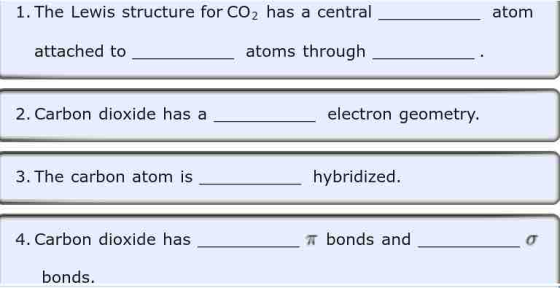
Ans:1. The Lewis structure for has a central carbon atom
attached to oxygen atoms through two double bonds.
2. Carbon dioxide has a linear electron geometry.
3. The carbon atom is  hybridized.
4. Carbon dioxide has two C(p)-O(p)  bonds and two O(p)-C(sp)
  bonds.
Add Answer to:
Use valence bond theory to write a hybridization and bonding
scheme for CO2.
Match the words...
2) Use valence bond theory to explain bonding in HCl, and Brci 3) When we mix...
 2) Use valence bond theory to explain bonding in HCl, and Brci 3) When we mix an "s" orbital and a "p" orbital we get two 4) When we mix an "s" orbital and two "p" orbitals we get three 5) When we mix an "s" orbital and three "p" orbitals we get four hybrid orbitals. hybrid orbitals. hybrid orbitals. 6) Give the electron geometry (eg), molecular geometry (mg), and hybridization for NH3. a) eg = tetrahedral, mg = trigonal...
6.) Use valence bond theory to describe the number and types of hybrid bonding orbitals on...
6.) Use valence bond theory to describe the number and types of hybrid bonding orbitals on the central atom of each of the following. (a) AlF4− type of hybridization: -sp-hybridization -sp2-hybridization -sp3-hybridization -sp3d-hybridization -sp3d2-hybridization In AlF4−, aluminum has _______ hybrid orbital(s). (b) ClF3 type of hybridization: -sp-hybridization -sp2-hybridization - sp3-hybridization -sp3d-hybridization -sp3d2-hybridization In ClF3, chlorine has ______ hybrid orbital(s). (c) CS2 type of hybridization: -sp-hybridization -sp2-hybridization -sp3-hybridization -sp3d-hybridization -sp3d2-hybridization In CS2, carbon has _______ hybrid orbital(s)
Which statement concerning the benzene molecule, C6H6, is false? A) Valence bond theory describes the molecule...
Which statement concerning the benzene molecule, C6H6, is false? A) Valence bond theory describes the molecule in terms of 3 resonance structures. B) All six of the carbon-carbon bonds have the same length. C) The carbon-carbon bond lengths are intermediate between those for single and double bonds. D) The entire benzene molecule is planar. E) The valence bond description involves sp2 hybridization at each carbon atom.
Since the hybridization of the central atom is usually the only factor needed to determine molecular...
 Since the hybridization of the central atom is usually the only
factor needed to determine molecular shape, you can simplify by
considering only the hybridization of the central atom. Using this
simplified method, the O atom of CO2 would bond with one of its
p or s orbitals. Use valence bond theory to
devise a hybridization and bonding scheme for CO2.
Match the items in the left column to the appropriate blanks in
the sentences on the right. Make certain...
Since the hybridization of the central atom is usually the only
factor needed to determine molecular shape, you can simplify by
considering only the hybridization of the central atom. Using this
simplified method, the O atom of CO2 would bond with one of its
p or s orbitals. Use valence bond theory to
devise a hybridization and bonding scheme for CO2.
Match the items in the left column to the appropriate blanks in
the sentences on the right. Make certain...
The hybridization of the central atom in a molecule is described as sp^2. The arrangement in...
 The hybridization of the central atom in a molecule is described as sp^2. The arrangement in space of the hybrid orbitals about that atom is linear. trigonal planar. Tetrahedral. Trigonal bipyramidal. Octahedral. What is the hybridization of Br in BrF_3? sp: sp^2 sp^3 dsp^3 d^2 sp^3 Which of these statements is true? A pi bond is twice as strong as a single bond. At bond has cylindrical symmetry about the bonding axis A double bond consists of a pi bond...
5. (5 pts) Consider the hybridization and bonding scheme for cis-1,2-dichloroethene, CH2Cl2, using valence bond theory....
 5. (5 pts) Consider the hybridization and bonding scheme for cis-1,2-dichloroethene, CH2Cl2, using valence bond theory. (a) Complete the Lewis structure using the skeletal structure shown below: H H c-c CI CI (b) Use VSEPR theory to predict the electron domain geometry and the hybridization around carbon; (c) Draw an energy diagram showing the formation of hybrid orbitals from the atomic orbitals; (d) Sketch the molecule showing the orbitals and any overlapping orbitals to indicate covalent bonds; (e) Label all...
Complete all the valence bond hybridization and bonding scheme for the following: a. H2CO b.HCCH c.HONO...
Complete all the valence bond hybridization and bonding scheme for the following: a. H2CO b.HCCH c.HONO d.BRF4- e.NO2+
Which hybridization scheme occurs about phosphorus when phosphorous forms a total of five single bonds? Which...
Which hybridization scheme occurs about phosphorus when phosphorous forms a total of five single bonds? Which hybridization scheme occurs about phosphorus when phosphorous forms a total of five single bonds? a. sp3 b. sp3d c. sp2 d. sp
1. What is the geometry and the hybridization of the Carbon indicated with the arrow? an...
 1. What is the geometry and the hybridization of the Carbon indicated with the arrow? an tetrahedral, sp3 trigonal pyramidal, sp2 trigonal pyramidal, sp3 trigonal planar, sp2 trigonal planar, sp3 2. What kind of molecular orbital (0,0*, ni, ne*, or n) results when the two atomic orbitals shown below interact in the manner indicated? 8.8 A) o molecular orbital B) o* molecular orbital C) a molecular orbital D) r* molecular orbital E) n nonbonding molecular orbital D. Focus
Using Valence Bond Theory, clearly draw the bonding scheme for N2F2. Draw all the orbital overlaps...
 Using Valence Bond Theory, clearly draw the bonding scheme for N2F2. Draw all the orbital overlaps and lone pair electrons, identify the hybridization of all the atoms, and label the o and bonds. Hints: (i) Draw the Lewis structure first. (ii) The skeleton structure is F-N-N-F.
 2) Use valence bond theory to explain bonding in HCl, and Brci 3) When we mix an "s" orbital and a "p" orbital we get two 4) When we mix an "s" orbital and two "p" orbitals we get three 5) When we mix an "s" orbital and three "p" orbitals we get four hybrid orbitals. hybrid orbitals. hybrid orbitals. 6) Give the electron geometry (eg), molecular geometry (mg), and hybridization for NH3. a) eg = tetrahedral, mg = trigonal...
 Since the hybridization of the central atom is usually the only
factor needed to determine molecular shape, you can simplify by
considering only the hybridization of the central atom. Using this
simplified method, the O atom of CO2 would bond with one of its
p or s orbitals. Use valence bond theory to
devise a hybridization and bonding scheme for CO2.
Match the items in the left column to the appropriate blanks in
the sentences on the right. Make certain...
Since the hybridization of the central atom is usually the only
factor needed to determine molecular shape, you can simplify by
considering only the hybridization of the central atom. Using this
simplified method, the O atom of CO2 would bond with one of its
p or s orbitals. Use valence bond theory to
devise a hybridization and bonding scheme for CO2.
Match the items in the left column to the appropriate blanks in
the sentences on the right. Make certain...
 The hybridization of the central atom in a molecule is described as sp^2. The arrangement in space of the hybrid orbitals about that atom is linear. trigonal planar. Tetrahedral. Trigonal bipyramidal. Octahedral. What is the hybridization of Br in BrF_3? sp: sp^2 sp^3 dsp^3 d^2 sp^3 Which of these statements is true? A pi bond is twice as strong as a single bond. At bond has cylindrical symmetry about the bonding axis A double bond consists of a pi bond...
 5. (5 pts) Consider the hybridization and bonding scheme for cis-1,2-dichloroethene, CH2Cl2, using valence bond theory. (a) Complete the Lewis structure using the skeletal structure shown below: H H c-c CI CI (b) Use VSEPR theory to predict the electron domain geometry and the hybridization around carbon; (c) Draw an energy diagram showing the formation of hybrid orbitals from the atomic orbitals; (d) Sketch the molecule showing the orbitals and any overlapping orbitals to indicate covalent bonds; (e) Label all...
 1. What is the geometry and the hybridization of the Carbon indicated with the arrow? an tetrahedral, sp3 trigonal pyramidal, sp2 trigonal pyramidal, sp3 trigonal planar, sp2 trigonal planar, sp3 2. What kind of molecular orbital (0,0*, ni, ne*, or n) results when the two atomic orbitals shown below interact in the manner indicated? 8.8 A) o molecular orbital B) o* molecular orbital C) a molecular orbital D) r* molecular orbital E) n nonbonding molecular orbital D. Focus
 Using Valence Bond Theory, clearly draw the bonding scheme for N2F2. Draw all the orbital overlaps and lone pair electrons, identify the hybridization of all the atoms, and label the o and bonds. Hints: (i) Draw the Lewis structure first. (ii) The skeleton structure is F-N-N-F.
Most questions answered within 3 hours.
-
Where is the error in this code sequence?
String s1 = "Hello";
String s2 = "ello";...
asked 10 months ago -
Financial data for Joel de Paris, Inc., for last year
follow:
Joel de Paris, Inc.
Balance...
asked 10 months ago -
Consider this reaction:
Al2(SO4)3 (aq)+ BaCl3
(aq) Al2Cl6 (aq)- +
3BaSO4(s) . What is the...
asked 10 months ago -
Suppose that Savneet is considering increasing her
recent random sample from 20 car rentals to 40...
asked 10 months ago -
Trucks arrive at an unloading terminal at an average rate of 120
per hour.
Trucks arrive...
asked 10 months ago -
Why are methanol and ethanol completely soluble in water while
octanol is not very little soluble....
asked 10 months ago -
A facilities manager at a university reads in a research report
that the mean amount of...
asked 10 months ago -
When the CuSO4 is rehydrated by adding water to the anhydrous
compound, is this an endothermic...
asked 10 months ago -
A ray of sunlight is passing from diamond into crown glass; the
angle of incidence is...
asked 10 months ago -
A block of mass 0.249 kg is placed on top of a light, vertical
spring of...
asked 10 months ago -
how do the kidneys compensate in the presences of acidosis
a) trigger hyperventilate
b) reserve acid...
asked 10 months ago -
Question 501 pts
The rental rate of capital to the firm increases. Which of the
following...
asked 10 months ago