
Homework Answers
An orbital could be defined as the distribution of an electron’s probability density in an atom, centered at the nucleus.
The quantum numbers form the identity of the atomic orbitals. The four quantum numbers together inform about the position of a given orbital in the energy hierarchy within an atom.
All quantum numbers take positive integral values.
The four quantum numbers are principal, azimuthal, and magnetic and spin.
The principal quantum number (n) effectively informs about the size of the electron density distribution with the nucleus of the atom as the center.
The azimuthal quantum number ( ) informs about the angular momentum of an electron occupying a given orbital.
The magnetic quantum number ( ) informs about the quantization of an orbital in terms of the orientation of the angular momentum vectors associated with an electron.
The spin quantum number (s) informs about the spin angular momentum of the electron.
For an orbital of principal quantum number ‘n’, the azimuthal quantum number could take values from 0 to .
.
For an orbital of azimuthal quantum number ‘ ’, the magnetic quantum number could take
  values from
Every orbital has two associated spin states denoted by the quantum numbers 
Aufbau Principle: The atomic orbitals in an atom are filled in the increasing order of their energies.
Hund’s Rule: Pairing in degenerate orbitals begins only after each of them is singly filled.
The electronic configuration would be as follows:

The diagram could be given as follows:

Chlorine is in period  indicating that the valence shell electrons enter subshells with principal quantum number
 .
.
From the atomic orbital diagram, it is clear that the following are not the shells populated by the valence electrons:

The subshells populated by valence electrons are:

The atomic orbital diagram would be as follows:
The subshells populated by valence electrons are:

Add Answer to:
Create the atomic orbital diagram for chlorine. In a chlorine atom, which subshells contain valence electrons?
3. The electron dot diagram for a neutral atom of chlorine (atomic number 17) is shown...
 3. The electron dot diagram for a neutral atom of chlorine (atomic number 17) is shown below. Which of the following symbols represents a chlorine ion with a stable arrangement of eight valence electrons? CI: O A 251 O B.2012 O c. 5c1 Op.
Write the orbital diagram for the valence electrons of Sr. Write the orbital diagram for the...
Write the orbital diagram for the valence electrons of Sr. Write the orbital diagram for the valence electrons of Ge.
1. Draw a valence orbital diagram of the central atom alone in CH3Cl. Draw a valence...
1. Draw a valence orbital diagram of the central atom alone in CH3Cl. Draw a valence orbital diagram of the central atom hybridized in the compound, CH3Cl. 2. Draw a valence orbital diagram of the central atom alone in ClNO. Draw a valence orbital diagram of the central atom hybridized in the compound, ClNO. 3. Draw a valence orbital diagram of the central atom alone in AsCl6-. Draw a valence orbital diagram of the central atom hybridized in the compound,...
What is the valence shell? It is the outermost shell of electrons in an atom. It...
 What is the valence shell? It is the outermost shell of electrons in an atom. It is the same as the orbital configuration. It is the last partially filled orbital in an atom. It is the shell of electrons in element V (atomic no. = 23) It is the shell of electrons in an atom that is the least reactive.
An orbital-filling diagram shows the number of electrons m each orbital, which are shown in order...
 An orbital-filling diagram shows the number of electrons m each orbital, which are shown in order of energy. The placement of electrons in orbitals follows a certain set of rules. Lower energy subshells fill before higher energy subshells. The order of filling is 1s, 2s, 2p, 3s, 3p, 4s, 3d, 4p, 5s, 4d, 5p, 6s, 4f, 5d, 6p, 7s, 5f, 6d, 7p. The periodic table can be used to help you remember this order. An orbital can hold up to...
The p subshells of an atom have three p orbitals that can be filled with electrons.
 The p subshells of an atom have three p orbitals that can be filled with electrons. In the images, each orbital is represented by a box, and each electron is represented by a half arrow. Classify each p-orbital diagram as obeying or violating the Pauli exclusion principle. Obeys Pauli exclusion principle Violates Pauli exclusion principle
2A. Complete the following table. Element Zeff Atomic orbital designation for highest energy valence electron (i.e.,...
2A. Complete the following table. Element Zeff Atomic orbital designation for highest energy valence electron (i.e., 2s) Se Kr 2B. Which atom (Se or Kr) has the smaller first ionization energy? Enter the chemical symbol in the space provided. 2C. Which one of the following statements best explains the trend observed in part 2? Ionization energy decreases down a group. Elements lower in a group have larger atomic radii. The valence electrons are further from the nucleus so that the...
1. Create the atomic orbital of diagram for nitrogen. 2. Construct the orbital diagram for Ni
1. Create the atomic orbital of diagram for nitrogen. 2. Construct the orbital diagram for Ni
The p subshells of an atom have three p orbitals that can be filled with electrons....
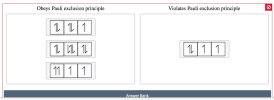 The p subshells of an atom have three p
orbitals that can be filled with electrons. In the images, each
orbital is represented by a box, and each electron is represented
by a half arrow. Classify each p-orbital diagram as
obeying or violating the Pauli exclusion principle.
Obeys Pauli exclusion principle Violates Pauli exclusion principle | 11 | 161 11 LIL 1L 11/1/17 Answer Bank
The p subshells of an atom have three p
orbitals that can be filled with electrons. In the images, each
orbital is represented by a box, and each electron is represented
by a half arrow. Classify each p-orbital diagram as
obeying or violating the Pauli exclusion principle.
Obeys Pauli exclusion principle Violates Pauli exclusion principle | 11 | 161 11 LIL 1L 11/1/17 Answer Bank
The following molecular orbital diagram is for the 2nd period homonuclear diatomic O. It only shows...
 The following molecular orbital diagram is for the 2nd period homonuclear diatomic O. It only shows the valence atomic and molecular orbitals. On the diagram fill in the valence electron for both atoms. (pt) Also on the diagram, fill in the valence electrons in the molecule. (% pt) Calculate the bond order of the molecule. (% pt) Does this molecule contain unpaired electrons? (1 pt) yes
 3. The electron dot diagram for a neutral atom of chlorine (atomic number 17) is shown below. Which of the following symbols represents a chlorine ion with a stable arrangement of eight valence electrons? CI: O A 251 O B.2012 O c. 5c1 Op.
 What is the valence shell? It is the outermost shell of electrons in an atom. It is the same as the orbital configuration. It is the last partially filled orbital in an atom. It is the shell of electrons in element V (atomic no. = 23) It is the shell of electrons in an atom that is the least reactive.
 An orbital-filling diagram shows the number of electrons m each orbital, which are shown in order of energy. The placement of electrons in orbitals follows a certain set of rules. Lower energy subshells fill before higher energy subshells. The order of filling is 1s, 2s, 2p, 3s, 3p, 4s, 3d, 4p, 5s, 4d, 5p, 6s, 4f, 5d, 6p, 7s, 5f, 6d, 7p. The periodic table can be used to help you remember this order. An orbital can hold up to...
 The p subshells of an atom have three p orbitals that can be filled with electrons. In the images, each orbital is represented by a box, and each electron is represented by a half arrow. Classify each p-orbital diagram as obeying or violating the Pauli exclusion principle. Obeys Pauli exclusion principle Violates Pauli exclusion principle
 The p subshells of an atom have three p
orbitals that can be filled with electrons. In the images, each
orbital is represented by a box, and each electron is represented
by a half arrow. Classify each p-orbital diagram as
obeying or violating the Pauli exclusion principle.
Obeys Pauli exclusion principle Violates Pauli exclusion principle | 11 | 161 11 LIL 1L 11/1/17 Answer Bank
The p subshells of an atom have three p
orbitals that can be filled with electrons. In the images, each
orbital is represented by a box, and each electron is represented
by a half arrow. Classify each p-orbital diagram as
obeying or violating the Pauli exclusion principle.
Obeys Pauli exclusion principle Violates Pauli exclusion principle | 11 | 161 11 LIL 1L 11/1/17 Answer Bank
 The following molecular orbital diagram is for the 2nd period homonuclear diatomic O. It only shows the valence atomic and molecular orbitals. On the diagram fill in the valence electron for both atoms. (pt) Also on the diagram, fill in the valence electrons in the molecule. (% pt) Calculate the bond order of the molecule. (% pt) Does this molecule contain unpaired electrons? (1 pt) yes
Most questions answered within 3 hours.
-
Where is the error in this code sequence?
String s1 = "Hello";
String s2 = "ello";...
asked 11 months ago -
Financial data for Joel de Paris, Inc., for last year
follow:
Joel de Paris, Inc.
Balance...
asked 11 months ago -
Consider this reaction:
Al2(SO4)3 (aq)+ BaCl3
(aq) Al2Cl6 (aq)- +
3BaSO4(s) . What is the...
asked 11 months ago -
Suppose that Savneet is considering increasing her
recent random sample from 20 car rentals to 40...
asked 11 months ago -
Trucks arrive at an unloading terminal at an average rate of 120
per hour.
Trucks arrive...
asked 11 months ago -
Why are methanol and ethanol completely soluble in water while
octanol is not very little soluble....
asked 11 months ago -
A facilities manager at a university reads in a research report
that the mean amount of...
asked 11 months ago -
When the CuSO4 is rehydrated by adding water to the anhydrous
compound, is this an endothermic...
asked 11 months ago -
A ray of sunlight is passing from diamond into crown glass; the
angle of incidence is...
asked 11 months ago -
A block of mass 0.249 kg is placed on top of a light, vertical
spring of...
asked 11 months ago -
how do the kidneys compensate in the presences of acidosis
a) trigger hyperventilate
b) reserve acid...
asked 11 months ago -
Question 501 pts
The rental rate of capital to the firm increases. Which of the
following...
asked 11 months ago